Cut from the Source: Barney's Farm Clones Are Now Live
Barney's Farm genetics now come as live plants. We are shipping rooted cuttings from our own California cultivation site, taken from mothers of the same stock that stands behind our seeds, and every mother clears a hop latent viroid test before we take a single cut.
A clone gives a grower something a seed cannot, a plant whose behavior is already known. Below, we explain what a clone is, how it compares with seed, which strains are in the first lineup and how to handle the first week after the box arrives.
Key takeaways
- Every clone is a rooted cutting from one of our female mothers, with exactly the same genetics as that mother.
- Clones skip germination and sexing and run about three weeks ahead of a seed started the same day.
- Each mother clears a hop latent viroid test first, and every clone we ship is guaranteed HLVd-free.
- Orders placed by midnight ET on Sunday ship on Monday by UPS Next Day Air, in a box with a built-in LED light.
- The first lineup runs from Skunk #1 and Blue Dream to LFG and Lemon Cherry Gelato, with Mimosa x Orange Punch coming soon.
A clone, explained
A clone is a cutting taken from a living cannabis plant and rooted until it can stand as a plant of its own. It is not a seedling and not a new genetic individual. It is the same plant, continued, so it carries the mother's cannabinoid profile, terpenes, growth structure and flowering time. Growers call them cuttings or cuts.
We sell our live, rooted clones with the propagation stage already done, so the roots are established before the box is packed. Because every mother is female, every clone is female, too. And because all the cuts of one strain come from one mother, every clone of that strain grows the same way, with one phenotype per strain, the one we selected.
In grower terms, that phenotype is a keeper, the standout plant chosen from many. Breeders find one through phenohunting, growing out many plants from seed and keeping the best one in vegetative growth so it can be cut again and again.
Seeds or clones
Clones remove variables, and seeds keep options open. Neither is the wrong choice, and side by side the two compare like this:
| What you compare | From seed | From a rooted clone |
|---|---|---|
| Genetics | A new individual, with some variation in a pack | An exact copy of the mother |
| Sex | Almost all female in a feminized pack, mixed in a regular one | Always female |
| First stage | Germination, then a seedling | Already rooted, ready to settle in |
| Time to harvest | The baseline | About three weeks ahead |
| Root system | A taproot | A fibrous lateral root mass, often staked |
| Phenotype | A chance at an exceptional plant | One known phenotype per strain |
| Storage | Keeps for months in a cool, dark place | A living plant that needs light on arrival |
| What you compare | Genetics | Sex | First stage | Time to harvest | Root system | Phenotype | Storage |
|---|---|---|---|---|---|---|---|
| From seed | A new individual, with some variation in a pack | Almost all female in a feminized pack, mixed in a regular one | Germination, then a seedling | The baseline | A taproot | A chance at an exceptional plant | Keeps for months in a cool, dark place |
| From a rooted clone | An exact copy of the mother | Always female | Already rooted, ready to settle in | About three weeks ahead | A fibrous lateral root mass, often staked | One known phenotype per strain | A living plant that needs light on arrival |
A clone answers a different question than a seed does. It suits a grower who already knows the strain they want and wants the plant to behave exactly as its strain page says. A pack of seeds still gives the chance of finding something exceptional, and our seed catalog stays at the center of what we do. In our experience, autoflowers make poor clones, since a cutting shares the mother's age and starts to flower before it has time to grow.
Feeling lost on how to start? Try taking our quiz!
Start a QuizTested before we cut
Hop latent viroid, or HLVd, is the main reason careful growers ask where a clone came from. A 2023 review in the journal Viruses called it the biggest concern for cannabis and hop growers worldwide, and noted that the "dudding" disease linked to it was first reported in California in 2019 before spreading through grow facilities across North America. Many infected plants show no symptoms at all, while susceptible ones can produce smaller, looser buds with a weaker smell and fewer trichomes. The review adds that HLVd spreads mainly through vegetative cuttings and contaminated tools, and that no chemical treatment is available.
That is why the source of a cut matters so much. Every mother we cut from clears an HLVd test first, and every clone we ship is guaranteed HLVd-free. Most clone sellers are nurseries that buy genetics in and pass cuttings on, so two clones sold under one strain name can grow into visibly different plants. We bred these strains, and the mothers behind our clones are the same stock behind seeds we have sold for decades.
Clean habits still help after delivery, and our own growers follow two of them. Keep new plants apart from an existing grow for their first few weeks, and use clean, sterilized tools whenever you take cuttings of your own.
The unexamined day is a wasted opportunity. Reflect on what you did, what you learned, and how you can improve.
John Dewey
The first lineup
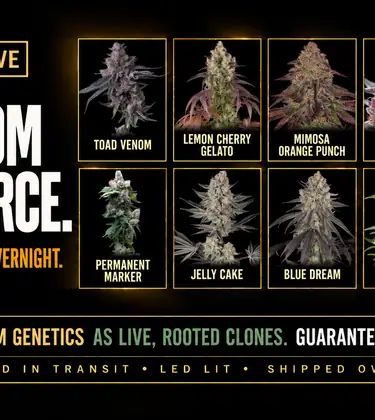
Our launch lineup mixes old-school classics with modern dessert strains, all cut from our own mothers. The cuts available now, listed from the fastest finishers to the slowest, look like this:
- Super Boof: Black Cherry Punch x Tropicana Cookies, 56 to 63 days of flower
- Jelly Cake: Biscotti x Sunset Sherbet, 56 to 63 days of flower
- Permanent Marker: Biscotti x Jealousy x Sherb Bx, 56 to 70 days of flower
- Toad Venom: Animal Face x Sin Mintz, 60 to 65 days of flower
- Cherry Poppers: Lemon Kush x Cherry Z, 60 to 65 days of flower
- Lemon Cherry Gelato: Sunset Sherbet x Girl Scout Cookies, 60 to 65 days of flower
- LFG: Lemon Cherry Gelato x Gelato #41, 60 to 65 days of flower
- Blue Dream: Blueberry x Super Silver Haze, 65 to 70 days of flower
- Skunk #1: Afghan x Acapulco Gold x Colombian Gold, 65 to 75 days of flower
Next in line is Mimosa x Orange Punch, a Mimosa Evo and Orange Punch cross with 55 to 60 days of flower, now marked coming soon. THC ranges from 26% for Skunk #1 to 32% for LFG, Lemon Cherry Gelato, Super Boof and Mimosa x Orange Punch. The cuts on offer can change from week to week, so check the clones page for the strains in the next Monday shipment.
Ordering and shipping
Clones are living stock, so they ship on a tight weekly schedule. Orders placed by midnight ET on Sunday ship on Monday, and anything after the cutoff joins the following week's shipment. Every order travels by UPS Next Day Air for a $50 flat rate, however many clones are in the box, and clone orders are not part of the free shipping on seed orders.
The box is built for the trip. The roots travel in a fixed pot so they are not disturbed, a built-in LED light keeps the plants lit on the way, and the packaging holds each plant upright through handling. If a clone arrives damaged, photograph the plant and the packaging on delivery day, before you unpot anything, and send the photos to our support team for a replacement or a refund.
Strains can be mixed freely from the cuts available that week. Three clones fill a standard tent, while six suit a larger tent, a light-deprivation run or a uniform single-strain grow, where a set of identical plants is worth the most. Checkout shows whether we can currently send a live plant to your address, and you can choose your clones on the clones page.
A clone is a living cannabis plant, so whether you can grow one depends entirely on where you live. Home growing is legal only in some states, and each sets its own plant limits, so check your state's rules before you order.
Your first week with a clone
The first days after delivery decide how fast a clone settles in. Air and steady light come first, and water does not, so we suggest this routine:
- Open the box on delivery day and stand the plants upright under low light, about 18 hours on and 6 off, since full-power light on day one can bleach a plant fresh from a box.
- Check the growing medium with a finger, aiming for damp and never soaked.
- Give the plants a day to settle before transplanting.
- Move each clone into a small container first, not straight into its final pot.
- Hold humidity around 60% to 70% for three or four days, then bring it down to your usual veg range.
- Skip nutrients for the first week, because the plug already holds what a young plant needs.
- Stake any clone that is tall for its root mass, since clones build lateral roots instead of a taproot.
From there, most clones veg for two to four weeks before the switch to flower, depending on the size you want, and harvest follows the strain's usual flowering time.
Clones from the people who bred them
Our clones are rooted cuttings from HLVd-tested mothers we grow ourselves, all female and true to the strain they carry. They skip germination and sexing, run about three weeks ahead of seed and ship overnight once a week in a lit box. Pick a strain you already know, give it a gentle first week, and it will grow the way its strain page says it will.
Barney's Farm has been developing premium cannabis genetics since the 1980s, with over 40 Cannabis Cup wins. Explore our full seed catalog and find strains bred for every climate and skill level.