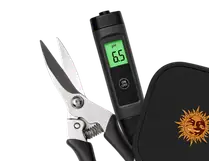
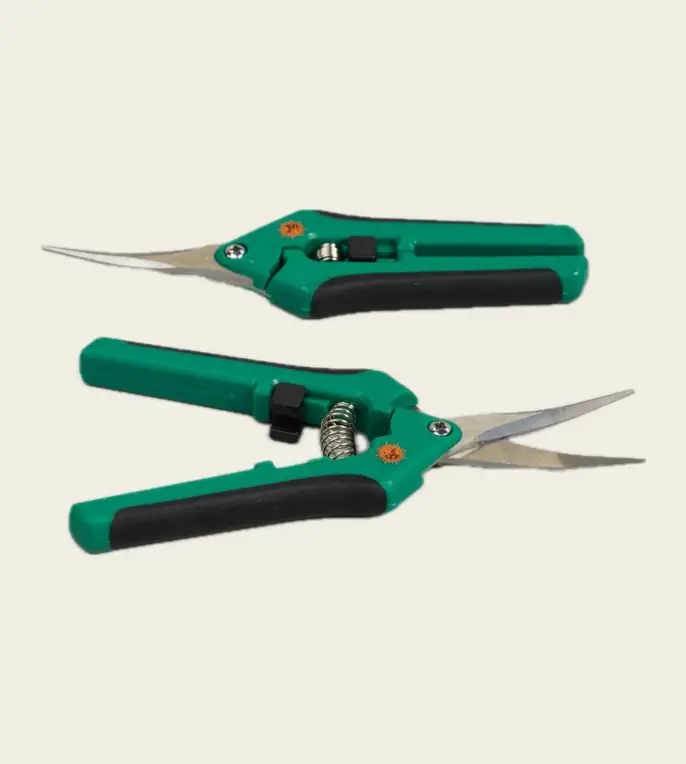
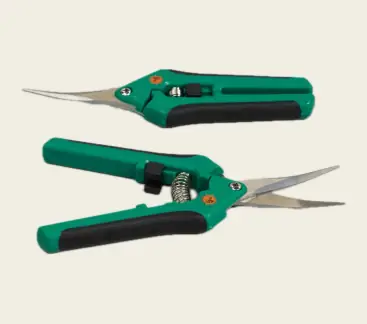
Precision trimming scissors with straight stainless steel blades for manicuring buds after harvest. At 67 grams, they are light enough to use for hours without hand fatigue, which matters on a day when trimming is the whole day. Stainless steel resists the resin build-up and rust that ruin cheaper scissors after one season.
Weight, blade length and steel
Trimming is thousands of small cuts, so a heavy pair hurts your hand long before the job is finished, and 67 grams is the difference between a full day and half of one. Short blades give control at the base of a bud where the tucked leaf sits, which is the cut that decides how the finished flower looks. Cheap steel pits, rusts at the pivot and stops closing cleanly, and a pair that does not close crushes leaf instead of cutting it.
Wet trim and dry trim
Wet trimming, straight after the cut, is faster and easier because the leaves still stand out from the bud. Dry trimming, after the hang, protects the flower during drying and keeps more of the trichomes on it, at the cost of a slower and more fiddly job. Both are defensible and growers argue about it endlessly. Straight blades handle either.
Keeping resin off the blades
Wipe them with isopropyl alcohol every twenty to thirty minutes, before the resin sets rather than after. Left to build up it glues the blades together and you end up tearing leaf rather than cutting it. The residue scraped off the blades is finger hash and is worth keeping rather than washing away.
The same blade length that suits manicuring also suits defoliation, removing lower growth during veg and taking cuttings for clones. A pair bought for one week of the year ends up in use through the whole grow, which is the argument for buying steel that lasts.