Is Weed Legal in Kansas in 2026? One of the Last Zero-Tolerance States
Drive west out of Kansas City and you cross an invisible line. On the Missouri side, adults walk into dispensaries, show ID, and buy legal flower. Cross the state line and that same jar in your cup holder becomes a criminal charge.
Kansas is boxed in by legal weed. Colorado to the west, Missouri to the east, Oklahoma to the south running one of the biggest medical programs in the country. Kansas has not moved. No dispensaries, no medical cards, no decriminalization, no possession threshold that gets you a ticket instead of a booking photo. Here is exactly where the state stands in 2026, what the penalties actually are, and why the federal government's biggest cannabis move in fifty years changed nothing inside Kansas borders.
Is weed legal in Kansas in 2026?
No. Not recreationally, not medically, not in any amount.
Marijuana remains a Schedule I controlled substance under Kansas law. There is no patient registry, no license framework, no pilot program, and no legal path to buy cannabis anywhere in the state. Kansas belongs to a shrinking group of states with no medical program at all, sitting alongside Idaho, South Carolina, and Wyoming while 24 states run adult-use markets.
An out-of-state medical card carries no weight here. A Missouri patient card, an Oklahoma card, a Colorado receipt, none of them create a defense in a Kansas courtroom. Reciprocity does not exist because there is no Kansas program for another state's card to plug into.
What are the penalties for weed possession in Kansas?
Kansas does not scale penalties by weight. One gram and one ounce sit in the same statutory box.
Under state law, a first possession offense is a class B nonperson misdemeanor, which carries up to six months in jail and a fine of up to $1,000. A second conviction bumps to a class A nonperson misdemeanor. A third puts you in felony territory as a drug severity level 5 felony, and that is the number that ends careers, housing applications, and professional licenses.
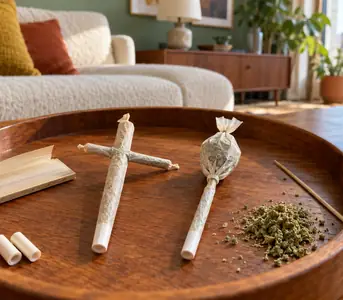
Paraphernalia charges stack on top. A grinder, a pipe, a set of scales, or a rolling tray can each add a separate count. Cultivation and distribution charges climb into serious felony ranges depending on plant count and quantity, and the state does not treat a personal-use tent any differently on paper than a commercial operation.
Enforcement is not evenly spread. Some prosecutors in the Kansas City and Lawrence metros treat small possession as low priority. Rural counties along Interstate 70 have a long reputation for aggressive traffic stops on cars with plates from legal states. Same statute, very different odds.
Is CBD legal in Kansas, and what about delta-8?
CBD is legal in Kansas as long as it contains zero THC. That is the baseline rule, and it is stricter than the federal 0.3% standard most people assume applies everywhere.
There is one narrow carve-out. Claire and Lola's Law gives an affirmative defense for possessing CBD preparations with up to 5% THC, but only for people with a diagnosed debilitating medical condition. To use it, you have to carry a signed letter from a Kansas-licensed physician, on their letterhead, dated within the previous 15 months, and hand it over when an officer asks. An affirmative defense is not a permission slip. It works after you have already been arrested and charged.
Delta-8 is where things get genuinely messy. A 2021 Kansas Attorney General opinion concluded that delta-8 THC is a Schedule I controlled substance in Kansas unless it comes from industrial hemp and sits inside a lawful hemp product capped at 0.3% total THC. That same opinion ruled out cigarettes, cigars, teas, and vape liquids as lawful hemp products entirely. Shops across the state pulled inventory. Some counties sent letters demanding surrender of stock. Others shrugged. Whether the gummy in your glovebox is a crime still depends heavily on which county you are standing in.
Feeling lost on how to start? Try taking our quiz!
Start a QuizWhat happens if you bring weed from Missouri or Colorado?
This is the single most common way Kansans get charged, and it is worth being blunt about it.
Legal purchase in one state does not travel. The moment your tires cross into Kansas, that dispensary bag is contraband under Kansas law, receipt and all. The packaging works against you rather than for you: a labeled, sealed, tamper-evident jar is a tidy piece of evidence with a purchase date printed on the side.
A few practical realities people learn the hard way. Odor still functions as a factor in vehicle searches in Kansas. Highway corridors running between legal states get watched. Out-of-state plates get noticed. And a passenger's stash can become the driver's problem depending on how the officer writes it up.
None of this is legal advice, and none of it is moral judgment. It is just the map. If you live in Kansas and you consume, the risk is not theoretical and the cost of a conviction is not a fine you shrug off.
The unexamined day is a wasted opportunity. Reflect on what you did, what you learned, and how you can improve.
John Dewey
Did federal rescheduling change anything for Kansas?
Short answer: no. And the reason is the part almost nobody explains properly.
In April 2026, the Justice Department moved FDA-approved cannabis medicines and state-licensed medical marijuana from Schedule I to Schedule III. That was the first meaningful crack in federal prohibition in more than half a century, and the cannabis industry treated it like a starting gun.
Read the actual scope, though. The order applies to cannabis covered by an FDA-approved drug product or held under a state medical marijuana license. Kansas issues no such licenses. There is no Kansas licensee for the federal reclassification to attach to, which means the benefit lands in every state around Kansas and skips Kansas entirely.
Everything else stayed in Schedule I, including recreational cannabis. A broader hearing on full rescheduling opened in summer 2026, and if it eventually pulls all marijuana into Schedule III, that still would not legalize anything at the state level. Federal scheduling and state criminal law are separate machines. Kansas would have to act on its own.
What rescheduling does do is remove the last excuse. Kansas lawmakers spent years saying they were waiting to see what Washington did. Washington did something.
Will Kansas legalize weed?
Public opinion is not the obstacle. It has not been for years.
The 2025 Kansas Speaks survey from Fort Hays State University found 70% of Kansans support legalizing medical marijuana and 59% support recreational legalization. Opposition to medical sat at 14%. Support for medical cannabis crossed party lines, including a clear majority of Republicans. The same survey has tracked this question since 2017 and the trend has barely wobbled.
The blockage is structural. Medical cannabis bills have been introduced in Kansas session after session. The House passed one in 2021. The Senate would not bring it to a vote. Senate Bill 294, the Kansas Medical Cannabis Act, sat in the Federal and State Affairs Committee without a hearing through both 2025 and 2026 before dying when the Legislature adjourned in April 2026. House Bills 2678 and 2679, filed in February 2026 for medical and adult-use respectively, went to committee and stopped there.
Even sideways attempts have failed. In 2025, a Senate Democrat tried to attach narrow medicinal cannabis language for terminally ill patients to a separate treatment bill, and the amendment was voted down along party lines. Senate leadership and the Kansas Bureau of Investigation have both stayed publicly opposed.
Kansas also has no citizen ballot initiative for statutes, so voters cannot go around the Legislature the way Missouri and Oklahoma did. Reform has to pass through the same committees that have been killing it. The realistic watch points are the November 2026 elections, where the governor's seat, the attorney general's office, and the entire state House are on the ballot, followed by the 2027 session.
What Kansas cannabis fans should know about genetics
Barney's Farm has been breeding since 1986 in Amsterdam. Our founder Derry spent the 1980s tracking landrace genetics through Afghanistan and the Himalayas, hand-collecting seed stock from growers whose families had worked the same lines for generations. Those trips built the genetic library behind more than 40 Cannabis Cup wins.
We have watched prohibition maps redraw themselves for four decades. Amsterdam in the eighties, Spain in the nineties, California, Colorado, then the wave that reached most of the country. The pattern rarely changes. Public opinion shifts first, legislatures move last, and the people who understand the plant before the law catches up are the ones who benefit most when it does.
If you follow genetics for the culture rather than the cultivation, two of our lines carry that history plainly.
- Critical Kush
- Pineapple Chunk
Barney's Farm seeds ship from our US distribution center and are sold strictly as souvenirs, storage, and genetic preservation. Germination laws vary by state, and in Kansas cultivation remains a serious criminal offense. Know your local law and respect it.
Where this leaves Kansas
Kansas in 2026 is a prohibition island with legal markets on three borders, a population that supports reform by wide margins, and a Legislature that will not schedule a hearing. Federal rescheduling handed every neighboring state a benefit and handed Kansas nothing, because Kansas built nothing to receive it.
For now the rules are simple and harsh. Any amount is a crime. Your Missouri card means nothing. Your Colorado receipt means nothing. Delta-8 depends on your county. CBD has to be clean.
The map keeps redrawing itself. Kansas is running out of company on the wrong side of it.
Barney’s Farm has been developing premium cannabis genetics since 1986, with more than 40 Cannabis Cup wins. Explore our full cannabis seed catalog and find the genetics that fit how you actually medicate.