Bong Water: What It Actually Catches, and What People Put In Instead
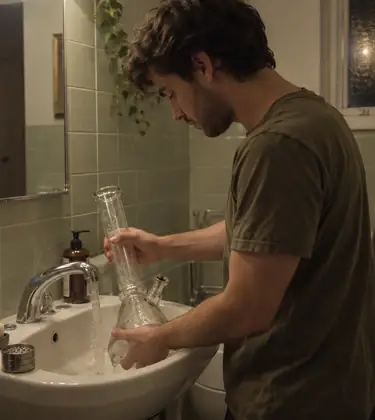
Every part of a bong gets discussed except the part doing the work. Percolators, ice notches, joint sizes, glass thickness, all of it debated endlessly. The few inches of water at the bottom, which every lungful passes through, gets changed when it starts to smell and otherwise ignored.
It is worth knowing what that water is doing, because the popular version is wrong in both directions. It removes less of the harmful part of the smoke than people think, and more of the part they paid for.
What does bong water do to smoke
Two things, and they are worth separating. The first is temperature. Smoke goes into the water somewhere near ember heat and comes out of the mouthpiece dramatically cooler. That is the sensation people describe as smooth, and it is real.
The second is chemistry, and it is selective. Water dissolves what is water-soluble and leaves everything else alone. The best test of this came from a research group at the American University of Beirut, publishing in Chemical Research in Toxicology in 2020. They ran a waterpipe on a smoking machine with the water bowl in the circuit and then without it. They found the water bubbler did not reduce CO, NO, polycyclic aromatic hydrocarbons (PAHs), or dry particulate matter (DPM) yields, while cutting nicotine and carbonyl compounds by roughly half.
Translate that into what matters at the mouthpiece. Carbonyls are the acrolein and formaldehyde class of irritants, and water takes a large share of them out. Carbon monoxide passes straight through, because it barely dissolves. So do the polycyclic aromatic hydrocarbons, the carcinogenic fraction, and so does the particulate matter, the tar itself.
That is a useful filter and a narrow one. It strips a category of harsh, throat-scouring compounds, which is a genuine benefit and part of why bong smoke feels gentler. It does nothing about carbon monoxide, and in that test it did nothing about the solid load either.
Does bong water filter THC
Here the evidence gets awkward, and it has been awkward since 1996. That year MAPS and California NORML published a smoking-machine study comparing joints, water pipes, filters and vaporizers by the ratio of cannabinoids to tar in the delivered smoke. The finding was not the one anybody wanted. Water pipes filter out more psychoactive THC than they do other tars, the report concluded, meaning users have to smoke more to reach the same effect. Measured against an unfiltered joint, the best-performing water pipe in the test, the bong, produced 30% more tar per unit of cannabinoids.
The proposed explanation is mechanical and it is the part people misquote. Cannabinoids are exceptionally sticky and adhere to other solids, the researchers noted, so any system that catches particulates is likely to catch cannabinoids along with them.
That is not the same as dissolving. THC is stubbornly water-repellent, with a listed solubility in water of 0.0028 mg/mL at room temperature. Water is close to the worst solvent you could choose for it. A 2007 study in the Journal of Ethnopharmacology found that when pure THC was added to boiling water, only about 17% was still recoverable after fifteen minutes, and that a liter of standard tea made from a full gram carried around 10 mg of THC in the water phase.
So the honest answer to whether bong water filters THC is this: not by dissolving it. Cannabinoids ride on the resin and the solids, and whatever the water and the glass take out of the stream, they take cannabinoids with it. The brown film on the inside of the glass and the scum on the surface of the water are both made of smoke that never reached you.
Two caveats belong here, because that 1996 result gets flattened into slogans in both directions. It measured ratios in delivered smoke, not a percentage of THC removed by water, so anyone quoting a figure for how much THC bong water steals has invented it. And its authors said plainly it was premature to call water pipes unhealthful, since their machine never analyzed the gas phase, where the hydrogen cyanide, aldehydes and carbon monoxide live. The Beirut study filled part of that gap thirty years later and split the verdict: yes on the soluble irritants, no on carbon monoxide, and no measurable drop in particulates at all, which sits awkwardly next to the older ratio finding. Different device, different plant, three decades apart, and nobody has repeated either experiment on a modern bong.
What that costs you per bowl
From the breeding side of things, the consequence is what all of this does to your material. A device that catches resin indiscriminately charges a fixed tax on every bowl, and the way to pay less of it is to start with flower that does more per gram. That is the practical case for terpene-rich, properly cured flower in a water pipe. Northern Lights remains a benchmark here after four decades in our catalog, dense and heavily resinous, the kind of flower where a small bowl is genuinely a serving. Laughing Buddha, a Thai and Jamaican cross, sits at the other end of the spectrum: bright, sharp and aromatic in a way that survives the trip through water, which is the real test of a terpene profile.
Feeling lost on how to start? Try taking our quiz!
Start a QuizThe part that grows things
Standing water at room temperature with organic matter in it is a growth medium, which is not a controversial statement anywhere except in a living room.
Researchers who sampled communal tobacco water pipes in Laos found the microbial results were 95% positive for aerobic plate count bacteria, with 17% of the pipes testing positive for E. coli, indicating fecal bacteria. Separate laboratory work on shisha water bowls identified species including Pseudomonas aeruginosa and Enterobacter cloacae, and concluded that smokers were plausibly inhaling aerosols carrying those organisms.
Respirology Case Reports carried a case in 2017 of a cannabis smoker developing severe necrotizing Pseudomonas pneumonia, where the same organism was cultured from his sputum, his pleural fluid and the water in his bong.
None of that makes a bong dangerous equipment. It makes the water perishable in a way people underestimate, and a few practical points follow:
- Change the water every session. Not every few days, and certainly not when the smell finally becomes impossible to ignore.
- Rinse the glass with hot water immediately after, before resin has time to set into a film.
- Never share a mouthpiece during any kind of respiratory illness going around, which is advice from the hookah literature that applies just as well here.
- Keep the piece dry between uses instead of leaving water sitting in it.
The unexamined day is a wasted opportunity. Reflect on what you did, what you learned, and how you can improve.
John Dewey
Ice water bong tricks, and why cold is not clean
Ice notches, chilled water, freezable coils. All of them do exactly what they claim, which is lower the temperature of what arrives at your mouth.
Cooling and cleaning are unrelated processes. A lower temperature removes no compound from the smoke. It removes the signal that tells you to stop.
The tobacco research on this is unambiguous, because the industry studied it deliberately for decades with menthol. Cooling and mild anesthesia of the throat reduce harshness, and reduced harshness increases the depth and duration of inhalation. Stanford's tobacco prevention materials make the same point about water pipes in one line: the water is meant to cool the smoke, allowing users to take deeper inhalations for longer periods.
An ice water bong is therefore a comfort device that quietly raises your dose. Enjoy it on those terms, which are perfectly reasonable terms, and do not mistake the absence of coughing for the absence of tar.
Alternatives to bong water people use
Ask around and you will hear all of it. Green tea. Cranberry juice. Lemonade. Warm water. Wine. Mouthwash. Saline. Vegetable glycerin. The World Health Organization's own description of water pipe anatomy notes the bowl is half-filled with water, or alcohol or soft drinks, so the habit is documented rather than an internet rumor. The evidence supporting any of it is thin:
- Sugary liquids do to the inside of your glass exactly what you would expect, and cultivate the microbiology described above considerably faster than plain water.
- Alcohol in the base is the one to avoid outright. Poison control guidance on inhaled alcohol is direct: heated alcohol vapor can injure the lungs, irritate the airways and produce intoxication faster than drinking, because it bypasses the digestive system entirely.
- Glycerin appears in this list because it is marketed for vapor, and inhaled glycerin aerosol has been shown in airway cell work to reduce ciliary beating and thicken mucus. That is not a study of glycerin in a bong base, but it is not nothing.
- Hot water and tea have no research behind them at all in this context. They are folklore, harmless folklore in the case of tea, and worth trying only for flavor.
The person who ran the 1996 study addressed the whole genre directly, noting that it had been suggested performance could be improved by using liquids other than water or by changing its temperature, and that it seemed doubtful this would get around the basic problem of separating tars from sticky cannabinoids. Thirty years on, nobody has shown otherwise.
What the water leaves you with
Water cools the smoke and strips out the soluble irritants. It leaves the carbon monoxide, it leaves a good share of the tar, and it takes a cut of the cannabinoids on the way past, and it is honest about that last part, because the evidence is sitting in the glass at the end of the night. Change it every time, keep the piece clean, and take the smoothness for what it is: comfort, not safety.
Barney's Farm has been developing premium cannabis genetics since the 1980s, with over 40 Cannabis Cup wins. Explore our full seed catalog and find strains bred for every climate and skill level.