Cold Chain, Couriers and Vaults: How Weed Physically Moves
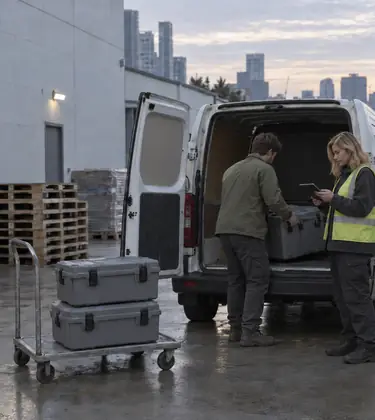
Between the grower and the store there is a van, and that van is one of the most tightly regulated vehicles on an American road. It cannot be marked. It usually cannot be left alone. In Michigan it cannot leave without a route filed with the state first, and in Massachusetts the odometer reading goes on the paperwork at both ends.
Cannabis logistics is the part of the industry nobody photographs, and it is where a surprising share of the compliance burden actually sits.
Who is allowed to carry it
In most legal states, cannabis distribution is its own license category, separate from growing and from selling. California defines distribution as the procurement, sale and transport of cannabis between licensees, and reserves it to licensed distributors. The state goes further than the license: the driver of a vehicle transporting cannabis must be directly employed by a licensee authorized to transport it. No contractors, no courier companies, no gig drivers.
There is also a stripped-down version of the license for firms that only want to haul. A California distributor transport only licensee may move product between licensees but may not hold title to it, may not store or package it, and may not arrange lab testing. Colorado's transporter is similar and cannot buy, sell or be given cannabis at all, and may hold it for no more than seven days. Massachusetts splits its transporter license into a standalone company and an existing licensee that also hauls for others. Michigan calls the category a secure transporter and, uniquely, licenses it to move the money as well as the product.
That is what people mean by a cannabis courier license, and it is worth being precise: in almost every state it authorizes movement between licensed businesses, not delivery to a customer's door, which is a separate permission entirely.
The cannabis transport rules that govern the vehicle
California's regulation on transporting cannabis between licensees is the clearest single list, and the opening line is the one that surprises people: transportation by means of aircraft, watercraft, drone, rail, human-powered vehicle, or unstaffed vehicle is prohibited. No planes, no boats, no drones, no trains, no cargo bikes, no autonomous vehicles. From there, the requirements stack up:
- Product must travel inside a vehicle or trailer and must not be visible or identifiable from outside it, in a fully enclosed, windowless, locked trailer or trunk that cannot be reached from the passenger compartment.
- Every transport vehicle and trailer must carry a vehicle alarm system, at minimum.
- A vehicle carrying product may not be left unattended in a residential area or parked overnight in one.
- The vehicle travels between the licensees shipping and receiving, and its own licensed premises. Nowhere else.
Other states add their own. Massachusetts requires that every vehicle transporting product be staffed with a minimum of two agents, with at least one always remaining with the vehicle. Michigan requires the driver to hold a state chauffeur's license and the load to travel in sealed containers, inaccessible in transit. New York requires GPS, a locked box or cage, and no signs or markings that would indicate the vehicle carries cannabis. Montana extends that ban to any marking suggesting the vehicle is even owned or leased by a cannabis business.
One correction to a widely repeated claim: trailers are not banned. California and Nevada both write the locked, windowless trailer into the rule as an approved option.
The manifest knows your odometer
Nothing moves without paperwork, and the paperwork is unusually specific. A shipping manifest accompanies every transport of cannabis in California, transmitted to the regulator and the receiving licensee before the vehicle leaves. In Colorado the manifest is generated by the state inventory tracking system, not written by the company. In Michigan a route plan goes into the statewide monitoring system before departure and a copy rides in the cab.
Massachusetts spells out what the document must contain, and one line stands out: the mileage of the transporting vehicle at departure from the originating establishment, the mileage on arrival, and the mileage on return. Alongside it, the weight or count before departure and on receipt, the time of departure and arrival, the plate number, and the names of every agent who touched the load.
A detour shows up in arithmetic. Accidents, losses and any unusual discrepancy in weight or count must be reported to the commission and to law enforcement within 24 hours, and manifests are kept for at least a year.
At the destination, the rules keep going. Massachusetts requires finished product to be stored in a secure, locked safe or vault, and each state sets its own period for how long the cameras watching it must keep their footage:
- Massachusetts requires recordings available for immediate viewing by the commission covering at least the preceding 90 days.
- California also sets 90 days, and specifies the hardware: a minimum resolution of 1280 by 720, recording continuously at no fewer than 15 frames per second.
- Colorado asks for a minimum of 30 days, the shortest of the three.
Feeling lost on how to start? Try taking our quiz!
Start a QuizWhere the cold chain is required
Cold chain in cannabis is usually described as a quality practice, and for most product categories that is exactly what it is. No state rule requires fresh frozen material to stay frozen on its way to an extractor. That freezer truck runs on market discipline, not law.
Edibles are different, because edibles are food. Maryland requires that transport provides adequate temperature control to prevent edible cannabis products from becoming unsafe in transit, and cross-references the federal sanitary food transportation rule. Both ends keep records: the sending permittee logs the temperature at departure and the receiving dispensary logs it on arrival, and both keep those logs for at least two years. A dispensary can refuse a load on temperature grounds.
New York takes the general approach instead, requiring temperature controls designed and maintained as necessary to prevent cannabis from deteriorating during transport. That is a performance duty covering everything, not just food.
The unexamined day is a wasted opportunity. Reflect on what you did, what you learned, and how you can improve.
John Dewey
The cash problem is the same problem
Because cannabis businesses still struggle to bank normally, a second cargo travels the same roads: money. And money in a vehicle is what turns a compliance story into a crime story. In May 2021, an armored vehicle run by Empyreal Logistics, a company that moves cash between state-licensed cannabis businesses and financial institutions, was stopped on Interstate 70 in Kansas while carrying takings from licensed Missouri dispensaries to credit unions in Colorado. During the three-hour stop, the sheriff's office seized five bags of cash totaling $165,855. The same company later had roughly $1.1 million taken across a series of stops in California, all eventually returned.
Legal at the origin, legal at the destination, and crossing a state in between where none of it counted. That is the whole interstate problem in one traffic stop, and it is why Oregon and California both passed laws authorizing interstate cannabis agreements that cannot take effect until federal law changes.
The exposure is not theoretical either. Washington state's industry association counted 27 armed robberies of cannabis businesses in 2020, 34 in 2021, and at least 80 by April 2022, with the cash-only model named repeatedly as the reason.
What all this looks like from the breeding end
The practical consequence for anyone buying cannabis at retail is a supply chain with very few chances to react.
Product moves on scheduled runs, in sealed containers, on manifests written before departure. There is no informal restock, no quick swap, no driver popping back. Anything that goes wrong in transit becomes a reportable incident rather than a phone call. That rigidity is exactly why shelf variety narrows over time, and why a strain has to justify the entire chain of custody behind it before a buyer will take a chance.
It is also the argument for growing your own, made in paperwork instead of principle. Nothing in this article applies to a plant in a tent. The whole system, the manifests and the alarms and the odometer readings, exists to move a product that a home grower simply harvests. If you want the two ends of that contrast, Durban Poison and Blue Dream are both on dispensary shelves across the country after a journey like the one described above, and both are available as seed to anyone whose supply chain is a walk across the room.
What the paperwork is really protecting
Strip away the detail and the rules are all doing one job: proving that every gram that left one licensed building arrived at another. The GPS, the sealed cases, the odometer readings, the 90 days of video and the locked vault are not there to stop theft in the ordinary sense. They are there to make diversion visible.
That is the price of a legal market, and it lands hardest on the least glamorous part of it, the people driving unmarked vans at six in the morning with a route filed and a tablet full of manifests. Barney's Farm has been developing premium cannabis genetics since the 1980s, with over 40 Cannabis Cup wins. Explore our full seed catalog and find strains bred for every climate and skill level.