Terp Pearls, Carb Caps and Inserts: Dab Accessories Ranked

The accessory shelf next to any dab rig has grown faster than the evidence behind it. Beads that spin. Caps in six shapes. Buckets inside buckets. Each arrives with a confident physical explanation, and almost none of those explanations trace back to anybody who measured anything.
This is an attempt to rank them by what can actually be shown, which means starting with the one variable in dabbing that has real published data behind it.
The only variable with real evidence behind it
Temperature. Not the glass, not the beads, not the cap. Researchers at Portland State ran cannabis terpenes across a heated nail at a series of controlled temperatures and measured what came off. The numbers were reported again in a 2025 review of concentrate vaping chemistry: methacrolein concentrations of 185 ppb at 526 degrees Celsius, 157 ppb at 455, 131 ppb at 403, and undetectable at 322. Benzene appeared only at the top of the range.
Read that as a dose-response curve, because that is what it is. Same material, same draw, and the measured output climbs by roughly 40 percent between 403 and 526 degrees, then vanishes entirely at 322. A torch crosses that whole span in about fifteen seconds. Everything worth buying is worth buying because it helps you sit lower and steadier on that curve.
Two caveats belong with it. Those measurements were taken on a ceramic nail, and no equivalent study has ever been run on quartz, so anyone telling you quartz is chemically cleaner is guessing. And low is not the same as harmless: the same group found ketene, a serious respiratory toxin, coming off cannabinoid acetates at 250 degrees.
Carb cap types, and what a cap is really doing
The popular explanation is that restricting airflow drops the pressure inside the bucket, which lowers the boiling point of the oil, so it vaporizes cooler. The physics is real. Reduce pressure over a liquid and its boiling point falls.
The trouble is the size of the effect. Human inspiratory effort is measured in tens of centimeters of water. Run that through the standard vapor pressure relationship and the boiling point of a typical terpene falls by somewhere around one degree in a normal draw, and by about five degrees if you pull as hard as a chest can physically pull. Against a working surface at 300 to 500 degrees, that is not a mechanism. That is noise.
Now look at how the people who patented a carb cap describe it. The 2025 grant held by Puff Corp says a cap provides a controlled flow of gas into the vaporization chamber, and that the shape of the cap and its conduit can be chosen to control the velocity and direction of that flow to enhance contact with the product. Read the whole document and the words boiling, vacuum and lower temperature never appear.
So the cap works, for a different reason than the one everybody repeats. It converts a slow drift of air across the oil into a fast directed stream, which is convection, and it keeps vapor in the bucket instead of letting it escape into the room. That is also the only defensible argument for a directional carb cap: a spinning or angled airflow moves oil around the hot surface instead of letting it pool in one spot.
What cannot be defended is the ranking of cap shapes. There is no measurement anywhere comparing bubble, flat and directional caps. Pick on fit and feel.
Do terp pearls work?
Here is the honest answer, and it is shorter than the marketing. A search of the US patent database for terp pearls returns no patents at all. Not one. The same database returns real, granted, on-topic patents for carb caps, so the search works. There is also no peer-reviewed study of terp pearls, no independent technical description, and no measurement of what they do to vapor output, flavor or emissions. Every claim made for them traces back to somebody selling them.
The fair concession is that materials differ, and by a lot. Fused quartz has a thermal conductivity of 1.3 watts per meter-kelvin, while silicon carbide sits near 348. Dropping a highly conductive object into a hot bucket plainly changes how heat moves around in there. That is a physics argument, not a finding, and it cuts both ways: cold pearls also add thermal mass that has to be heated before anything else happens, which lowers your starting temperature in the first seconds.
So terp pearls might do something. Nobody has ever shown that they do.
Feeling lost on how to start? Try taking our quiz!
Start a QuizThe quartz insert dab, and the cold start
Inserts have exactly the same evidence problem: no patents, no studies, nothing outside retail copy. The technique around them is a different matter. Cold starting means loading the oil into a cold bucket, capping it, and applying heat gently until it begins to vaporize, instead of torching to red and waiting for the drop. Given a temperature curve where methacrolein was undetectable at 322 degrees and benzene shows up only at the top, deliberately approaching from underneath is a defensible thing to do. The technique inherits the support that the hardware never earned.
That distinction is worth holding on to across the whole category. A quartz insert dab is not a proven product. Working at the bottom of the temperature range is a proven idea, and an insert is one of several ways to make that easier.
The unexamined day is a wasted opportunity. Reflect on what you did, what you learned, and how you can improve.
John Dewey
Why the bucket is quartz in the first place
Quartz is a strange choice on paper. It conducts heat badly, which is why a freshly torched banger has hot spots and needs a wait before it is usable.
It wins on the other number. Fused quartz has a coefficient of thermal expansion of about 5.5 times ten to the minus seven per kelvin, which accounts for its remarkable ability to undergo large, rapid temperature changes without cracking. Take a naked flame to a piece of glassware, then put cold oil straight onto it, and almost nothing else survives that treatment repeatedly. Titanium conducts heat around seventeen times better and equalizes fast, which is why a titanium nail is harder to hold at a low temperature. Ceramic sits between them and is what most of the published research was actually conducted on.
What holds a temperature
If the temperature curve is the only thing with data behind it, the useful question is what helps you sit on it, and the honest answer involves very little glass.
- An electronic nail with a set point removes the guesswork entirely, which is why the researchers switched to one for their own experiments.
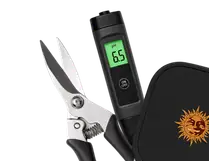
- An infrared thermometer does the same job for a torch setup, and costs less than most cap collections.
- A thicker bucket holds its heat longer, which is a consequence of mass and specific heat capacity rather than a measured claim, but it is sound and it means fewer wild swings mid-dab.
- Smaller loads finish before the bucket falls out of range, which is free.
None of that is an accessory in the shelf sense. It is the boring equipment that does what the beads are advertised to do.
What we would spend the money on instead
Breeding is upstream of all of this, and the thing that struck us most in the research is how little of your material reaches you regardless of hardware. In the 2015 study that examined California concentrates, up to 40 percent of the theoretically available THC was captured in the vapor stream during dabbing experiments. The same paper found that over 80 percent of the concentrate samples were contaminated in some form, with residual solvent or pesticide.
Sit with those two numbers. More than half your material never arrives, and more than four fifths of what was on the shelf in that survey carried something it should not have. No bead, cap or insert touches either problem. Clean input does, and clean input starts with what went into the extractor. Two of ours that reward that kind of attention:
- Gorilla Z is the resin answer, bred for a heavy trichome load with a sweet fruit and chocolate profile that survives extraction intact.
- Black Cherry Gushers is the terpene answer, dense and loud, the kind of flower where a low-temperature dab has something left to say.
Ranked, honestly
Three accessories, three very different evidence positions. The carb cap is the only one with a primary source behind it, and it works by moving air, not by lowering boiling points. The insert has no evidence of its own but supports a technique that the temperature research genuinely backs. Terp pearls have nothing at all: no patent, no study, no independent measurement, only people selling them.
None of that makes any of them a bad purchase. It makes the reasoning behind them worth knowing, so you can spend on the thing that actually changes your dab, which is holding a lower and steadier temperature, and on the material going into the bucket. Barney's Farm has been developing premium cannabis genetics since the 1980s, with over 40 Cannabis Cup wins. Explore our full seed catalog and find strains bred for every climate and skill level.