Can Police Scan Your House for a Grow? What Kyllo v. United States Actually Decided
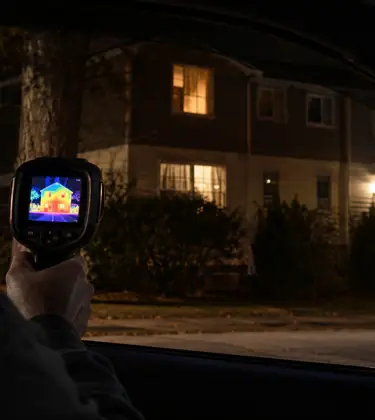
At 3:20 in the morning on January 16, 1992, two federal agents parked across the street from a triplex on Rhododendron Drive in Florence, Oregon, and pointed a heat camera at a stranger's wall. The man inside was Danny Kyllo. Nine years later his name became the reason police in this country cannot scan your house for a grow room without a warrant.
Kyllo v. United States is the most important cannabis privacy case the Supreme Court has ever decided, and most growers have never read a word of it. Here is what happened, what it protects, and where the cracks are starting to show.
What is thermal imaging and why do police point it at houses?
A thermal imager reads infrared radiation. Every object emits some. The camera converts it into a picture where warm surfaces glow and cool surfaces stay dark. It does not see through walls. It reads the outside of your wall and tells the operator how hot that surface is.
That mattered enormously in the 1990s. Indoor grows ran on high intensity discharge lamps, thousand watt metal halide and sodium fixtures that dumped serious heat into a sealed room. All that energy had to go somewhere. It went into the ceiling, the garage door, the wall behind the tent, and out the exhaust. On an imager, a house with a working flower room did not look like a house. It looked like a hot spot with a roof on it.
Police called those readings thermal signatures and used them to build probable cause. A tip from a neighbor, a power bill triple the block average, a wall that glows on infrared, and a magistrate signs the warrant. Cheap, quiet, and done from the public street. Nobody inside ever knew it happened.
What happened in Kyllo v. United States?
Agent William Elliott of the Department of the Interior suspected Kyllo was growing in his section of the triplex. He and a colleague scanned the building with an Agema Thermovision 210 from a car across the road. It took minutes. The roof over the garage and one side wall read hotter than the rest of the building and hotter than the neighboring units.
That reading went into a warrant application alongside informant tips and utility records. The warrant was granted. Agents found an indoor grow with more than a hundred plants. Kyllo moved to suppress the evidence and lost, with the trial court reasoning that the device recorded only heat leaving the home and could not reveal conversations or human activity inside. He pleaded guilty on the condition that he could appeal, lost again at the Ninth Circuit, and took it to the Supreme Court.
What did the Supreme Court actually decide?
Pointing a thermal imager at a private home is a search under the Fourth Amendment, and police need a warrant to do it.
That was the holding, decided five to four on June 11, 2001. Justice Antonin Scalia wrote the opinion, and the lineup was odd enough to be worth noting. Scalia and Clarence Thomas landed on the same side as Ruth Bader Ginsburg, Stephen Breyer and David Souter, while Chief Justice Rehnquist signed onto a dissent written by John Paul Stevens.
The government's argument was mechanical. The imager only measured heat radiating off an exterior surface, so nothing private was invaded. The Court threw that out. The rule it set turns on whether police used a device not in general public use to learn details of a home they could not have learned without going inside. The justices also refused to sort information into intimate and non intimate categories. Inside a house, they said, everything counts.
Scalia was writing about where technology was heading rather than where it stood. If the standard were whatever a machine can pick up from outside the wall, the homeowner loses ground every time the machines get better.
Feeling lost on how to start? Try taking our quiz!
Start a QuizDoes Kyllo still protect you now that everyone owns a thermal camera?
This is the uncomfortable part. The protection hangs on technology not being in general public use. In 1992 a thermal imager was specialist equipment operated by trained agents. Today a phone attachment costs a few hundred dollars, and roofers, electricians, home inspectors and HVAC techs carry them to work.
The Court never defined general use. Analysis published through the Justice Department's own research library has pointed out that the term is undefined and open to subjective interpretation, and that a general use rule bends with whatever gear the public happens to be buying. No court has ruled that cheap consumer imagers pushed thermal scanning outside Kyllo's protection. The reasoning holding Kyllo up just gets thinner every year the hardware gets cheaper.
The unexamined day is a wasted opportunity. Reflect on what you did, what you learned, and how you can improve.
John Dewey
Can police fly a thermal drone over your yard?
Drones are the live question and the courts are still fighting about it. In Michigan, a township hired a drone operator to photograph a resident's property during a zoning dispute. The case climbed to the Michigan Supreme Court, which declined to decide whether the drone surveillance was a search at all and resolved the case on the exclusionary rule instead. The constitutional question is still sitting there unanswered.
Legislatures are moving quicker than judges. Ohio is the freshest example. Governor Mike DeWine signed House Bill 251 into law on July 7, 2026, requiring police to obtain a warrant before using a drone to observe the interior of a home or any place where an in person search would need one. The same law bans arming police drones with lethal weapons and makes warrantless surveillance data inadmissible in criminal proceedings. Exceptions cover emergencies, disaster response, crash investigations and crime scene documentation.
Read alongside Kyllo, the direction is clear enough. A drone camera looking at what any neighbor could see sits in one bucket. A drone carrying infrared and aimed at your walls sits in Kyllo's bucket, and that takes a judge.
What thermal imaging never actually saw
Here is the part that gets lost in the legal talk. A thermal imager never detected a cannabis plant. Not one. It detected lamps. It detected ventilation. It detected a room somebody kept hot for eighteen hours a day. The plants were always an inference drawn from a warm rectangle on a screen.
We have been breeding since 1986 and we watched the arms race play out in real time from Amsterdam. Growers in the States flipped their lights to run at night, insulated attic floors, ducted exhaust into chimneys, packed walls with rigid foam, and traded tricks that mostly made their houses stranger rather than cooler. A basement running 30 degrees warmer than the one next door reads hot no matter how much foil tape you own.
LEDs and legalization did more to retire the thermal scan than any stealth trick ever managed. A modern LED fixture runs at a fraction of the surface temperature of a thousand watt HPS bulb, and a grower operating legally has nothing to hide from a camera in the first place.
What does Kyllo mean for a legal home grower today?
If you are growing inside your state's plant count, Kyllo is background law rather than daily concern. Nobody is scanning a four plant tent, and if somebody did there would be nothing illegal to find. Your real friction points are landlords, HOA rules, insurance policies and neighbors with strong opinions about smell.
If you want a small footprint anyway, genetics do most of the work. Critical Kush finishes indoors around 100 to 110cm in 55 to 60 days, a short dense plant that fits a closet without training gymnastics. Blue Gelato 41 stretches taller and takes nine to ten weeks, and pays back the extra headroom with the kind of resin hash makers hunt for. Both are photoperiod plants, so you decide when the lights run and when the heat happens.
Four decades in, the thing we keep coming back to is that discretion was a genetics problem long before it was an equipment problem. Derry was riding through Afghanistan and the Himalayas in the early eighties, collecting landraces from farmers whose families had grown the same plants for generations, in places where nobody owned a thermal camera and nobody needed one. Those lines came home to Amsterdam and became the backbone of everything we have released since, including the Cannabis Cup winners.
The law around this plant keeps moving, usually in growers' favor and usually slower than anyone wants. Kyllo held the line for 25 years. Whether it holds for the next 25 depends on how a court decides to define general public use, and on how many of us are watching when they do.
Barney's Farm has been developing premium cannabis genetics since the 1980s, with over 40 Cannabis Cup wins. Explore our full seed catalog and find strains bred for every climate and skill level.