THCA Snowballs: What They Are and Why They Exist
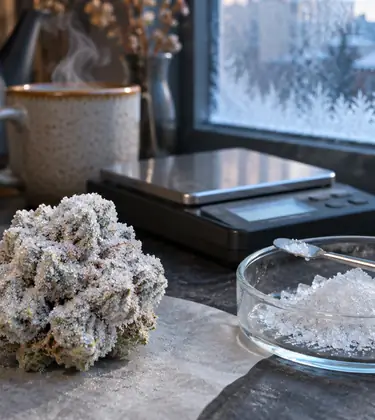
Some buds sold online look as if someone rolled them in powdered sugar. Under the white crust sits ordinary cannabis flower, and the crust itself is crystalline THCA, the raw acid form of THC.
These THCA snowballs exist because of a gap in federal hemp law, and that gap is about to close. How they are made explains both their strength and their legal trouble.
Key takeaways
- Snowballs are buds coated in powdered THCA isolate, which is why they look white instead of green.
- Heat turns THCA into THC, so smoking a snowball delivers THC like a strong concentrate.
- Most snowballs sell online as hemp, because federal law has counted only delta-9 THC.
- A November 2025 law switches to total THC, with most of the change starting December 11, 2026.
- Colorado has sued sellers over THCA products with too much delta-9 THC and mislabeled contents.
- Growers can get a frosty look with no coating at all by choosing resin-heavy strains.
Snowball weed, explained
So what are THCA snowballs? In our experience, they are buds, usually hemp flower, rolled in THCA isolate or finely crushed THCA diamonds until the whole surface turns white. Some makers brush the bud with a little terpene sauce or distillate first so the powder sticks, which makes them close relatives of moon rocks. Online, snowball weed also goes by names such as snowcaps or frosted flower. A real snowball leaves white dust on your fingers and inside the bag, which is the quickest way to spot one.
Most of the strength sits in the coating. THCA isolate is one of the most refined cannabis concentrates, and a good batch holds little besides the THCA crystal itself. A THCA snowball is, in effect, a bud wearing a concentrate.
Next to its cousins, a snowball carries the purest coat of the three. Sun rocks wear kief, moon rocks wear hash oil and kief, and a snowball wears refined THCA. For a seller, the coating also turns plain hemp flower into a premium product, which is why snowballs usually cost far more per gram than the bud underneath.
THCA, the raw acid
Raw THCA does little on its own. It is a precursor of tetrahydrocannabinol, the compound behind the high, and it turns into THC slowly as cannabis dries and much faster under the heat of a flame or an oven, Wikipedia's THCA entry explains. Isolated, it forms a white crystalline powder, the same powder that coats a snowball.
That conversion is why snowballs hit hard. The moment a coated bud burns, a crust of nearly pure THCA turns largely into THC, and much of it goes up in the first few hits. We find the smoke harsher than flower alone, too. The same chemistry explains why a raw snowball does little if eaten as is, while one baked into a brownie becomes a very strong edible.
Feeling lost on how to start? Try taking our quiz!
Start a QuizIs a THCA snowball legal?
Is a THCA snowball legal? For now, it rests on a gap in federal law. The 2018 Farm Bill defined hemp by its delta-9 THC level, which inadvertently permitted the production and sale of other intoxicating cannabinoids from hemp, THCA among them, Wikipedia's entry on the hemp loophole explains. Because THCA only turns into delta-9 THC when heated, raw THCA flower often tests below the 0.3% line and can be sold as hemp, even though it acts like marijuana once smoked.
That gap is closing. A November 2025 law redefines hemp by total THC, THCA included, and limits finished hemp products to 0.4 milligrams of total THC per container. A September 2026 funding bill pushed most of the change to December 11, 2026, the Congressional Research Service reported in October.
Total THC is usually calculated as delta-9 THC plus 0.877 times the THCA, since THCA loses part of its weight when it converts. A hemp bud with 0.2% delta-9 THC and 20% THCA works out to about 17.7% total THC, nearly 60 times the 0.3% line, and a snowball coated in near-pure THCA lands far higher still. The timeline looks like this:
| When it happens | What it means for snowballs |
|---|---|
| December 2018 | The Farm Bill defines hemp by delta-9 THC only, which opens the door to THCA flower |
| November 2025 | Congress passes a total-THC definition that counts THCA |
| November 12, 2026 | Only the ban on cannabinoids the plant cannot make naturally takes effect |
| December 11, 2026 | Total THC and the 0.4 mg per container cap apply to most hemp products |
| When it happens | December 2018 | November 2025 | November 12, 2026 | December 11, 2026 |
|---|---|---|---|---|
| What it means for snowballs | The Farm Bill defines hemp by delta-9 THC only, which opens the door to THCA flower | Congress passes a total-THC definition that counts THCA | Only the ban on cannabinoids the plant cannot make naturally takes effect | Total THC and the 0.4 mg per container cap apply to most hemp products |
States have moved faster. A federal appeals court let Arkansas enforce its ban on hemp-derived THC products in June 2025, Colorado's attorney general has sued at least two businesses over THCA products with more than 0.3% delta-9 THC and over mislabeling, and Tennessee stands out for listing THCA as an allowed hemp cannabinoid, according to Wikipedia's THCA entry. In our experience, wherever marijuana is legal, the safer snowball is one bought at a licensed dispensary, where it is tested and labeled like any other concentrate product. Dispensary versions usually go by names such as coated or infused flower, and they fall under state marijuana rules, not hemp law.
The unexamined day is a wasted opportunity. Reflect on what you did, what you learned, and how you can improve.
John Dewey
Testing, labels and red flags
Online THCA products often skip the testing rules that licensed cannabis must follow, so the buyer has to do the checking. The test method matters too. Any lab analysis that uses significant heat turns some THCA into THC during the test itself, as Wikipedia's THCA entry points out, so a certificate should name its method and report THCA and delta-9 THC separately. These red flags mean a snowball is worth skipping:
- No lab certificate, or one whose batch number does not match the package
- Delta-9 THC listed with no total THC figure
- A coating that looks gray, wet or patchy rather than bright white
- Claims such as "federally compliant" with no date or explanation
Frost without a coating
The white look also grows on its own. Growers who want it at home can get it from genetics, with no coating at all, since resin-heavy plants can look nearly as frosty as a snowball without a gram of isolate. Two of ours come close:
- LFG, a Lemon Cherry Gelato and Gelato 41 cross with THC up to 32%, glistens with a thick layer of resinous trichomes and a crystalline glaze, its page says.
- MAC 1 F1, an Alien Cookies and Miracle 15 cross at 27% THC, forms a frost so thick it looks as if the buds were dusted with powdered sugar, according to its page.
Frost is also a harvest signal for growers. Trichomes that turn from clear to cloudy mark peak THC, and that natural white coat is exactly what a snowball imitates. A well-grown, well-cured bud like these tastes better than any coated one, and its strength comes with the strain's own terpenes, not a layer of isolate.
Dosing a coated bud
Treat a snowball like a concentrate, not like flower. A small pinch in a clean glass pipe, one short hit and a 15-minute wait make the right start, even for people who smoke flower every day. The strongest part goes first, since the coating burns before the bud, so the first hit is the one to respect. A dry-herb vaporizer on a low setting works, too, though loose isolate tends to melt onto its screen. Keep water nearby, sit down for the first try and skip driving for the rest of the day.
Storage matters as well. THCA slowly turns into THC on its own, and the THC itself slowly breaks down, so a coated bud keeps best airtight, cool and dark. A crust that clumps, yellows or turns sticky has been sitting too long or too warm.
Snow on the outside, hemp law underneath
THCA snowballs are buds coated in THCA isolate, which turns into THC as soon as it burns, so they smoke like a concentrate. They exist because hemp law long counted only delta-9 THC, and that changes when the total THC rule takes effect on December 11, 2026, while some states have already acted. Check for a full lab certificate, start with a single small hit, and remember that a frosty, resinous strain can look the part without any coating at all.
Barney's Farm has been developing premium cannabis genetics since the 1980s, with over 40 Cannabis Cup wins. Explore our full seed catalog and find strains bred for every climate and skill level.