Brick Weed: The Compressed Mexican Import America Grew Up On
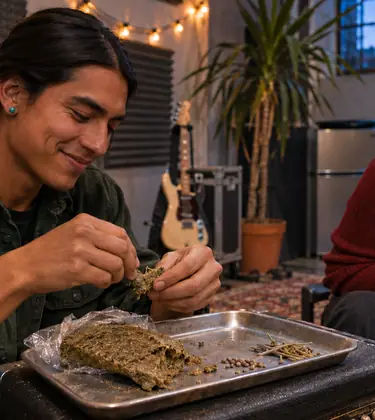
Ask someone who bought weed in the US before legalization about brick weed, and the description rarely changes: a flat, brownish slab that had to be pried apart, full of seeds and stems, smelling more of hay than of flowers. For decades, that pressed block from Mexico was simply what weed looked like in most of the country.
Legal markets have pushed it to the margins, though compressed weed has not disappeared. Where the bricks came from and why they were so weak says a lot about how far cannabis has come since.
Key takeaways
- Growers in Mexico pressed dried cannabis into blocks so more of it fit into a car, truck or boat.
- In 1978, an herbicide sprayed on Mexican fields turned up in 21% of marijuana samples tested in the Southwest.
- A 2014 NPR report put brick weed at 3% to 8% THC, against 10% to 20% for American-grown flower.
- Seeds, stems, a hay smell and a flattened, matted shape are the classic signs of a pressed bud.
Pressed flat for the border
Smokers of the 1970s and 1980s rarely needed to ask, “What is brick weed?” For most of them, it was the only weed around. It is cannabis flower dried and squeezed into a dense rectangular block, usually wrapped in plastic and tape. A pressed kilo takes up a fraction of the space of loose buds and gives off less smell, so more of it fit into a hidden car panel or a truckload of produce. The process behind most bricks ran roughly like this:
- Whole plants were cut in large outdoor fields and dried in the sun or in sheds.
- Buds were stripped from the branches in a hurry, with leaves, seeds and stem pieces left in.
- The dried material was packed into a wooden or metal mold.
- A hydraulic press or a car jack squeezed it into a solid block.
- The block was wrapped tightly in plastic and tape for the trip north.
The press did the flower no favors. Squeezing flattens buds into a matted sheet, knocks resin heads off the surface and traps any moisture left inside, so a block packed before it was fully dry could turn musty or moldy inside its wrapping.
From Mexican fields to American pockets
Mexican brick weed rode the boom of the 1960s and 1970s, when demand north of the border grew faster than any homegrown supply. Three turning points shaped its story.
Operation Intercept, 1969
In PBS Frontline's chronology of the drug war, Operation Intercept essentially closes the Mexican border in September 1969, as customs officers give every vehicle crossing from Mexico a three-minute inspection. The two-week operation wreaked economic havoc on both sides of the border, the chronology notes, yet it did not seriously cut the flow of marijuana into the US.
The paraquat scare
Later that decade, Mexico sprayed marijuana fields from the air with paraquat, an herbicide that damages the lungs. In March 1978, 13 of 61 marijuana samples from the southwestern US, or 21%, carried the chemical, and researchers traced it to an aerial spraying program in Mexico supported indirectly by US funds, a 1983 paper in the American Journal of Public Health reported. No clinical cases of paraquat poisoning turned up among smokers during the studies, but the scare gave American buyers one more reason to look for homegrown weed.
Legal weed undercuts the brick
Legalization finished what border inspections could not. In 2014, NPR reported that prices for marijuana from Mexico have fallen sharply as Americans bought more domestic weed, with one Mexican grower saying a kilo that fetched $60 to $90 two or three years earlier now brought $30 to $40. As one source in the story put it, Mexican weed was typically dried but not really cured.
Feeling lost on how to start? Try taking our quiz!
Start a QuizWeak by modern standards
Those bricks were weak by any modern measure. The same NPR report put the THC content of Mexican brickweed at 3% to 8%, against 10% to 20% for American-grown cannabis at the time.
Seizure data show the same climb over a longer span. A 2024 paper in Frontiers in Public Health, from a team that has tracked the potency of seized US cannabis for decades, notes that potency rose from ~4% in 1996 to ~14% in the year 2019, and the same team found most high-THC samples seized from 2013 to 2022 above 10% THC. The jump came from sinsemilla, seedless flower from unpollinated female plants, along with indoor growing and decades of selecting plants for resin, the same forces that explain why modern weed is so much stronger than the weed of the 1970s.
Seeds also cost a brick dearly. A pollinated plant pours its energy into seeds instead of resin, and every seed adds weight to the block without adding any THC.
Mexican cannabis was never weak by nature. The bricks were weak because of how the plants were grown, seeded and pressed, and the same country gave the world some of its most famous landraces. Acapulco Gold, our version of the famous sativa originating from Mexico, reaches 26% THC with citrus, coffee and pine notes and fat colas flecked with reddish-brown calyxes, and Skunk #1, which carries Acapulco Gold in its cross with Afghan and Colombian Gold, stacks dense, chunky buds at the same 26%. Grown from seed, kept seedless, dried slowly and cured, that Mexican heritage smells nothing like a brick.
The unexamined day is a wasted opportunity. Reflect on what you did, what you learned, and how you can improve.
John Dewey
Bricks, reggie and mids
Online, brick weed vs. reggie gets argued as if the two were rivals, but the words describe different things. Brick names a form, flower pressed into a block. Reggie, short for regular, names a grade, the cheap, seedy, middling weed most people smoked before dispensaries. Most brick weed was reggie, but plenty of reggie never saw a press. Mids sit one step up, decent flower without much character, and top shelf means the best a dispensary sells. The slang lines up roughly like this:
| What you compare | Brick weed | Reggie, short for regular | Mids, short for mid-grade | Top-shelf dispensary flower |
|---|---|---|---|---|
| What the word means | A form, flower pressed into a block | A grade, cheap and seedy | A grade, middle quality | A grade, the best on the menu |
| Typical look | Flat, matted and brownish | Loose, dull green and leafy | Green and lightly frosted | Dense, frosty and neatly trimmed |
| Seeds and stems | Common | Common | Occasional | Rare |
| Smell | Hay, dust or musty | Faint and grassy | Mild strain aroma | Strong and distinct |
| Where you see it today | Unlicensed sellers | Unlicensed sellers | Value shelves at dispensaries | Premium dispensary shelves |
| What you compare | What the word means | Typical look | Seeds and stems | Smell | Where you see it today |
|---|---|---|---|---|---|
| Brick weed | A form, flower pressed into a block | Flat, matted and brownish | Common | Hay, dust or musty | Unlicensed sellers |
| Reggie, short for regular | A grade, cheap and seedy | Loose, dull green and leafy | Common | Faint and grassy | Unlicensed sellers |
| Mids, short for mid-grade | A grade, middle quality | Green and lightly frosted | Occasional | Mild strain aroma | Value shelves at dispensaries |
| Top-shelf dispensary flower | A grade, the best on the menu | Dense, frosty and neatly trimmed | Rare | Strong and distinct | Premium dispensary shelves |
Spotting a compressed bud
Compressed weed still turns up, mostly from unlicensed sellers whose product nobody tests for mold or pesticides. It is easy to recognize once you know the signs:
- Flat, matted shape with leaves pressed into the buds
- Seeds and bits of stem in nearly every pinch
- Brownish or dull olive color
- Smell of hay, dust or ammonia instead of fruit or fuel
- Few visible trichomes on the surface
- Harsh smoke that fades into a short, mild high
A sour or musty smell, white fuzz or gray patches mean mold, and that weed goes straight in the trash. In our experience, a pressed bud that passes the smell test still smokes better after a day in a sealed container with a humidity pack, which lets the matted flower loosen up.
Drying and curing, the step bricks skipped
The hay smell of a brick comes mostly from a rushed finish. Fast drying in hot sun locks chlorophyll into the leaf, and pressing the flower straight after leaves no time for a cure, so the smoke tastes green and scratchy. In our grow rooms, branches hang for 10 to 14 days at around 60°F and 60% humidity, then the trimmed buds cure in sealed containers for at least two weeks, opened briefly each day at first to let moisture out. That slow finish keeps the terpenes that give each strain its smell, and no smuggling operation ever had time for it.
Old bricks, new buds
Brick weed was Mexican cannabis dried in bulk, pressed into blocks and wrapped for the trip north, and for decades it was the weed most Americans knew. Border crackdowns, an herbicide scare and finally legal homegrown competition pushed it aside, while potency climbed from single digits into the teens. If a pressed, seedy, hay-scented bud still lands in your hands, check it for mold before anything else, and remember that the same Mexican genetics, grown and cured properly, make some of the finest flower around.
Barney's Farm has been developing premium cannabis genetics since the 1980s, with over 40 Cannabis Cup wins. Explore our full seed catalog and find strains bred for every climate and skill level.