Can You Smoke Weed in a Hookah?
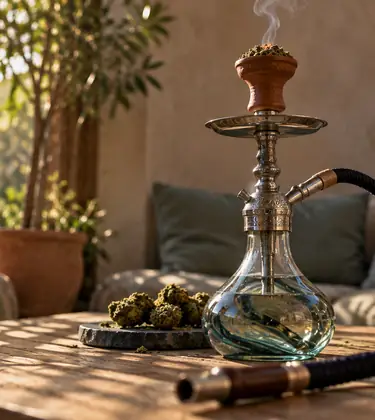
Can you put weed in a hookah? Yes, and people have packed water pipes with cannabis and hashish for centuries. The better question is how well it works, and here the hookah's design gets in the way. It was built to slow-cook wet, sweetened tobacco under hot coals for the better part of an hour, and the coal turns out to be the biggest problem.
Coals on top, water below
A hookah is an instrument for heating or vaporizing and then smoking tobacco, flavored tobacco or sometimes cannabis, hashish and opium, according to Wikipedia. It spread from the Indian subcontinent to Persia, where it took its current shape, and then to the Ottoman Empire. The names trace that route: hookah comes from the Hindustani huqqa, shisha from a Persian word for a glass container, and narghile from the Sanskrit word for coconut. From top to bottom, a hookah has four working parts:
- The bowl holds the shisha under a sheet of perforated foil or a metal screen.
- The coal, a glowing piece of charcoal, sits on top and heats the shisha from above.
- The stem carries the smoke down into the water base, where it bubbles up and out.
- The hose, often long, delivers the smoke to your mouth.
Classic shisha, called mu'assel, which means "honeyed" in Arabic, is tobacco mixed with molasses, vegetable glycerol and flavorings. It is meant to cook slowly. In a 2003 study of a Middle Eastern water pipe, the tobacco ran from 450°C (842°F) nearest the coal down to 50°C (122°F) farthest away, and the smoke particles came mostly from heating the paste, with little actual burning.
People already pack it with cannabis
Cannabis in a water pipe has deep roots. In Egypt, the gozah is the traditional water pipe, and a 1980 Egyptian study found that smoking was the most popular way to use cannabis, at 89.4 percent of those surveyed, with most smokers using the water pipe. In the United States, cannabis in a hookah is common enough that public health researchers track it. In a 2010 survey of 3,447 students at eight North Carolina universities, 44 percent had smoked tobacco from a hookah. Of those users, 90 percent reported smoking flavored tobacco in a hookah, 45 percent marijuana, 37 percent herbal shisha without tobacco and 18 percent hashish. The authors concluded that prevention work should recognize the range of substances young adults smoke through hookahs.
A hookah with weed in the bowl is still a hookah, though, and the same physics apply. The coal, the long session and the shared hose all come along.
How a cannabis hookah differs from a bong
A bong burns a small bowl with a direct flame and delivers one hit at a time through a short path. A cannabis hookah is built for the opposite: a big bowl, a slow heat source above it and a long hose for a session that lasts. That mismatch shapes every way of doing it.
Hookah weed setups fall into a few camps. Dry ground flower under a hot coal burns fast and hot, which wastes cannabis and makes harsh smoke. Some people mix ground flower into flavored tobacco shisha, a blend sometimes called weed shisha, but tobacco shisha brings nicotine along with the molasses. A tobacco-free herbal base avoids the nicotine. The simplest route skips the coal entirely: light a small bowl of flower with a lighter and use the hookah as an oversized bong, with the long hose in place of a short mouthpiece.
Whichever way you go, pack less than you think. A hookah bowl holds far more than one person needs.
Feeling lost on how to start? Try taking our quiz!
Start a QuizCharcoal does most of the damage
Whatever goes in the bowl, the coal comes along. In a 2008 study that compared charcoal heating with an electric heater, approximately 90 percent of the CO and most of the heavier PAH compounds, combustion chemicals linked to cancer, in waterpipe smoke came from the charcoal itself. Putting cannabis in the bowl changes the filling, while the coal keeps giving off what it always does. We found no study that measured cannabis under hookah coals.
Hookah sessions also mean a lot of smoke. In a 2009 lab study of 31 people, a waterpipe session of up to 45 minutes produced 48.6 liters of smoke, against 1.0 liter for one cigarette, and carbon monoxide in the blood peaked about three times higher, with similar nicotine. The World Health Organization's tobacco treaty team puts a typical one-hour session at about 200 puffs and 90,000 milliliters of smoke, against 500 to 600 milliliters for a cigarette. The water does not fix that, because the toxic chemicals, carcinogens and heavy metals in hookah smoke are not filtered out by it.
At the extreme, coals cause carbon monoxide poisoning. In a 2014 case report, a hookah bar employee who had been lighting coals arrived at the hospital unconscious, with a carboxyhemoglobin level of 33.8 percent, meaning about a third of the blood's hemoglobin was carrying carbon monoxide instead of oxygen, and recovered with hyperbaric oxygen. If you use coals:
- Light them outdoors or under a running range hood, never in a closed room or a car.
- Keep a window or door open for the whole session.
- Stop and get fresh air at once if anyone has a headache, dizziness or nausea or feels faint, and call for help if someone passes out.
- Consider skipping the coal and lighting a small bowl directly, which removes the charcoal's carbon monoxide altogether.
The unexamined day is a wasted opportunity. Reflect on what you did, what you learned, and how you can improve.
John Dewey
Herbal shisha still makes smoke
Tobacco-free herbal shisha removes the nicotine and little else. In a 2012 crossover study of 31 waterpipe smokers, tobacco-free products did not lower the yields of PAH, aldehydes, carbon monoxide, nitric oxide or tar. Smoke from both waterpipe preparations contained substantial quantities of toxicants, and the authors wrote that their findings contradict advertising that herbal waterpipe products are a healthy alternative to tobacco. The same logic applies to cannabis. The plant in the bowl changes the high, and the charcoal and the smoke stay.
Fruit-forward flower for a slower bowl
If what you like about a hookah is the flavor, let the flower carry it and leave the tobacco out. Two of ours lean toward the fruit flavors that made flavored shisha popular:
- Papaya Frosting crosses Papayamosa with Banana Frosting. Papaya leads the palate with mango and blueberry accents, and pepper and spice show up on the exhale, at 28 percent THC in 60 to 65 days of flowering.
- Super Boof crosses Black Cherry Punch with Tropicana Cookies, with an orange-led aroma, tropical fruit underneath and a grape note up front when you smoke it. It reaches 32 percent THC in 56 to 63 days, so a small bowl goes a long way.
Both are strong, so pass the hose slowly and let each round settle before the next.
Lounges, laws and a shared hose
Hookah lounges are licensed for tobacco, cannabis lounges are licensed for cannabis, and the rules keep them apart. California lets cities approve on-site consumption at licensed cannabis retailers, with conditions: the area must be limited to adults 21 and over and hidden from public view. Sale or consumption of alcohol or tobacco is not allowed on the premises, which rules out tobacco shisha at a cannabis lounge. Colorado's marijuana hospitality businesses may not allow tobacco smoking or alcohol either, and a regular hookah lounge holds no cannabis license, so lighting up there is off-limits. California law also bans smoking cannabis anywhere smoking tobacco is prohibited, and in public places outside licensed lounges.
Shared hoses carry their own risk. Wikipedia's hookah article notes infection risks when hookahs are shared or not properly cleaned, and as our look at bong water found, lab work on shisha water bowls turned up bacteria such as Pseudomonas aeruginosa. Use your own mouth tip, change the water after every session and wash the hose.
Possible, smoky and better without coal
You can put weed in a hookah, and plenty of people do, but the hookah was designed for wet tobacco under charcoal, and the charcoal brings most of the carbon monoxide. Herbal bases still make toxic smoke, the water filters out less than it seems, and shared hoses spread germs.
If you want the ritual, skip the coal, keep the bowl small and use your own mouth tip. Barney's Farm has been developing premium cannabis genetics since the 1980s, with over 40 Cannabis Cup wins. Explore our full seed catalog and find strains bred for every climate and skill level.