Glass Blunts: Reusable Blunts Without the Tobacco Wrap
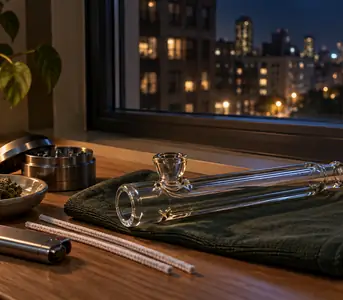
A blunt is a cigar that has been hollowed out and filled with cannabis, and even with the tobacco filling gone, the wrapper is still tobacco leaf. A glass blunt swaps that wrapper for a glass tube you can wash and use again, with a rod inside that pushes the burning flower forward as you smoke.
It is a smart piece of glass, and it does remove the tobacco. It does not remove the smoke.
Blunts carry tobacco in the wrapper
Blunts started in cities such as New York, Philadelphia and Baltimore and took their name from Phillies Blunt cigars, though any cheap cigar or cigarillo does the job. Smokers split the cigar, dump the tobacco filling and roll cannabis in the leaf that's left. In a 2014 national survey, 20.3 percent of American adults who currently used cannabis smoked blunts, and the habit has grown since. An analysis of federal drug-use survey data published in 2026 found that the share of US adults who smoked a blunt in the past month rose by about a third between 2015 and 2022.
The leaf brings nicotine with it. When researchers tested the wrappers of five cigars commonly used for blunts, every one contained nicotine. Total nicotine content in the cigar wrapper ranged from 1.2 to 6.0 mg per cigar, even with the tobacco filling removed, and the authors warned that blunt users may expose themselves to some degree of nicotine, the addictive part of tobacco.
Blunts also tend to be bigger. People in a 2011 study reported putting 50 percent more marijuana in a blunt than in a joint, and more than twice as much as in a pipe.
A glass tube with a plunger
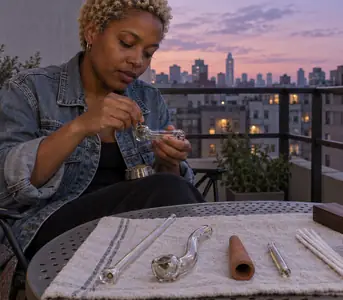
A glass blunt keeps the shape and drops the leaf. The common design is a thick tube of borosilicate, the heat-resistant glass of lab beakers, about the size of a blunt, with a mouthpiece at one end and a rod inside that ends in a snug seal. You pack ground flower into the front of the tube, light it, and push the rod forward as it burns. That feeds fresh flower to the flame and pushes the ash out of the end. When the rod reaches the front, the session is over. Borosilicate suits the job because it is more resistant to cracking from big changes in temperature than ordinary glass, and a glass blunt goes from flame-hot to room temperature every session.
Some versions use a screw instead of a push rod. A 2018 US patent titled "Smoking device" describes a smoking device comprising a glass housing with an auger inside, a spiral screw that turns with the mouthpiece and moves the smoking material toward the lit end.
The appeal of a reusable blunt is simple. You buy no wraps, you roll nothing, and you throw away nothing but ash.
How to use a glass blunt
This glass blunt how-to uses the push-rod design described above:
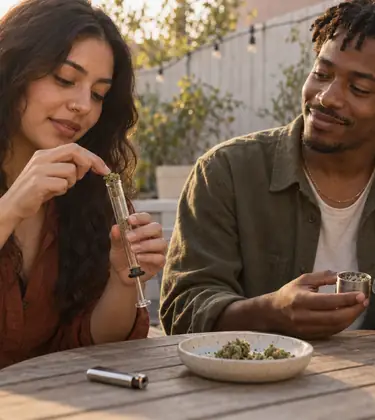
- Pull the rod all the way back and pack ground flower into the open front end, firm enough to stay put but loose enough to draw air.
- Slide the rod forward until the flower sits flush with the end of the tube.
- Light the flower while drawing gently, turning the tube so the edge catches evenly.
- Nudge the rod forward whenever ash builds up, and tap the ash off into a tray.
- Let the glass cool before you touch the front, which gets hot.
Small loads work best. A joint holds about a third of a gram on average, according to a 2016 estimate, and there is no reason to pack a glass blunt with more than that.
Feeling lost on how to start? Try taking our quiz!
Start a QuizGlass blunt vs. joint
The glass blunt vs. joint comparison comes down to what wraps the flower:
- Wrapper. A joint burns paper along with the flower. A glass blunt burns only the flower, and the glass stays behind.
- Paper quality. Paper is not always neutral. A 2024 study of 53 commercial rolling papers, reported by Forbes, found that around a quarter exceeded the recommended copper levels for inhaled medicines, with copper in some colored papers and chromium in gold-colored tips.
- Tobacco. Joints and glass blunts both skip the leaf, and the leaf makes a difference. In a 2009 lab study with 24 participants, joints delivered more THC, while
- Convenience. A joint needs papers and rolling skills. A glass blunt needs a cleaning routine.
A glass joint is the simpler cousin: a short glass tube with a chamber for flower at one end and a cooling passage leading to the mouthpiece, with no plunger at all. A 2015 patent titled "Glass cigarette" describes exactly that, in borosilicate glass about 4 inches long.
The unexamined day is a wasted opportunity. Reflect on what you did, what you learned, and how you can improve.
John Dewey
Dense, earthy flower for a slow session
A glass blunt burns flower and nothing else, so the flower's flavor is all you taste. We would pick strains with rich, earthy smoke:
- Bubba Kush crosses an Afghan Kush landrace with OG Kush. Its page compares the fragrance to Turkish delight chocolate bars and lists a dank, earthy, mocha and sweet hashish taste, at 29 percent THC in 56 to 63 days of flowering.
- Ayahuasca Purple crosses Red River Delta with Master Kush and smells earthy and pungent with a sweet undertone. Its dense, resin-coated buds give a flavorful smoke that lingers on the palate, at 24 percent THC in 55 to 65 days.
Leaving out the leaf matters
Dropping the tobacco wrapper is the real health argument for a glass blunt. Blunt smokers absorb nicotine whether they think of themselves as tobacco users or not. A 2026 study of young men aged 18 to 30 who smoked blunts but reported no other tobacco use found that more than half of those who gave saliva samples had cotinine, a breakdown product of nicotine, above 10 nanograms per milliliter in at least one sample. The researchers put it this way: participants had considerable nicotine exposure exceeding that which is typical of secondhand smoke, despite not reporting other tobacco use.
People who keep tobacco out of their cannabis are also more likely to want to cut down on tobacco. In the 2014 Global Drug Survey of 33,687 people who smoked cannabis, tobacco-based routes were the norm in Europe and uncommon in the Americas, and people who used tobacco-free routes had 80.6 percent higher odds of wanting help to use less tobacco.
Nicotine also seems to tangle with cannabis dependence. In a 2015 study of 298 young cannabis and tobacco users in the United Kingdom, cigarette smoking was linked to cannabis dependence regardless of how often people used cannabis, and it explained 29 percent of the variation in dependence between users.
Tobacco-free wraps are the other option, made from hemp, banana leaf, palm leaf and other fibers. We found no independent lab testing that confirms every brand is free of nicotine, so a glass tube is the surer bet.
Smoke is still smoke
A glass blunt changes the wrapper. The fire stays the same. Burning cannabis still produces carbon monoxide, tar and fine particles. When researchers measured mainstream smoke in 2020, marijuana smoke particles were on average 29 percent larger than tobacco smoke particles and carried 3.4 times more mass, and 110 of the compounds they detected are known to harm health. A 2024 review in the journal Respiratory Medicine concluded that unequivocal evidence established that cannabis smoking is harmful to the respiratory system, from coughing and wheezing to the symptoms of chronic bronchitis.
The glass gets hot, too. The front of the tube sits right behind the burning flower, so hold it by the mouthpiece end and give it a few minutes before it goes back in a case. Clean it the way you would any glass pipe: soak it in isopropyl alcohol with a little coarse salt, run a pipe cleaner through the tube, wipe the rod and its seal, and rinse everything with warm water.
Same flower, no leaf
A glass blunt is a reusable blunt, a glass tube with a rod or screw that feeds burning flower forward, so you get a blunt-style session without the tobacco wrap. That wrap is the part worth losing, because cigar wrappers carry nicotine even when the filling is gone. Next to a joint, a glass blunt also skips the paper. Next to either one, it still burns the flower, with all the smoke that comes with it.
Pack it light, keep it clean, and let the flower carry the flavor. Barney's Farm has been developing premium cannabis genetics since the 1980s, with over 40 Cannabis Cup wins. Explore our full seed catalog and find strains bred for every climate and skill level.