Cold Cure Rosin: Why Waiting Turns Oil into Badder
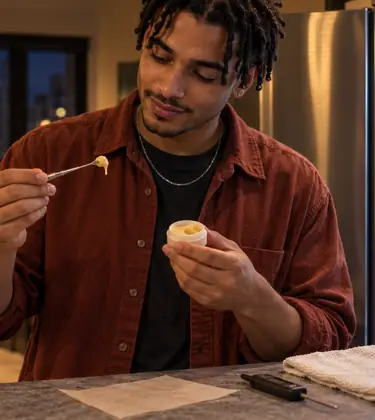
Fresh rosin comes off the press glossy and sticky, a golden sap that clings to everything it touches. Leave it in the fridge for a week or two and it turns opaque and creamy, as easy to scoop as frosting.
That change is the cold cure, a resting step hash makers use to turn oil into badder. The chemistry is simple, and it starts with what rosin is.
Key takeaways
- Rosin is cannabis oil pressed out with heat and pressure, and live rosin starts with plants frozen fresh at harvest.
- Curing rosin sealed in the fridge for one to two weeks turns glossy sap into creamy, opaque badder.
- The texture changes because THCA slowly crystallizes out of a crowded mix of cannabinoids and terpenes.
- Cold cure and live are not rivals, since one names a step after pressing and the other the starting material.
- California's cannabis rules list water as a nonvolatile solvent, even though ice water rosin is sold as solventless.
- Licensed rosin in California and Colorado is tested for microbes, including pathogenic Aspergillus mold.
Rosin, live rosin and the cure
Rosin is one of the simplest concentrates to make. Wikipedia's hashish entry credits Phil Salazar with discovering the method in 2015, and rosin is made by pressing flower, dry sift or ice water hash between sheets of parchment paper. It belongs to the family the encyclopedia calls hash oil, an extracted cannabis product made with minimal or no residual solvent. The same entry describes hash rosin as the cleanest form of concentrating cannabis for dabbing, made with ice, water, heat, pressure and collection tools instead of solvents like butane.
Live rosin adds one condition. The plants are frozen fresh at harvest instead of dried and cured, then washed into ice water hash and pressed. In our experience, that keeps more of the bright terpenes that drying flattens.
So what is cold cure rosin? It is any rosin, live or not, that rests sealed in a cold place after pressing until it turns from glossy sap into creamy badder.
Two labels that answer different questions
The question of cold cure rosin vs live rosin comes up often, but the two names describe different things. Live tells you what went into the press, and cold cure tells you what happened after it. In our experience, the two terms break down this way:
| Question | Cold cure rosin | Live rosin |
|---|---|---|
| What the name describes | A resting step after pressing | The fresh-frozen starting material |
| Starting material | Any rosin, from dried or fresh-frozen plants | Hash or flower frozen fresh at harvest |
| When it happens | Days to weeks after the press | At harvest, before the press |
| Usual texture | Creamy, opaque badder | Sap, badder or jam, depending on the cure |
| Can they combine? | Yes, live rosin is often cold cured | Yes, sold as cold cure live rosin |
| Question | What the name describes | Starting material | When it happens | Usual texture | Can they combine? |
|---|---|---|---|---|---|
| Cold cure rosin | A resting step after pressing | Any rosin, from dried or fresh-frozen plants | Days to weeks after the press | Creamy, opaque badder | Yes, live rosin is often cold cured |
| Live rosin | The fresh-frozen starting material | Hash or flower frozen fresh at harvest | At harvest, before the press | Sap, badder or jam, depending on the cure | Yes, sold as cold cure live rosin |
The law has its own vocabulary. California's cannabis rules define extraction as separating cannabinoids from plant material through chemical or physical means, and they count water as a nonvolatile solvent, along with carbon dioxide and ethanol. Volatile solvents, the kind that make explosive mixtures, include butane, hexane and propane. So in California's terms, ice water hash rosin uses a solvent, just not a dangerous one.
Feeling lost on how to start? Try taking our quiz!
Start a QuizCrystals, cold and the turn to badder
Fresh rosin is a crowded mixture. THCA, the raw acid form of THC, sits dissolved in terpenes and other plant oils at a level the mix cannot hold forever. In chemistry terms, it behaves like a supersaturated solution, and a supersaturated solution is in a metastable state that can return to balance when the excess solute separates out. Cooling usually lowers how much a liquid can keep dissolved, which pushes the extra out as crystals.
In our experience, those crystals stay tiny in rosin and spread through the whole batch, which is why a cold cure turns clear sap into an opaque paste instead of a few hard chunks. The cold also slows the loss of light terpenes while the change happens. Good cold cure badder scoops like soft butter and keeps its shape on a dab tool. Pushed much further, the same crystallization makes THC diamonds, large crystals of THCA that grow as the dissolved compound comes out of solution.
None of this makes the rosin stronger. THCA is the form found in fresh, undried cannabis, and it turns into THC slowly as the plant dries and fast under intense heat, such as smoking or cooking, Wikipedia's THCA entry notes. That conversion happens on a hot banger, not in the fridge.
The unexamined day is a wasted opportunity. Reflect on what you did, what you learned, and how you can improve.
John Dewey
Starting material for good badder
Better material makes better badder. Our washing collection is built for hash makers, and its page notes that a good washing return is 4% or more by weight, with top performers pushing toward 7%. Two of its strains suit a cold cure well:
- Frozen Bananas F1, a Cookies & Cream and Banana Punch cross at 25% THC, is a strong candidate for bubble hash, rosin and dry sift work, its page says.
- MAC 1 F1, an Alien Cookies and Miracle 15 cross at 27% THC, shows spectacular trichome coverage and makes exceptional hash, according to its page.
In our experience, clean, resinous material presses into rosin that cures evenly, while damp or moldy buds should never go near a wash or a press.
A cold cure, step by step
Learning how to cold cure rosin takes more patience than skill. In our experience, this routine works:
- Press at a low temperature and collect the rosin into a clean glass or silicone container while it is still warm.
- Seal the container and let it cool on the counter for about an hour, so no condensation forms inside.
- Put it in the fridge at about 40°F (4°C) and leave it alone for one to two weeks.
- Check it every few days, opening it as little as possible, and stop once the rosin looks opaque and creamy all the way through.
- Whip it with a dab tool if the texture is uneven, then keep it sealed and cold.
Temperature sets the result. In our experience, the three common approaches differ like this:
| Curing approach | Where the rosin rests | How long | What you get |
|---|---|---|---|
| Fresh press | Not rested, used right away | None | Glossy, sticky sap |
| Cold cure | Sealed in the fridge at about 40°F (4°C) | One to two weeks | Creamy, opaque badder |
| Warm cure | Sealed at warm room temperature or a little above | A few days or more | Jam, with crystals in a terpene-rich sauce |
| Curing approach | Fresh press | Cold cure | Warm cure |
|---|---|---|---|
| Where the rosin rests | Not rested, used right away | Sealed in the fridge at about 40°F (4°C) | Sealed at warm room temperature or a little above |
| How long | None | One to two weeks | A few days or more |
| What you get | Glossy, sticky sap | Creamy, opaque badder | Jam, with crystals in a terpene-rich sauce |
Badder made this way is easy to handle. In our experience, a small scoop loads cleanly onto a dab tool, and a low-temperature dab shows off the terpenes the cold cure protected.
A heat press also matters for the law in states like California. The state says no one may manufacture concentrated cannabis using a volatile solvent without a license, and it defines a volatile solvent as one that is or produces a flammable gas or vapor. A heat press uses no solvent, so that ban does not reach it.
Testing, mold and storage
Licensed rosin goes through the same lab checks as other concentrates, and mold gets special attention. California's regulations require testing for four pathogenic species of Aspergillus, A. niger, A. flavus, A. fumigatus and A. terreus, in flower and inhalable products, scientists at the state's cannabis testing lab wrote in 2022. Colorado requires microbial testing for heat- and pressure-based concentrates, rosin among them, and its Aspergillus testing rule took effect on July 1, 2022.
In our experience, the risk starts with the plants. Fresh-frozen material has to go into the freezer quickly and stay frozen, and any bud with visible mold belongs in the trash, not the wash.
Once cured, badder keeps best sealed, cold and dark. In our experience, a fridge holds its texture and flavor for weeks to months, while a warm room slowly turns it back toward sap or jam.
Cold cure rosin, worth the wait
Cold cure rosin is fresh rosin given time and cold. Sealed in the fridge for one to two weeks, its THCA slowly crystallizes and the glossy sap turns into creamy badder, whether it started as live rosin or not. Press from clean, resinous material, keep the container sealed and cold, and buy licensed rosin that has passed mold testing.
Barney's Farm has been developing premium cannabis genetics since the 1980s, with over 40 Cannabis Cup wins. Explore our full seed catalog and find strains bred for every climate and skill level.