Who Lobbies for Weed? Inside Cannabis Trade Associations
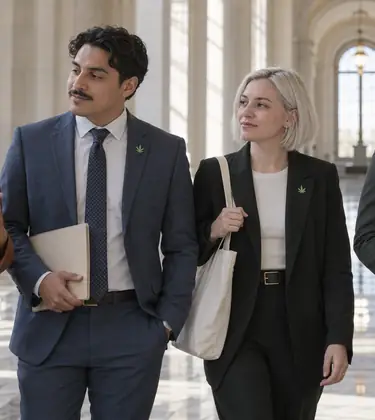
Cannabis lobbying sounds like one thing. It is at least four: consumer advocates who have been at it since 1970, policy shops that write ballot measures, trade associations that speak for licensed businesses, and a hemp industry that sometimes wants the opposite of everyone else. Then there is the side lobbying against all of them.
They agree on a lot and fight about more than you would expect. The money is also smaller than most people assume, and it has been moving from the associations to the biggest companies.
NORML started as a consumer group and still is one
The oldest name in the business began with a lawyer and a magazine. In 1970, attorney Keith Stroup founded NORML as the National Organization for the Repeal of Marijuana Laws, and the organization received $5,000 in early funding from the Playboy Foundation. "Repeal" later became "Reform," but the job stayed the same: speak for the people who use cannabis.
NORML is still built around those people. It has a grassroots network of 135 chapters and more than 550 lawyers, and its own site explains that because NORML lobbies state and federal legislators, donations to it are not tax deductible.
For a seed company, the consumer issue that matters most is home cultivation, the right to grow your own. Many adult-use states allow it, typically around six plants per adult, and we keep a state-by-state guide to home grow limits. Inside those limits a compact autoflower does a lot of work. White Widow XXL Auto goes from seed to harvest in 70 to 75 days at 80 to 100 centimeters, it is extra compact, and it suits growers at every level of experience.
MPP runs the campaigns
Put NORML vs. the Marijuana Policy Project side by side and you get two different jobs. MPP was founded by NORML alumni: Rob Kampia, Michael Kirshner and Chuck Thomas had all worked at NORML before they incorporated MPP in Washington, D.C., on January 25, 1995. Today MPP is the largest organization working solely on marijuana policy reform in the United States by budget, members and staff, and much of its money, including for its ballot initiatives, came from the late billionaire Peter B. Lewis and then his family. The split between them looks like this:
- NORML is the consumer voice, with local chapters, lawyers and lobbying on behalf of people who use cannabis.
- MPP is the campaign shop, working on state ballot initiatives and legislative campaigns.
- Both run a second, tax-deductible organization for education, because federal tax law bars charities from making lobbying a substantial part of what they do.
Trade associations speak for licensed businesses
The industry side arrived later. The National Cannabis Industry Association, founded in late 2010, calls itself the voice of Main Street cannabis, and a cannabis trade association like it lobbies Congress on the issues that decide whether a licensed business survives: banking access and tax. The tax problem is a rule called 280E, which stops sellers of Schedule I and II drugs from deducting normal business costs.
The US Cannabis Council is newer still, and the line between advocacy and industry runs right through it. In 2021 MPP said it would remain a member and keep sharing staff, board members and resources with the council. When President Trump signed an executive order in December 2025 to reschedule cannabis, the vice president of industry trade and lobbying organization U.S. Cannabis Council, David Culver, told Forbes it was "the most significant cannabis reform in modern history" and set the industry "on the clear path to federal legalization." The same report put the effective tax rate that 280E imposes on marijuana companies at about 60 percent of gross revenue.
The biggest companies also lobby on their own. Forbes reported that Kim Rivers, the CEO of Trulieve, "has been an integral part of lobbying President Trump to reschedule cannabis," and was among the executives in the Oval Office before the order.
The April 2026 order that followed moved only state-licensed medical marijuana to Schedule III, and the reactions showed who stood where. Michael Bronstein, president of the American Trade Association for Cannabis and Hemp, called it "the most significant federal advancement in cannabis policy in over 50 years," the Associated Press reported, while Kevin Sabet of Smart Approaches to Marijuana, the opposition group he co-founded in 2013 with former Rep. Patrick Kennedy, attacked it for "giving a tax break to Big Weed."
Feeling lost on how to start? Try taking our quiz!
Start a QuizLobbying money is smaller than you think
Federal lobbying is public, because the Lobbying Disclosure Act makes lobbyists file quarterly reports. Under that law, a lobbyist is someone paid for work that includes more than one lobbying contact, unless lobbying takes up less than 20 percent of their time for that client over three months. The totals they report are modest. OpenSecrets found that the industry reported spending a record $2.7 million on lobbying in 2018, with NCIA at an all-time high of $560,000. By 2025 the money had moved. Federal lobbying filings for that year show:
- Trulieve, a single multistate operator: $762,500 in its own filings.
- Smart Approaches to Marijuana and its advocacy arm, SAM Action, the main opposition: $410,000.
- The US Hemp Roundtable: $390,000 paid to outside firms.
- The US Cannabis Council: $180,000 reported by its lobbying firm.
- NCIA: $100,000.
- NORML: $40,000.
One company outspent NCIA, NORML and the US Cannabis Council's lobbying firm combined, and so did the leading opposition group. Total cannabis lobbying spend is modest on any scale: the same OpenSecrets report noted that the American Bankers Association spent more than $2.4 million in the first quarter of 2019 alone, close to the whole cannabis industry's record year.
The unexamined day is a wasted opportunity. Reflect on what you did, what you learned, and how you can improve.
John Dewey
The hemp fight split the coalition
The clearest recent test of who lobbies for what came in November 2025, when Congress rewrote the federal definition of hemp and banned most intoxicating hemp THC products. The Associated Press reported that the $24 billion hemp industry was scrambling to save itself, that some in the legal marijuana industry celebrated because the ban would end what they consider unfair competition, and that Rand Paul's amendment to strip the hemp language failed 76 to 24. The same law also excludes viable seeds of high-THC plants from the hemp definition, which is the part a seed company watches most closely.
The fight is not over. A stopgap funding bill signed in September 2026 pushed the ban back to December 11, and the Senate set the stage for the delay on August 8 by voting 61 to 32 to table an amendment from Republican Sen. Ted Budd that would have kept the original November 12 start date.
The industry did not speak with one voice. NCIA's policy page says hemp- and marijuana-derived intoxicating products should be tested, labeled and sold only to adults, and states plainly: "We oppose federal or state prohibition on these products." Smart Approaches to Marijuana took the other side. Its advocacy arm's lobbying report for late 2025 lists "advocating for a prohibition on hemp-derived intoxicants," alongside opposing the SAFE Banking Act and blocking marijuana rescheduling.
Seed companies watch three fights
From our side of the counter, three of these fights reach our customers directly:
- Home grow rights and plant limits, because they decide how many plants a legal grower can keep.
- The hemp definition, because the seed rule starts on December 11, 2026, unless Congress moves it again.
- Rescheduling, because the April 2026 order moved only state-licensed medical marijuana to Schedule III. Adult-use cannabis stays in Schedule I, and a DEA hearing on broader rescheduling was scheduled for June.
Plant limits shape what people plant. When a grower can keep only a handful, a short, productive photoperiod earns its place. Blue Cheese is an easy-to-grow strain that builds a short, stocky plant with strong side branches and heavy colas in 60 to 65 days of flowering, at 80 to 110 centimeters, which makes it a natural fit for a small legal grow.
Follow the filings, not the slogans
Cannabis lobbying is a crowded room. NORML still speaks for consumers, MPP runs the campaigns, NCIA and the US Cannabis Council speak for licensed businesses, the hemp industry fights its own war, and the opposition outspends most of them. The filings show that the biggest checks now come from single companies, not associations.
For growers, the useful part is knowing which fight touches you: home grow limits, the hemp and seed rules, and how far rescheduling goes. Barney's Farm has been developing premium cannabis genetics since the 1980s, with over 40 Cannabis Cup wins. Explore our full seed catalog and find strains bred for every climate and skill level.