Weed and Sleep Apnea: Does THC Help or Hurt Breathing at Night?
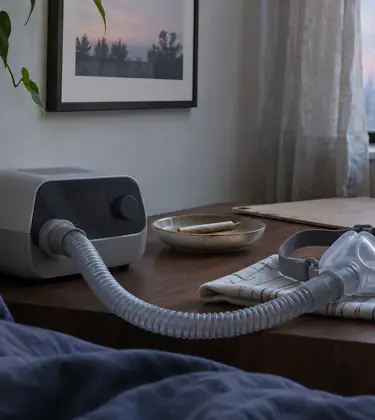
You had a gummy, fell asleep halfway through the movie and woke up convinced you had a great night. Across the bed, your partner heard the snoring cut out, waited through the silence and heard you gasp. You can both have the story right.
That missing stretch of the night matters when you talk about weed and sleep apnea. THC can make it easier to drift off while your airway still closes repeatedly. Sleep specialists advise against using cannabis to treat obstructive sleep apnea.
Key takeaways
- Falling asleep quickly gives you little information about how often your airway closes overnight.
- A small trial of prescription dronabinol reduced breathing interruptions on average but showed no improvement in overnight oxygen measures.
- The American Academy of Sleep Medicine advises against treating obstructive sleep apnea with cannabis.
- Frequent gasping, witnessed pauses or daytime sleepiness are good reasons to ask about a sleep study.
What happens during a breathing pause?
With obstructive sleep apnea, the muscles and soft tissues around the back of your throat relax enough during sleep to narrow or close the airway. Your chest may still be working to draw air in. Oxygen can fall, and the brain may briefly rouse you just enough to reopen the airway. You can go through that sequence many times without remembering an awakening. A bed partner may be the first person who notices anything unusual.
Say you wind down with Watermelon Z, a cultivar with a sweet watermelon aroma. You might remember the flavor and the moment you turned out the light. Your partner is more likely to remember the long silence between snores. Snoring is the sound of tissue vibrating as air passes, and its volume tells you little about how much oxygen reaches your blood.
How sleep clinicians count interruptions
A sleep study can record airflow, breathing effort and blood oxygen. An in-lab study can also tell when you are actually asleep. One result is the apnea-hypopnea index, or AHI, the average number of pauses and partial reductions in breathing per hour of sleep. A person with an AHI of 20 averaged about one event every three minutes. Events can cluster, so that average tells only part of the story.
| Measure | What it tells you | What it can miss |
|---|---|---|
| AHI | How often breathing is interrupted | How long oxygen stays low |
| Overnight oxygen recording | How deep and prolonged oxygen drops are | Why the drops occurred |
| Daytime sleepiness questionnaire | How likely you feel you are to doze in everyday situations | Airflow and oxygen during sleep |
| Measure | AHI | Overnight oxygen recording | Daytime sleepiness questionnaire |
|---|---|---|---|
| What it tells you | How often breathing is interrupted | How deep and prolonged oxygen drops are | How likely you feel you are to doze in everyday situations |
| What it can miss | How long oxygen stays low | Why the drops occurred | Airflow and oxygen during sleep |
If you are wondering how THC affects breathing during sleep, look at what a study actually measured. Fewer breathing pauses, steadier oxygen and feeling sharper on the early shift are three different results. A trial can show improvement in the first while the other two barely move.
What the dronabinol trial actually found
Dronabinol is a prescription form of delta-9 THC. A trial of dronabinol for sleep apnea, called PACE, enrolled 73 adults with moderate or severe OSA. Participants took one of two measured doses or a placebo for up to six weeks. Neither the participants nor the investigators knew who got which pills. The team compared the groups’ sleep recordings and tested how alert people felt and how well they could stay awake.
Compared with placebo, the lower-dose group averaged about 11 fewer breathing events per hour and the higher-dose group about 13 fewer. Participants on the higher dose also reported feeling less sleepy. Yet overnight oxygen measurements showed no improvement, and an objective daytime test of the ability to stay awake showed no clear change. Those last two results matter if you are hoping for steadier oxygen at night or safer mornings behind the wheel.
The trial did not compare dronabinol with a CPAP machine. It also did not test whether taking THC for years prevents heart problems or reduces traffic crashes. An average reduction of 13 events an hour does not tell an individual whether their apnea resolved. A person starting at 40 events an hour could improve by that amount and still have substantial sleep apnea.
Why promising early results have not changed the advice
A review of nine studies included five full-text studies and four published abstracts. Seven examined dronabinol experimentally, and two observed people using cannabis. Some reports were available only as conference abstracts. The median treatment period was three weeks, a short window for a condition people often manage for decades. Side effects and gaps in long-term follow-up limited what the review could conclude.
The pill in PACE contained a measured amount of a single drug. With a homemade brownie, you may have no idea how much THC ended up in your corner of the pan. Even a precisely labeled gummy gives you no way to predict your overnight oxygen levels. The American Academy of Sleep Medicine advises against cannabis for apnea until there is sufficient scientific evidence of safety and efficacy.
Feeling lost on how to start? Try taking our quiz!
Start a QuizDoes smoking weed make sleep apnea worse?
There is no reliable figure for how much smoking a joint will raise or lower a particular person’s AHI. Research on cannabis for sleep apnea gives us far more information about a measured prescription capsule than about flower. Products vary, people inhale different amounts, and the effects of an edible can carry over into a different part of the night. Switching delivery routes does not give you a tested apnea treatment.
The question many people mean to ask is whether they can safely drive the next morning. Untreated apnea can already leave you struggling to keep your eyes open. Drowsiness is also a possible effect of THC. If you feel impaired or catch yourself nodding off, skip the drive and arrange another way home. Tell the clinician about near misses or falling asleep at a light. Those details matter even if your main complaint is snoring.
Can an indica strain keep your airway open?
Open a jar of Sour Diesel and its sharp fuel aroma gives the cultivar away. An indica or sativa label tells you even less about overnight breathing than a sleep diary does. The dronabinol trial tested a measured dose of THC in a capsule. It gives us no way to predict how often your airway will close after smoking flower.
If you lie awake listening to traffic for an hour before the snoring starts, how cannabis affects sleep may be on your mind for two reasons. Tell the clinic how long it takes to drift off and what your partner hears afterward. Insomnia and apnea can share the same bed, and each may need attention.
The unexamined day is a wasted opportunity. Reflect on what you did, what you learned, and how you can improve.
John Dewey
What helps when your partner hears you gasp?
If you suspect sleep apnea and use marijuana, mention when you last used it along with what happened that night. Write down who noticed the pauses, how often you wake with a dry mouth or headache, and whether you have been dozing on the train or at your desk. A partner’s observations can help even if you live apart and only spend the occasional weekend together.
| What’s happening | A useful next step |
|---|---|
| Someone notices repeated pauses or gasping | Ask a clinician whether a home or laboratory sleep study is appropriate. |
| Your mask leaks or comes off in your sleep | Bring the mask and machine data to your sleep clinic for a fit and settings review. |
| You still struggle to stay awake despite using CPAP | Report how often you use it, your sleep schedule and any sedating substances. |
| What’s happening | Someone notices repeated pauses or gasping | Your mask leaks or comes off in your sleep | You still struggle to stay awake despite using CPAP |
|---|---|---|---|
| A useful next step | Ask a clinician whether a home or laboratory sleep study is appropriate. | Bring the mask and machine data to your sleep clinic for a fit and settings review. | Report how often you use it, your sleep schedule and any sedating substances. |
If the mask is the reason you are looking for another option
- Pin down the part that wakes you. Air blowing toward your eyes, a dry nose and a sense of pressure are different problems. Tell the clinic which one happens and when.
- Ask to try the mask while lying in your usual sleeping position. A seal that works sitting upright may shift when your cheek meets the pillow.
- Discuss alternatives if adjustments fall short. A clinician can assess whether a fitted oral appliance or another treatment makes sense for your anatomy and apnea severity.
Positive airway pressure delivers air through a mask to hold the upper airway open during sleep. A fitted oral appliance can move the lower jaw forward in selected patients. The National Heart, Lung, and Blood Institute explains how a positive airway pressure or oral device can keep the airway open during sleep. Keep using prescribed therapy while arranging a review. Feeling sleepy enough to leave the mask on the nightstand does not tell you how your airway will behave.
What to take away from a quieter night
Take your partner’s account seriously, even after a night you would rate ten out of ten. If you use CPAP, bring the machine data and describe any gasping or daytime drowsiness that has crept back. If you have never been tested, the detail worth leading with is that someone heard you stop breathing in your sleep.
Barney's Farm has been developing premium cannabis genetics since the 1980s, with over 40 Cannabis Cup wins. Explore our full seed catalog and find strains bred for every climate and skill level.