
Cannabis and Rastafari: The Religion That Made Ganja Sacred
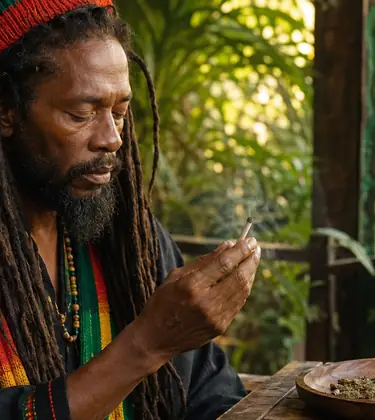
Walk into almost any dispensary in America and you will spot it somewhere on the wall. Red, gold, and green. A lion. Maybe Bob Marley on a rolling tray. Rastafari imagery is stitched so deep into cannabis culture that most people never stop to ask where it came from or what it actually means.
Behind the flags and the reggae playlists sits a real religion with real beliefs, born in 1930s Jamaica, that treats the cannabis plant as a sacred herb. For Rastafari, lighting up sits closer to prayer than to a party. Here is how ganja became holy, and why that history still shapes the way millions of people think about weed today.
Why do Rastafarians smoke weed?
For Rastafari, cannabis is a sacrament. They call it ganja, the holy herb, or simply the herb, and they use it to clear the mind, open the spirit, and draw closer to Jah, their name for God.
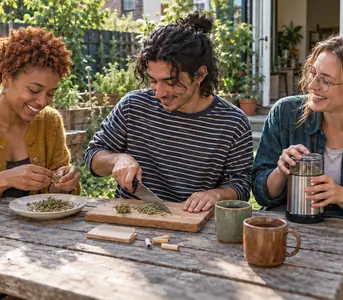
This is worship. Many Rastas reach for the herb during reasoning sessions, where people gather to smoke, talk, and work through questions of scripture, history, and daily life. The smoke rising upward reads as a kind of offering, a prayer lifting toward the divine. Elders and younger members sit together, pass the herb, and let the conversation run deep.
It ties into a wider idea called livity, the Rasta principle of living in harmony with nature. Cannabis grows from the earth with no factory in between, which fits a worldview that prizes the natural over the processed. Plenty of devout Rastas avoid alcohol, tobacco, and hard chemical drugs entirely while embracing the herb, because they see it as clean, God-given, and alive. The line they draw is between what nature makes and what people manufacture.
There is a meaning layered underneath all of it. Rastafari language talks about Babylon, the name for systems of oppression and the corrupt institutions that kept their people down. For decades, the laws used to criminalize ganja were part of that same machinery, so smoking the herb in the open became a quiet act of defiance. Lighting up was faith and resistance folded into one gesture, a way of holding onto African identity and spirituality in a world that punished both.
Where ganja in Jamaica actually came from
The plant reached Jamaica before Rastafari ever existed. In the 19th century, indentured workers from India arrived on the island and brought cannabis with them, where it spread as a folk medicine and settled into rural life.
The word ganja itself traces back to Sanskrit, carried across the ocean through that same Indian connection. So by the time the Rastafari movement emerged in the 1930s, the herb was already woven into Jamaican culture, waiting for a new spiritual meaning to grow around it.
That meaning arrived with the movement. Rastafari took shape among poor Afro-Jamaican communities, inspired partly by Marcus Garvey and his message of Black pride and a return to Africa. When Ras Tafari Makonnen was crowned Emperor Haile Selassie I of Ethiopia, followers read it as prophecy fulfilled, and a faith was born around him.
What ganja means: the holy herb and the Tree of Life
Rastafari ground their use of cannabis in the Bible. They point to passages about green herbs given for the service of humankind, and many treat the plant as the Tree of Life named in scripture. Smoking it becomes an act of communion, their version of taking the cup. The herb is read as a teacher, a healer, and a key that opens the mind to truth. Prayers often come before the herb is lit, so the act starts as worship and stays that way through the last of the smoke.
This is where Barney's Farm feels a real kinship with the culture. We have spent close to four decades treating cannabis as something worth respecting rather than rushing. The Rastafari view of the plant as sacred, natural, and alive runs close to how any serious breeder comes to see it after years in the garden. You stop thinking of it as a product and start thinking of it as a living thing with a lineage worth protecting. That shift in attitude is the whole reason landrace genetics survived long enough for the rest of us to enjoy them.
Feeling lost on how to start? Try taking our quiz!
Start a QuizChalices, spliffs, and the art of reasoning
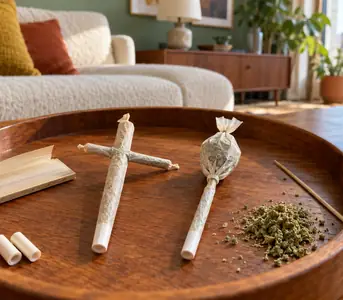
Rastas consume the herb a few traditional ways. The spliff, a hand-rolled cannabis cigarette, is the everyday method. For ceremony, many reach for the chalice, a water pipe often built from natural materials like coconut, bamboo, and clay that cools and filters the smoke before it reaches the lungs.
These tools matter more than they might look. The steam chalice in particular works at lower temperatures, closer to vaporizing than burning, which keeps the ritual gentle and the herb's flavor and character intact. There is a quiet craft to it that any modern cannabis lover would recognize the moment they saw it.
The setting carries weight too. Groundings and the larger Nyabinghi gatherings bring drumming, chanting, and shared herb together in one space, sometimes for days. The goal is clarity and connection, never getting wrecked. Ganja is the tool that slows everything down enough for real conversation to happen.
The unexamined day is a wasted opportunity. Reflect on what you did, what you learned, and how you can improve.
John Dewey
Two strains that carry deep roots
You cannot manufacture the heritage behind a landrace sativa. You can only preserve it, and that preservation work is exactly what Barney's Farm has built its name on for more than 40 years.
Laughing Buddha is the natural place to start for anyone drawn to this story. It is a sativa-dominant cross of Thai and Jamaican genetics, so actual island lineage runs straight through it. The high comes on bright, cerebral, and energizing, the kind of clear headspace built for conversation and creativity rather than the couch. The name fits the feeling, and the Jamaican parentage ties it directly to the herb's spiritual home.
Acapulco Gold reaches back to another corner of cannabis history. A legendary Mexican landrace sativa with golden, resin-flecked buds, it delivers an uplifting, clear-headed effect that defined high grade decades before the term was common. For growers who care where their genetics come from, it is a direct line to the counterculture roots that ran parallel to Rastafari's rise.
Both lean sativa, both carry real landrace history, and both reward the kind of patience the culture has always prized. Grow either one and you are tending a piece of the same story this article is about.
The long fight to smoke in peace
Sacred or not, ganja kept Rastafari in legal trouble for most of the movement's existence. Followers were jailed, profiled, and harassed across the Caribbean and beyond, often targeted for their dreadlocks and their herb in the same breath.
Jamaica only began to shift in 2015, when the country decriminalized small amounts of cannabis and carved out a specific exemption letting Rastafari use the herb as a sacrament.
The United States has been less generous. In a 2002 federal appeals case, a court accepted that Rastafari practice includes smoking cannabis but refused to protect importing it. One attorney compared the logic to telling Christians they may use sacramental wine only if they grow their own grapes.
Change keeps coming, slowly. In 2023, Antigua and Barbuda became one of the first Caribbean nations to grant Rastafari official authorization to grow and use their sacramental herb. And the fight is still live elsewhere: in Kenya, the Rastafari Society has been pressing the courts to decriminalize cannabis for religious worship, with hearings carrying into 2026.
How Marley carried ganja to the world
None of this would sit so deep in American culture without the music. In the 1970s, Jamaican artists like Bob Marley and Peter Tosh carried Rastafari, reggae, and the herb across the globe all at once. Tosh literally titled a song Legalize It. Marley turned spiritual conviction into stadium anthems that people still play at full volume fifty years later.
That export is why red, gold, and green ended up on so many rolling papers, and why so much of cannabis culture borrows Rasta language without always knowing the source. The throughline from a Kingston grounding to a modern 420 celebration is a lot shorter than it looks.
For us at Barney's Farm, the takeaway is simple. The plant carried meaning for people long before legalization made it convenient. Treating it with respect, knowing where it comes from, and protecting the genetics that tell its story is the least any of us can do for an herb that so many have called holy.
Barney's Farm has been developing premium cannabis genetics since the 1980s, with over 40 Cannabis Cup wins. Explore our full seed catalog and find strains bred for every climate and skill level.