Is Weed Legal in Puerto Rico, Guam and the US Virgin Islands?
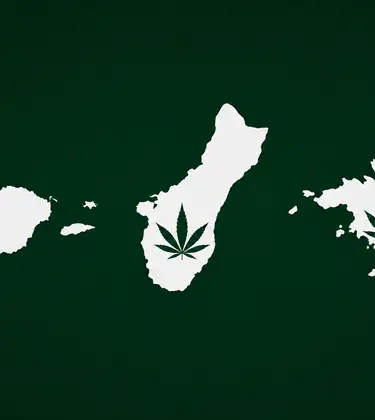
Guam legalized adult-use cannabis in 2019. The US Virgin Islands legalized it in 2023. Between them, in August 2026, they have exactly zero legal shops selling it.
Puerto Rico, which never legalized adult use at all, has more than 300 licensed dispensaries and over 120,000 registered patients.
Three American territories, three completely different outcomes, and none of them work the way the mainland does. This guide covers what is legal in each, whether a visitor can buy anything, and why legalizing and actually selling turn out to be very different problems.
Why territories are not states, except when they are
Start with the federal position, because it shapes everything else.
The Controlled Substances Act defines its terms broadly. The word "State" in the Act means a state, the District of Columbia, and any commonwealth, territory or possession of the United States. Federal cannabis law therefore applies in San Juan and Hagåtña exactly as it applies in Denver.
The congressional spending rider that stops the Justice Department interfering with medical cannabis programs also names the territories explicitly, covering the US Virgin Islands, Guam, Puerto Rico, the Northern Mariana Islands and DC. So the same uneasy federal truce that protects state medical programs protects territorial ones.
What territories lack is voting representation in the body writing those riders. It is the DC problem, repeated across three time zones.
Puerto Rico: medical only, and it works
Puerto Rico is the outlier, and the numbers are the reason.
Medical cannabis arrived by executive order in 2015 and was codified by legislation in 2017. Recreational use remains illegal under a prohibition dating to 1932, carrying a month to a year in jail. Smoking cannabis is prohibited even for patients, so the program runs on vaporisation, oils, capsules and topicals.
Despite that, the program is enormous. Official health department figures put registration at 120,316 patients, served by 325 dispensaries and 480 total licences as of January 2025. The leading qualifying conditions are insomnia, anxiety and chronic pain, in that order.
For a jurisdiction of roughly three million people, that is a participation rate no mainland medical program comes close to. Puerto Rico built the market it was allowed to build, and then filled it.
Visitors can participate. The regulator permits non-residents to register if they hold a document issued by their home state or country and meet the programme's requirements. In practice that makes Puerto Rico the only one of the three territories where a traveller can legally buy cannabis today.
Guam: legal for seven years, no shop until now
Guam legalized adult use in April 2019, after the legislature passed it by a single vote. Medical had arrived earlier, through a 2014 referendum that passed with 56% support.
The adult-use rules read normally enough. Adults 21 and over may possess up to an ounce of dried flower and grow three flowering plus three non-flowering plants, kept enclosed and out of public view. Gifting up to an ounce is permitted. Concentrates and infused products were held back until a licensed retailer existed.
That last clause turned out to matter, because a licensed retailer did not exist for a very long time. As of January 2026, nearly seven years after legalization, only two of the fifteen applicants since 2019 were still active, and no dispensary was operating. The first medicinal licence holder never opened. Another company ran out of funding.
Things finally moved in 2026. The Cannabis Control Board approved the island's first establishment licences in February, and in June issued Guam's first-ever permit to operate, to a cultivator. Even then, the absence of a licensed testing laboratory continued to hold up retail sales, because product cannot reach a shelf untested.
So Guam in August 2026 has legal possession, legal home cultivation, a licensed grower, and still nowhere to buy anything.
Feeling lost on how to start? Try taking our quiz!
Start a QuizUS Virgin Islands: three years, still waiting
The USVI took the longest road of the three. Decriminalization came in December 2014 through a unanimous legislative override of a governor's veto. Medical followed in January 2019, allowing patients up to four ounces and twelve plants. Adult use was signed in January 2023, with published regulations setting a two ounce possession limit and capping concentrates at fourteen grams.
Three years later there are no legal sales. The office running the programme started from nothing, and its director has described inheriting a mandate with no desks, no electrical outlets and no telephones.
Licensing has progressed on paper. By February 2026 the territory had issued fourteen commercial cultivation licences, eleven micro-cultivation permits and ten conditional dispensary licences across St. Croix, St. John and St. Thomas. The medical program, meanwhile, remains tiny, with nine participating practitioners and 44 active patients as of May 2026.
The most recent development is that business applications reopened in July 2026 with a September 15 deadline, alongside confirmation that the grace period for intoxicating hemp and artificially derived cannabinoid products had ended. The regulator's position is that none of those products should be on sale in the Virgin Islands at all.
Officials have pointed at autumn 2026 for a launch. Previous targets have slipped.
The unexamined day is a wasted opportunity. Reflect on what you did, what you learned, and how you can improve.
John Dewey
What a visitor can actually do
Puerto Rico: register online as a non-resident patient with documentation from home, and buy legally. Note that smoking is not permitted.
Guam: possession and gifting are legal for adults 21 and over, but there is nowhere lawful to buy. Bringing cannabis to Guam by air means crossing federal jurisdiction, which is its own offence.
US Virgin Islands: possession within the limits is lawful. Sales are not operating. The same federal travel problem applies.
In all three, cannabis is federally controlled on arrival and departure, and airports are federal space.
Why legalizing is the easy part
Look across the three and a pattern emerges that has nothing to do with the Caribbean or the Pacific.
Puerto Rico built a functioning market under a medical framework because the regulatory machinery arrived with the law. Guam and the USVI passed adult-use statutes and then discovered that a statute is not an industry. Somebody has to write rules, hire inspectors, accredit laboratories, set up seed-to-sale tracking, and find a bank willing to hold the money.
Every one of those is harder on an island. The testing laboratory problem is the clearest example, because a lab needs expensive instrumentation, trained analysts and enough sample volume to be viable. On a small island there may not be enough throughput to justify one, and without a lab nothing can be legally sold. Guam has been stuck at exactly that point.
Banking is the other recurring block. Territorial operators face the same federal banking problem mainland operators do, with a much smaller pool of institutions willing to take the risk. The USVI has been working through a specialist banking arrangement precisely because ordinary options were not available.
None of that is unique to territories. It is simply more acute when the whole jurisdiction is smaller than a mid-sized American city.
Growing at 18 degrees north
Here is the horticultural reality behind those home cultivation allowances, and it is a genuinely difficult one.
All three territories sit deep in the tropics. Puerto Rico and the USVI are around 18 degrees north, Guam around 13. At those latitudes day length barely changes across the year, running from roughly eleven to thirteen hours regardless of season.
For cannabis that produces a strange effect. A photoperiod plant put outside in the tropics receives near-flowering-signal light almost immediately, so it starts to flower while still small and yields poorly. The plant never gets its long vegetative summer, because there is no long summer.
The second problem is water and air. Caribbean and Western Pacific humidity sits high year-round, and the wet season delivers sustained rain. Dense flowers in that environment rot. Add hurricane and typhoon season landing squarely in the back half of a normal flowering cycle and outdoor cultivation becomes a genuine gamble.
Which is why tropical cannabis, historically, looks nothing like the compact dense plants bred for northern Europe. Equatorial landraces evolved long thin airy flowers with plenty of space between calyxes, precisely so that water passes through instead of sitting in the bud. They flower for a long time and they stretch enormously, and both of those traits are adaptations to exactly this climate.
That heritage runs through our own catalogue. Laughing Buddha is a Thai crossed with a Jamaican, two tropical landraces and nothing else, an 80% sativa that takes 70 to 75 days to flower and gives an energetic, social effect rather than a heavy one. Acapulco Gold is our version of the Central American heritage line, 70% sativa at 26% THC, reaching 150 to 200 cm outdoors with the open structure that its ancestors needed.
Four decades of breeding has taught us that you do not fight a climate, you select for it. A plant bred for a Dutch greenhouse will drown in a Caribbean September.
The short version
Puerto Rico has no adult-use law and a large functioning medical program that non-residents can join. Guam legalized adult use in 2019 and issued its first operating permit in June 2026, with retail still blocked by the lack of a testing lab. The US Virgin Islands legalized in 2023 and has issued licences but no sales, with applications reopened through September 2026.
Federal law treats all three exactly as it treats states, and the medical protections in the annual spending bill name them explicitly.
If you are travelling, Puerto Rico is currently the only one where you can legally buy anything.
Barney's Farm has been developing premium cannabis genetics since the 1980s, with over 40 Cannabis Cup wins. Explore our full seed catalog and find strains bred for every climate and skill level.