
Cannabis Jobs and Salaries: What Growers, Trimmers and Budtenders Actually Earn
For a decade the pitch was straightforward. Get into cannabis early, because the industry only goes one way.
In 2026 it went the other way. American cannabis employment fell for a second consecutive year, and for the first time since legal sales began, revenue fell alongside it.
This guide covers what the industry actually pays now, which roles are holding value, why budtender wages have stalled at the minimum wage line, and what the current contraction means for anyone thinking about getting in.
The numbers turned
Total legal cannabis employment in the United States stands at roughly 412,500 jobs, down from 425,002 a year earlier and 440,445 the year before that.
That is a decline of around 2.7%, on top of a 3.4% decline the year before. Two consecutive contractions, roughly 28,000 positions gone from the peak.
What makes 2026 different is that it happened while sales fell too. Retail revenue came in at $29.1 billion against $30.1 billion the previous year, the first year-over-year decline since adult-use sales began in 2014. Prior job losses could be explained as efficiency gains in a growing market. This one cannot.
The picture is not uniform. New York added more than 16,000 jobs as its market finally opened, more than doubling its total. Maryland and Ohio grew. California and Michigan remain the largest employers by a distance, with roughly 57,500 and 42,500 jobs respectively, and both are under pressure.
What the roles pay
There is no government wage data for this industry. The Bureau of Labor Statistics has no cannabis occupational category, so everything comes from industry surveys and union contracts.
The clearest occupational breakdown comes from union-negotiated starting wages, which are worth reading as a floor and not an average. Analysis of cannabis union contracts put starting hourly rates at $15 to $21 for growers and horticulturalists, $15 to $17 for trimmers and harvesters, $23 to $25 for extraction and lab technicians, and $15 to $21 for budtenders. Those figures date from 2021 and should be read with several years of inflation applied.
The shape is what matters and it has not changed. Extraction and lab work pays a genuine premium because it requires technical skill and carries real risk. Trimming pays the least because it is the most replaceable task in the entire supply chain. Cultivation sits in between, and cultivation is around 31% of all cannabis jobs.
Management is where the money is. Store managers, extraction managers and directors of cultivation earn salaries comparable to equivalent roles in food production and specialty retail, with cultivation directors at the top of the operational ladder.
Budtender pay is being caught by the minimum wage
This is the single clearest story in cannabis employment right now.
Budtending was never highly paid, but it used to carry a premium over general retail. That premium has evaporated. Curaleaf listed Arizona retail sales associate roles at $15.15 to $15.25 an hour against a state minimum wage of $15.15, which is to say at the floor exactly. A Florida operator advertised budtender roles starting at $45,000 a year in a state whose minimum wage reaches $15 an hour this September.
Twenty-two states raised their minimum wage in 2026. Cannabis retail wages largely did not move, so the gap closed from below.
The consequence is visible in turnover. Roughly 55% of budtenders leave their job each year, and close to a quarter leave within their first month. That is a churn rate that makes training uneconomic, which suppresses investment in staff, which raises churn further.
Feeling lost on how to start? Try taking our quiz!
Start a QuizWhere the layoffs are landing
Manufacturing and processing are taking the hardest hits, because they sit furthest from the customer and closest to price compression.
Two California manufacturers filed mass layoff notices in July 2026, one cutting around 60 workers and another around 49, primarily production, packaging and trimming staff. California sales fell from $4.2 billion to $3.9 billion across a single year. One chief executive described his company as having been sized for a scale of industry that never materialised.
That phrase captures the whole contraction. Enormous capacity was built between 2019 and 2022 on projections of federal legalization and continued price growth. Neither arrived. What arrived instead was oversupply, price collapse, and hemp-derived THC eating the low end of the market.
The unexamined day is a wasted opportunity. Reflect on what you did, what you learned, and how you can improve.
John Dewey
Unions are growing while the industry shrinks
One counter-trend worth noting. Cannabis workers have been organising steadily, and cannabis retail has become one of the more actively unionised parts of American retail.
Union representation carries a measurable premium. The same analysis of cannabis contracts found processing workers earning roughly $8,690 more annually under a unionised scenario, a premium in the range of 23.6% to 28%, with cultivation workers around $7,030 better off and retail workers around $2,810 better off. The premium for workers of colour ran higher still.
Organising continues through the downturn. In July 2026, workers at a Missouri dispensary ratified the state's first cannabis union contract, covering wage increases, additional paid time off, sick time and paid bereavement leave.
What the work is actually like
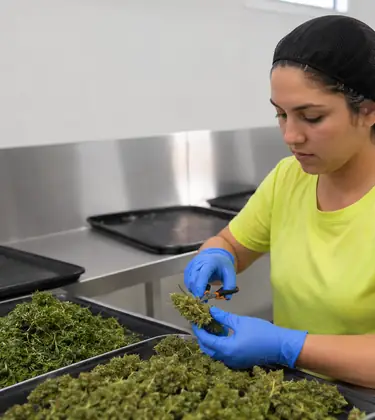
Some plain description, because job listings rarely provide it. Trimming is repetitive precision work performed seated for long shifts, with real incidence of repetitive strain injury in the hands and wrists. It is frequently seasonal, frequently paid by weight, and it is the first task any operator automates.
Cultivation technician work is warehouse labour in a controlled environment. High humidity, artificial light cycles that may put your shift at three in the morning, heavy lifting, and constant vigilance about pests and pathogens. It is genuinely skilled, and it is physical.
Extraction is the closest thing to industrial chemistry in the sector. It pays more because solvents are dangerous and the equipment is expensive, and because the consequences of doing it badly are severe.
Budtending is retail with a compliance burden. Product knowledge expectations are high, the regulatory rules are unforgiving, and the pay is now the same as a supermarket.
How people actually get hired
Worth knowing if you are trying to enter now, because the route in has changed since the boom years.
Entry level retail is still the most accessible door, and it is the one with the most applicants per opening. Operators screen for reliability and regulatory discipline far more than product enthusiasm, because a compliance failure costs a licence and an under-informed budtender costs a sale.
Cultivation hiring runs differently. Most operators recruit technicians with agricultural or horticultural backgrounds, and greenhouse, nursery and hydroponics experience transfers directly. A candidate who has run commercial tomatoes understands integrated pest management, environmental controls and harvest logistics, which is most of the job.
Extraction hiring wants laboratory experience and safety training. A chemistry background, or time in food processing under strict hygiene rules, matters more than cannabis familiarity.
Compliance and inventory roles are the quiet growth area, because every regulated market generates paperwork that has to be exactly right. Those roles reward people who are meticulous, and they are less exposed to the retail wage floor.
One structural note. Nearly every state requires a worker permit or badge, usually involving a background check and a fee, and in many jurisdictions certain convictions are disqualifying. That is worth checking before paying an application fee.
The one job nobody counts
Forty years in this trade has given us a particular view of the industry's employment statistics, which is that they miss the largest category of skilled cannabis work in the world.
Nobody counts home growers. There is no payroll line for the person running four plants in a spare room, and yet the skill involved is the same skill a cultivation technician is paid for: reading a plant, managing humidity, judging ripeness by trichome colour, knowing when to feed and when to stop.
That is worth saying to anyone considering a cannabis career. The most transferable qualification in cultivation is not a certificate, it is having grown well and repeatedly, and being able to explain why a particular run went the way it did. Growers hire growers.
The plants that teach the most are the ones with a bit of a temperament. Amnesia Haze is a long-flowering sativa built from Jamaican, Thai, South Asian and Cambodian landraces, taking 70 to 85 days and demanding patience that a fast indica never asks for. Getting it right teaches more than three easy harvests. AK-47 is the other side of that lesson, a Mexican, Colombian, Thai and Afghan four-way that finishes in 60 to 70 days and forgives more, which makes it a good place to build the fundamentals before attempting something temperamental.
Fewer jobs, flatter pay
American cannabis employment has fallen two years running to around 412,500 jobs, and 2026 was the first year job losses came with declining sales. Manufacturing and processing are absorbing the layoffs.
Extraction and lab work pay the best of the hourly roles, cultivation sits in the middle, and trimming pays least. Budtender wages have been caught by rising state minimums and now sit at the floor in several markets, with annual turnover around 55%.
Unionised roles pay a real premium, and organising is continuing despite the contraction. If you are trying to get in, cultivation experience is the credential that actually travels.
Barney's Farm has been developing premium cannabis genetics since the 1980s, with over 40 Cannabis Cup wins. Explore our full seed catalog and find strains bred for every climate and skill level.