The First Legal Weed Sale in America: What 1 January 2014 Actually Looked Like
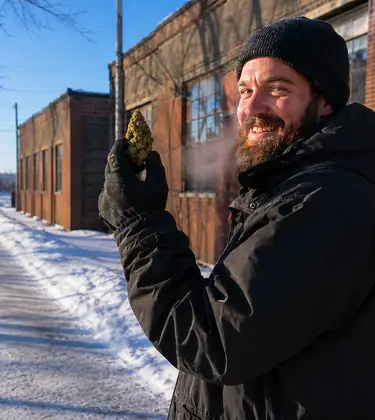
Eight o'clock in the morning, New Year's Day, Denver, freezing. A Marine Corps veteran named Sean Azzariti walked into a shop on Brighton Boulevard and bought an eighth of Bubba Kush and some chocolate truffles.
The total came to $59.74. It was the first legal recreational cannabis sale in the United States, and by most accounts in the world.
He still has it. This guide covers what actually happened that day, what it cost people, what the state made, and what became of the shop.
The sale
The store was 3D Cannabis Center at 4305 Brighton Boulevard in Denver. The owner was Toni Savage Fox, and she made the sale herself. Azzariti was chosen deliberately. He was a veteran and a medical marijuana patient who had campaigned for Colorado's Amendment 64, and putting him first was a statement about who legalization was supposed to serve.
He never smoked it. “I still have the entire first purchase,” he told a reporter years later, adding that he tried to donate it to local museums shortly afterward and was turned down every time, on the grounds of federal prohibition.
Ten years on he was still stuck with it. He said he could not give it away and did not know what to do with it.
One small point of historical confusion worth knowing. Wire coverage that day called the shop the 3-D Denver Discrete Dispensary, while local reporting called it 3D Cannabis Center. Same business, two names in the record, which is why you will see both.
There is no substantiated rival claim to the first sale, despite how often people assume there must be. Several Colorado shops opened at eight o'clock that morning, and any of them could have rung up a transaction seconds apart. What made this one first in the record is that it was staged for it: a named customer, press in the room, and a photographer. History tends to record the sale somebody documented.
What it cost
Prices that morning were brutal, and it is the detail most retrospectives skip.
Roughly 24 shops opened on January 1, most of them in Denver, and high-quality product went for around $70 an eighth against as little as $25 for medical patients the day before. Combined state and local taxes ran to more than 25 percent.
People queued for hours in winter weather to pay nearly triple what the same product had cost twenty-four hours earlier. Some had driven across the country. The state's marijuana regulator, asked how it was going, said everything had gone pretty smoothly, which is about as much drama as a regulator ever offers.
The price gap had a straightforward cause. Supply was fixed on day one, demand was enormous and heavily publicized, and the tax stack landed on top of both. Every legal market since has repeated some version of that opening week, and in most of them prices fell hard within eighteen months once cultivation caught up. Colorado's did.
Purchase limits were an ounce for Colorado residents and a quarter ounce for out-of-state visitors, and one shop closed early that day because it ran out.
The money
January's numbers arrived two months later and they were smaller than the hype suggested. Total marijuana sales for the month came to $14 million, generating $2.1 million in recreational marijuana taxes and $3.5 million once medical taxes and fees were counted, from 160 licensed recreational stores. The tax structure was a 12.9 percent sales tax alongside a 15 percent excise tax.
For the full year, the figure that gets repeated is $700 million. The state's own accounting is more precise and slightly lower: $683,523,739 in combined medical and retail marijuana sales for calendar year 2014.
Both numbers appear in print. The rounder one is a press approximation and the exact one is the Department of Revenue's.
Feeling lost on how to start? Try taking our quiz!
Start a QuizWhy Colorado could open at all
The thing that made January 1 possible was not the vote. It was the industry that already existed.
Colorado had been running a licensed medical marijuana system since 2010, with growers, testing, tracking and inspectors already in place. When adult-use sales were authorized, most of the first shops were existing medical dispensaries adding a second counter. The supply chain did not have to be invented, only relabeled.
That is why the state could turn on 24 stores in a single morning. Washington State, which voted for legalization on the same night in November 2012, did not open until July 2014 and then spent months rationing, because it built its system from scratch instead of converting one.
Every state that has legalized since has faced the same choice, and the ones that converted an existing medical market opened faster every time. New York, which built new, took years to get shops open and is only now catching up.
The unexamined day is a wasted opportunity. Reflect on what you did, what you learned, and how you can improve.
John Dewey
Ten years later
By the anniversary, Colorado had recorded more than $15 billion in cumulative legal cannabis sales and roughly $2.6 billion in cannabis tax and fee revenue, with a 99 percent ID verification compliance rate. The governor described the state as having built one of the leading regulatory systems in the world.
The shop itself did not last. Toni Fox sold 3D Cannabis to another operator in 2017. The Brighton Boulevard building later housed a different retailer, which closed it in autumn 2023 over structural problems and moved the license elsewhere. The building where the first legal cannabis sale in America happened now sits empty.
Nobody has put a plaque on it.
What was actually in that bag
Here is the detail we find genuinely interesting, and it is the one nobody follows up on.
The first legal cannabis sold in the United States was Bubba Kush. Not a novelty cultivar bred for the occasion, not something with a marketing budget. A pre-existing indica whose lineage runs back through OG Kush to Afghan Kush landrace stock, a plant that had been circulating in American gardens for two decades before anyone could sell it legally.
That is the part of the day worth remembering. Legalization did not create the genetics. It legalized plants that growers had already spent thirty years developing under prohibition, passing cuttings and seeds hand to hand with no patents, no registry and considerable personal risk. The industry that turned up on January 1, 2014 inherited a finished library it had not paid for.
Bubba Kush is still in our catalog and still doing what it did in that bag, at 29% THC across a 56 to 63 day flower, 600 to 700 grams per square meter indoors, with the mocha and sweet hashish profile and the tranquilizing weight that made it a dispensary staple in the first place. Girl Scout Cookies is the other genetic that defined that era, OG Kush crossed with Durban Poison, 28% THC over 60 to 65 days, and it went on to parent a substantial share of everything on American shelves since.
Four decades of breeding teaches you to notice when a plant outlives the market conditions that produced it. Bubba Kush was bred by people who could have gone to prison for it, and it was good enough that when prohibition ended it was the first thing anybody bought.
The short version
At 8am on January 1, 2014, Sean Azzariti bought an eighth of Bubba Kush and chocolate truffles for $59.74 from Toni Savage Fox at 3D Cannabis Center in Denver. He never used it and still has it.
About 24 shops opened that day. Prices ran near $70 an eighth against $25 medical the day before, with taxes over 25 percent. January produced $14 million in sales and $3.5 million in tax, and the year finished at $683,523,739 by the state's count.
The building is empty now. The genetics that were sold out of it are still in production, which is the more durable legacy of the two.
Barney's Farm has been developing premium cannabis genetics since the 1980s, with over 40 Cannabis Cup wins. Explore our full seed catalog and find strains bred for every climate and skill level.