Why Your Weed Has Seeds: What Seedy Buds Tell You About Quality and Plant Stress
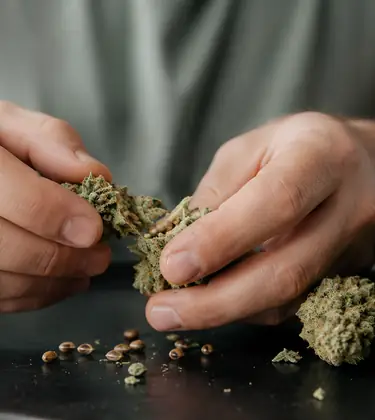
You crack open a fat nug expecting sticky green, and a hard little brown pebble rolls onto the table. A seed. Maybe three. Suddenly that eighth you were hyped about feels like a rip-off. So what actually happened?
A seed in your flower is a story about sex, stress, and how that plant got treated weeks before it ever hit a jar. Read it right and it tells you a lot about the quality of what you are holding. Here is what those seeds are really saying.
Why is my weed seedy?
Cannabis is a dioecious plant, meaning male and female grow as separate individuals, with females carrying XX chromosomes and males XY. Only the females grow the dense, resin-coated flowers people smoke.
A seed shows up when pollen from a male flower lands on a female pistil, one of those little hairs on the bud, while the flower is still forming. That is pollination, and it is the plant doing exactly what nature built it to do: make the next generation before it dies.
The pollen can drift in from a stray male in the same garden, a neighbor's grow downwind, or, more often than growers like to admit, from the female plant itself. Once a pistil gets dusted, that spot on the flower stops chasing trichomes and starts building a seed instead. Multiply that across a whole cola and you get a bud that rattles.
Pollen is also tiny and stubborn. A single overlooked male can seed an entire room, and the grains hang in the air and cling to clothes and fans long enough to find a flower across the tent. That is why a few seeds in an otherwise solid bag almost always trace back to one slip during the grow, not the strain being junk.
What is a hermaphrodite cannabis plant?
Sometimes there is no male anywhere and you still find seeds. That usually means a hermie. A hermaphrodite cannabis plant grows both female flowers and male pollen sacs on the same body, so it can pollinate itself and everything around it.
Researchers studying marijuana flowers found that these spontaneous hermaphroditic flowers produce viable pollen and lead to unwanted seed formation. The same work notes that true separate-sex plants show up in only about 6 percent of flowering species, which means cannabis sits on some genetically flexible wiring.
Growers also run into nanners, little banana-shaped anthers that poke out of a bud late in flower. Same problem, smaller package. They sneak out, drop pollen, and seed your buds before you even spot them.
That flexibility is also a tool when you aim it. Breeders flip female plants into making pollen on purpose by spraying them with colloidal silver or silver thiosulfate, which blocks the hormone signal a plant needs to stay all-female. That pollen is how feminized seeds get made. Done deliberately in a breeding room, it is the backbone of the whole feminized market. Happening by accident in your tent, it is a headache.
What plant stress causes seedy weed?
A healthy, stable female left alone will almost never seed itself. Stress is what flips the switch. When a plant thinks it is about to die, it panics and tries to reproduce on the way out, and throwing pollen is its insurance policy.
The usual suspects:
Light leaks. A flowering plant needs unbroken darkness. A timer that misfires, light creeping under a tent zipper, or a streetlamp hitting an outdoor plant can interrupt the night and trip a stress response.
Heat and cold swings. Temperatures spiking into the 90s Fahrenheit or crashing hard at night put the plant on edge.
Bad harvest timing. Leave a plant flowering way past ripe and it may throw late nanners in a last-ditch attempt to seed itself.
Rough handling. Heavy pruning, snapped branches, root shock, and wild nutrient swings all stack up.
Genetics load the dice too. Some lines are simply twitchier than others, and unstable seeds from a sketchy source will herm at the first sign of trouble. Buy cheap, mystery genetics and you are gambling that the plant keeps its cool. Often it does not.
Feeling lost on how to start? Try taking our quiz!
Start a QuizAre seedy buds bad?
A few seeds will not poison you, and you have almost certainly smoked seeded weed without noticing. But seeds cost you, and the cost is potency.
Every seed a flower builds is energy the plant pulled away from making THC and terpenes. Seedless flower, called sinsemilla, lets the plant pour everything into resin instead of seeds. That gap shows up in the lab. One analysis of street samples found THC in herbal cannabis climbed by 14 percent between 1970 and 2017, driven largely by stronger seedless varieties taking over from older seeded weed.
So seeds are not just something you pick out and forget. They are a sign the flower never hit its ceiling. Seedy buds tend to be lighter, looser, and weaker than the same genetics grown clean. And if those seeds came from a hermie, planting them is a coin flip, because they usually carry the same urge to turn on themselves.
The seeds themselves give you a read on what went down. Dark, hard, tiger-striped seeds are mature, which means pollination happened early and the plant had weeks to fill them out, often at the expense of the whole crop's potency. Pale, soft, white seeds came in late and barely formed, so the hit to quality is smaller. Either way, you are looking at flower that spent effort on making babies instead of getting you high.
The unexamined day is a wasted opportunity. Reflect on what you did, what you learned, and how you can improve.
John Dewey
How did seedless weed become the standard?
Here is the punk rock part of the story. For most of the 20th century, American weed was brick weed: brown, dry, pressed flat, and packed with seeds and stems after a long ride up from Mexico and Colombia. You picked seeds out of the carpet for days.
Then in the 1970s growers worked out that pulling the males before they could pollinate left the females loaded with resin. That seedless flower picked up the name sinsemilla, Spanish for without seed, a technique popularized in Sinaloa, Mexico.
The idea traveled fast. Breeders in California and then Amsterdam grabbed it and ran, stabilizing legendary lines and turning a seedy import into a craft. Foundational strains like Skunk #1 became backbone genetics for the entire Dutch scene. Seedless stopped being a trick and became the baseline, and it rewired what people expected weed to be.
What Barney's Farm does about seeds
We have been chasing stable, seedless flower since 1986, and four decades of breeding goes straight at the thing most growers dread. Our feminized seeds are bred to grow into female plants, so you are not hunting through your tent for males to yank before they wreck the crop.
The bigger work happens before a strain ever earns a spot in the catalog. We select hard against the genetic twitchiness that makes a plant herm under pressure. A line that throws nanners every time a light leaks does not make the cut. Over 40 years and a wall of Cannabis Cups, that selection is the quiet part of why our flower comes out clean.
Take Pineapple Chunk. It is built tough and shrugs off the kind of environmental stress that sends weaker plants into panic mode, which is exactly what you want when the goal is dense, resinous, seedless buds. Stable genetics will not save you from a busted timer, but they hand you a plant that can ride out a bad day instead of seeding itself over it.
What should you do if you find seeds in your weed?
Read the seed as a clue. It means a plant somewhere got pollinated, either by a male nobody caught or by a stressed-out female that turned on itself. Your stash is still smokeable. Pick the seeds out, since they crackle and pop and add nothing but harsh smoke when they burn.
If you grow, the fix is upstream. Start with stable, feminized genetics, keep your dark period actually dark, hold your temps steady, and harvest on time. Do that and the seeds mostly take care of themselves. The cleaner you keep the grow, the closer your flower gets to everything those genetics were built to deliver.
Barney's Farm has been developing premium cannabis genetics since the 1980s, with over 40 Cannabis Cup wins. Explore our full cannabis seed catalog and find more Amsterdam classics, USA-bred hybrids, and award-winning strains.