Bhang: The Cannabis Drink India Has Legally Consumed for Centuries
In parts of northern India you can walk into a shop licensed by the state excise department and buy cannabis over the counter. There is a permit on the wall, an age limit, posted hours, a purchase cap and a sign telling you not to drive afterward.
This is not a recent reform. It has been running for well over a century, in a country where possessing a cannabis flower can land you in prison.
The substance is bhang, and the reason it is legal is not what most Western coverage says it is.
What bhang actually is
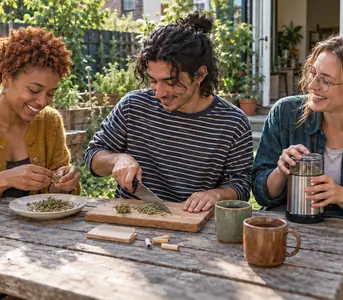
Bhang is made from the leaves and seeds of the cannabis plant, not the flowering tops and not the resin. The leaves are ground into a paste with a mortar and pestle, then worked into a drink or a sweet.
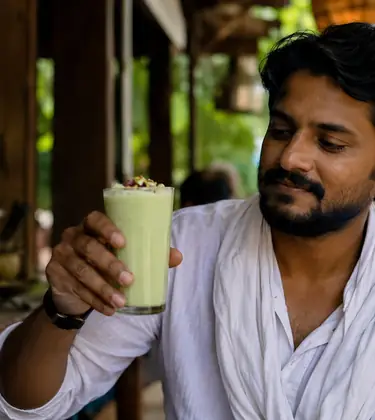
The two most common preparations are bhang lassi, a yoghurt drink, and thandai, a spiced milk with almonds, fennel, rose and cardamom. It also turns up as bhang goli, small balls swallowed directly, and in parts of Uttarakhand as a chutney.
Because it is eaten rather than smoked, it behaves like any edible: slow onset, long duration, and a dose that is very hard to judge from the first sip. Bhang goli in particular is reported to take around two hours to come on.
The legal mechanism is botanical, not religious
Here is the correction that matters, because nearly every English-language article on this gets it wrong.
Bhang is not legal in India because of a religious exemption. Indian narcotics law does not mention Shiva, Holi, or any deity. It is legal because of how the statute defines the plant.
The Narcotic Drugs and Psychotropic Substances Act of 1985 defines cannabis in two parts. Charas is the separated resin. Ganja is the flowering or fruiting tops of the cannabis plant, "excluding the seeds and leaves when not accompanied by the tops".
Read that parenthetical again. The leaves and seeds, on their own, fall outside the legal definition of cannabis entirely. They are not a controlled substance. They are just plant matter.
Bhang is made from leaves. So bhang is not, as a matter of Indian law, a cannabis product at all.
The Act then hands the states authority to regulate the cultivation, sale and consumption of cannabis excluding charas, which is why the answer changes depending on which state you are standing in.
Indian courts have upheld this reading. A Karnataka High Court decision in 2022 held that bhang is not a prohibited drug or drink under the NDPS Act and cannot be added to a ganja weight to push a defendant into commercial-quantity territory.
The irony sits right there in the supply chain. A licensed bhang shop sells a legal product made from the leaves of a plant whose flowers, growing on the same stalk, are contraband.
India already runs a cannabis regulatory regime
Look at how the licensed shops are actually governed and it reads exactly like a modern dispensary rulebook.
Uttar Pradesh's excise rules for retail bhang shops allot licenses by e-lottery or e-tender, require the licensee to be at least 21, restrict trading hours to 10:00 to 22:00, limit sales to adults, require warning signage against consuming in public or before driving, and specify that the licensee shall not sell more than 120 grams of bhang to any person.
Age gate. Purchase cap. Licensed operators. Fixed hours. Mandatory impaired-driving warnings. That is a cannabis regulation framework, written for a product India has been taxing since the British ran the excise department.
Rajasthan does not even produce its own. The state sources bhang from licensed wholesalers in Punjab, Uttar Pradesh, Bihar and West Bengal, with a wholesale license fee and a departmental warehouse issue price. There is an interstate supply chain.
Licensed shops operate in Uttar Pradesh, Rajasthan, Madhya Pradesh and Odisha, among others. Gujarat legalized bhang in 2017. Maharashtra requires licenses. And Assam bans it outright, by name, in a statute called the Assam Ganja and Bhang Prohibition Act.
Feeling lost on how to start? Try taking our quiz!
Start a QuizThe festivals
Bhang is most visible at Holi and Maha Shivratri, when thandai laced with bhang is served widely and the practice is entirely mainstream rather than countercultural. Varanasi is the traditional center, where it is prepared on the ghats. In Mathura the preparation is preceded by a Sanskrit prayer.
The religious association is genuine and old. The Atharva Veda names bhang among five sacred plants, described as easing anxiety, though scholars disagree about whether the Sanskrit term refers to modern cannabis. Sadhus have used it as an aid to meditation for centuries.
But the association explains the culture, not the legality. The law is about leaves.
The unexamined day is a wasted opportunity. Reflect on what you did, what you learned, and how you can improve.
John Dewey
The 1894 report that should be more famous
In 1893 the British colonial government convened the Indian Hemp Drugs Commission, largely because of pressure to ban cannabis on the grounds that it caused insanity.
The Commission sat for over a year, took testimony from roughly 1,200 witnesses, visited asylums to test the insanity claim directly, and produced a report running to about 3,281 pages across seven volumes.
Its conclusion, in the Commission's own words, was that the moderate use of hemp drugs is practically attended by no evil results at all, produces no injurious effects on the mind, and causes no moral injury whatever.
It recommended taxation over prohibition, partly because it predicted prohibition would cause unrest and partly for a more familiar reason: Bengal alone had earned around one crore of rupees in hemp taxes over the preceding two decades. Revenue helped save the thandai.
Two Indian members of the Commission dissented and favored a ban.
The report was then largely ignored for the next century of global drug policy. It remains one of the largest evidence reviews ever conducted on cannabis, and a striking amount of it has held up.
Why India waited until 1985
The 1961 UN Single Convention pushed member states toward prohibition, but it also excluded cannabis leaves from its definition of cannabis, and it gave India a 25-year grace period in recognition of traditional use.
India passed the NDPS Act in 1985, exactly at the deadline, and wrote the leaf exclusion straight into domestic law. Bhang survived because the international treaty that criminalized everything else had the same botanical gap in it.
Where India is now
India voted in favor at the UN Commission on Narcotic Drugs in December 2020 to remove cannabis from the most restrictive schedule, following a World Health Organization recommendation recognizing its therapeutic uses.
Domestically the movement is at state level. In February 2025 the Himachal Pradesh assembly passed a resolution to legalize cannabis cultivation for medicinal and industrial use, following a committee that studied the models used in Jammu and Kashmir, Uttarakhand and Madhya Pradesh. Industrial hemp at negligible THC, medicinal cannabis under NDPS controls comparable to opium.
There is no national move toward recreational legalisation.
A word of caution for visitors
Bhang lassi is sold openly to tourists in Varanasi, Pushkar and Jaisalmer, often at strengths nobody has measured, by people with no obligation to tell you anything.
It is an edible. It takes an hour or more to arrive, it lasts several hours, and a glass that tastes like a milkshake can be considerably stronger than the last one somebody else drank. There are documented cases of travelers ending up in hospital, including a British YouTuber hospitalized in Ujjain in 2024, who attributed his experience to unhygienic street preparation rather than potency.
Half a glass, then two hours of doing nothing, is the sensible approach. The same advice applies in Colorado.
What the leaf actually contains
We have been breeding cannabis in Amsterdam since 1986, and the bhang story touches something that gets ignored in modern cannabis entirely: the fan leaves.
Cannabis leaves carry a fraction of the cannabinoid content of the flower. Trichome density on a large fan leaf is low, and the potency comes overwhelmingly from the small sugar leaves closest to the bud and from whatever resin transfers during grinding. Which is exactly why a bhang preparation is milder and more variable than a modern edible, and why the traditional method involves grinding a large volume of leaf into a paste rather than measuring anything.
That variability is the whole reason bhang has a reputation for catching people out. There is no standard dose because there is no standard leaf.
The genetics behind the plants used for bhang are South Asian landraces, populations that developed regionally over centuries with no deliberate breeding, and those lineages still sit inside a surprising amount of the modern catalogue.
White Widow XXL carries that heritage directly. It is a Brazilian sativa crossed with a South Indian indica, which is the original White Widow lineage taken to a larger scale: 28 percent THC, 75/25 indica, 60 to 65 days in flower with an early October harvest, and up to 2,000g per plant outdoors. We describe it as mold and bug resistant with good cold-climate performance, and the South Indian side is where a lot of that hardiness comes from.
Amnesia Haze is a Cannabis Cup champion built from Jamaican, Thai, South Asian and Cambodian genetics, an 80/20 sativa at 28 percent THC running 70 to 85 days in flower with a late October harvest and around 1,000g per plant. It is a map of the old trade routes in a single plant, and the South Asian contribution is doing real work in the effect profile.
Seeds ship as collectible souvenirs, and germination is governed by your own jurisdiction, which in India would depend entirely on your state.
The short version
Bhang is legal across much of India because Indian law defines cannabis as the resin and the flowering tops, and explicitly excludes the leaves and seeds. Not because of religion. Because of botany.
It is sold in licensed shops with age limits, purchase caps and posted hours, taxed by state excise departments, and consumed openly at Holi by people who would never touch a joint. And the most thorough investigation ever conducted into whether any of this was harmful was completed in 1894, concluded it was not, and got shelved for a hundred years.
Barney's Farm has been developing premium cannabis genetics since the 1980s, with over 40 Cannabis Cup wins. Explore our full seed catalog and find strains bred for every climate and skill level.