Why Does Weed Hit Harder at Altitude?
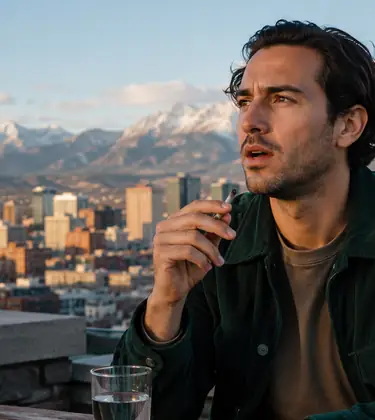
Ask anyone who has visited Denver and they will tell you the weed hit differently. They will say it with total confidence. They will usually mention the mile-high thing.
The effect is real in the sense that people genuinely experience it. The explanation almost everyone gives for it is wrong, and the actual reasons are more useful to know, especially if you are the one visiting.
Denver is not high altitude
Start here, because it undercuts the entire premise.
Medical guidance defines high altitude as beginning around 8,000 to 9,000 feet. Denver is 5,280. That is roughly 2,700 feet below the threshold where altitude illness becomes a clinical consideration at all.
At 10,000 feet, inspired oxygen pressure drops to about 69 percent of sea level and blood oxygen saturation runs 88 to 91 percent. In Denver it is closer to 94 percent against 96 at sea level. A two-point difference.
So the physiological gap between Denver and Miami exists, but it is small, and it sits well outside the range where the body starts doing anything dramatic. Altitude illness guidance does not consider Denver a meaningful altitude exposure for most people.
Nobody has actually studied this
Here is the honest core of the article: there is no peer-reviewed research on THC pharmacokinetics at altitude. None that we could find, and we looked hard. Every confident claim you read about cannabinoid receptors and hypoxia is somebody's reasonable-sounding guess.
But the closely related question has been studied properly, twice, and the answer is instructive.
The Federal Aviation Administration ran controlled experiments on whether alcohol is more intoxicating at altitude, because pilots. In a study at a simulated 12,500 feet, more than double Denver, peak breath alcohol came in at 78 mg percent at altitude against 77 at ground level. The researchers found no interactive effect of alcohol and altitude on either breathalyzer readings or performance.
A second study replicated it. Same simulated altitude, same finding: no significant effects on performance due to altitude or to the interaction of altitude with alcohol. The authors noted that prevailing beliefs about combined alcohol and altitude effects needed to be redefined.
Altitude on its own degrades performance. Alcohol on its own degrades performance. Together they are additive, not multiplicative. Two separate things happening, not one amplifying the other.
If altitude does not potentiate alcohol at 12,500 feet, the prior that it dramatically potentiates THC at 5,280 is weak. Not impossible. Just weak, and unsupported.
So why does everyone feel it?
Because several other things are all true at once, and none of them are about oxygen partial pressure.
You are a tourist with a tourist's tolerance. This is the big one, and there is data on it. Emergency department research at a Colorado hospital found cannabis-related visits among out-of-state visitors roughly doubled between 2012 and 2014, from 78 to 163 per 10,000 visits, while Colorado residents rose 44 percent, from 70 to 101. The visitor rate doubled. The resident rate did not.
Same air. Same altitude. Same products. Wildly different outcomes. That is not a physiology signal. It is a tolerance and dosing signal.
You bought an edible and did not wait. Follow-up research found edibles accounted for about 11 percent of cannabis-related emergency visits while representing a tiny fraction of sales, making them roughly thirty times over-represented relative to their market share. The researchers explicitly noted a disproportionate number of tourists, and described the mechanism as people taking a little more than they should or stacking doses before the first one landed.
An edible takes 45 minutes to two hours. A visitor on vacation time, in an unfamiliar city, with nothing scheduled, will absolutely eat a second one at the 40-minute mark. This is the single most common way a Colorado trip goes sideways, and it has nothing to do with elevation.
You are dehydrated. Altitude drives increased ventilation and a drop in plasma volume over the first days at elevation. You lose water through breathing faster in dry air, and Colorado is dry. Dehydration on its own produces lightheadedness, headache and that vaguely unwell floaty feeling that people then attribute to the weed.
The product is probably stronger than what you buy at home. A mature market with heavy competition on potency sells flower that tests higher than what a lot of visitors are used to. Same gram, more THC.
You are also drinking, at elevation, after a flight, having walked around all day. Altitude guidance suggests avoiding alcohol entirely for the first 48 hours at genuine high altitude. Most people on a Denver trip do the exact opposite.
Stack all of that and you do not need a pharmacological mechanism. The confounders more than explain the experience.
Feeling lost on how to start? Try taking our quiz!
Start a QuizThe grower version of the same myth
There is a parallel altitude myth on the cultivation side, and it deserves the same treatment because it is repeated constantly.
The claim is that mountain-grown cannabis is more potent because higher UV-B exposure at elevation drives the plant to produce more cannabinoids as sunscreen. It sounds elegant. It gets cited everywhere.
It traces to a 1987 study that did find increased THC with UV-B exposure in drug-type plants. But read the authors' own conclusion and they described the case for cannabinoids acting as selective UV-B filters as **equivocal**. Their word, not ours.
Then a controlled modern study tested it properly and got the opposite result. The title says it plainly: cannabis yield and cannabinoid concentration are **not** increased with exposure to short-wavelength UV-B. THC-equivalent concentrations actually decreased in one cultivar. Photosynthetic capacity fell 27 to 31 percent, growth was suppressed by a similar margin, yield dropped about 32 percent, and the plants showed leaf curling and necrosis.
UV-B did not make the plants stronger. It made them sick.
The unexamined day is a wasted opportunity. Reflect on what you did, what you learned, and how you can improve.
John Dewey
What actually matters about growing at elevation
We have been breeding cannabis in Amsterdam since 1986, and we get plenty of questions from growers in Colorado, Montana and the mountain West. The real constraints have nothing to do with ultraviolet light.
The frost-free window is short and unreliable. At 7,000 feet in the Rockies you can get frost in June and again in early September. That is not a season, it is a gap between two frosts, and it is the single hardest constraint on mountain outdoor growing.
The diurnal swing is brutal. A 40-degree difference between afternoon and night is normal at elevation. Plants can handle it, but it slows metabolism at night and stretches the finish date, which then collides with the frost problem.
CO2 partial pressure is genuinely lower. This one is real and rarely mentioned. Less atmospheric pressure means less available carbon dioxide, which is the raw material of photosynthesis. Growth rates at elevation are measurably slower for that reason alone.
The light is intense and the air is thin. Plants at altitude transpire hard in dry air with strong sun. Watering schedules that work at sea level will not work at 7,000 feet.
None of that is solved by a strain claiming high UV tolerance. It is solved by picking genetics that finish fast and come from cold, high places to begin with.
Hindu Kush is the obvious starting point, because it is literally mountain cannabis. A pure indica from the Hindu Kush range, where the plants that survived were the ones that finished before an alpine frost. 26 percent THC, 55 to 65 days in flower, harvest in the first two weeks of October, around 1,000g per plant outdoors. It purples hard in cold temperatures, which is an adaptation rather than a decoration.
Laughing Buddha comes at it from the other high-elevation tradition. Thai crossed with Jamaican, both mountain-grown lineages in their home regions, 24 percent THC, 80/20 sativa, 70 to 75 days flowering with a late October harvest and around 800g per plant. It is a Cup winner, it is disease and pest resistant, and it is forgiving enough for a novice, which matters when you are also fighting the weather.
Seeds ship as collectible souvenirs, and germination depends on your state's law.
What to actually do in Denver
Assume the weed is stronger than what you have at home, because it probably is. Take a fraction of an edible and then wait two hours before touching another one, no matter how sober you feel at minute forty. Drink far more water than feels necessary. Skip the alcohol on the first day.
Then, if it still hits harder than you expected, you will at least know it was the dose and the dehydration rather than the mile.
Barney's Farm has been developing premium cannabis genetics since the 1980s, with over 40 Cannabis Cup wins. Explore our full seed catalog and find strains bred for every climate and skill level.