Why Your Dispensary Still Only Takes Cash in 2026: The SAFE Banking Problem
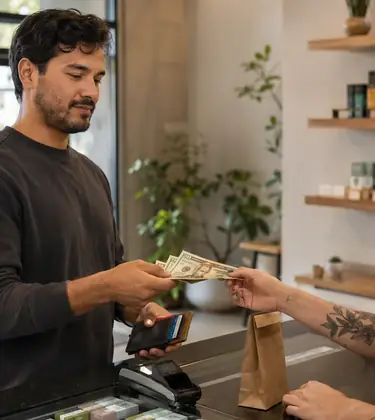
You walk into a licensed dispensary, pick out your gram, and reach for your card. The budtender points at a sign: cash only. There is an ATM bolted to the wall by the door, and it wants three or four bucks just to hand you your own money. Welcome to one of the weirdest contradictions in American retail. Cannabis is legal to buy across most of the country, yet you often cannot pay for it the way you pay for groceries, gas, or a coffee.
This is not your dispensary being difficult. It is the result of a long fight between state law and federal banking rules, plus a bill called the SAFE Banking Act that keeps almost passing and never does. Here is what is actually going on, why your card does not work, and where things stand in 2026.
Why are dispensaries cash only?
Short version: banks are scared of cannabis money.
Cannabis is still listed under the federal Controlled Substances Act. In April 2026 the Justice Department moved state-licensed medical cannabis and FDA-approved cannabis products to Schedule III, but recreational cannabis stayed in Schedule I, the same category as heroin. For a bank, that classification is the whole problem.
Federally chartered banks answer to federal regulators. If they hold deposits from a business selling a Schedule I substance, they risk being treated as money launderers, even when that business is fully licensed by its state. The Bank Secrecy Act also forces banks to file suspicious activity reports on cannabis money, which buries them in paperwork. Most decide the exposure is not worth it and refuse to open accounts for dispensaries at all.
No bank account means no merchant account. No merchant account means no card terminal that works with Visa or Mastercard. The store runs on cash because cash is the one thing nobody can freeze. A small slice of regional banks and credit unions do serve the industry, usually charging a premium to cover the compliance burden, but they are the exception.
That cash-only reality creates real problems on the ground:
Security risk. A cash-heavy shop is a target. Armed robberies at dispensaries are a documented hazard, and piles of bills only raise the stakes for staff and customers.
Tax headaches. Paying state and federal taxes in cash, sometimes hundreds of thousands of dollars, turns a routine filing into a logistics operation.
No credit. Without banking relationships, operators struggle to get the loans and lines of credit that every other legal business relies on to grow.
Can you use a credit card at a dispensary?
For a straight credit card purchase on the Visa or Mastercard network, the honest answer is no. Those networks do not knowingly process cannabis sales, period.
What you actually bump into is a workaround called the cashless ATM, sometimes labeled point of banking. You swipe your debit card at the counter, the machine treats it like an ATM withdrawal instead of a purchase, rounds your total up to the nearest five or ten dollars, and the budtender hands you the change in cash. That rounding, plus a flat fee of a few bucks per swipe, is why the machine in the corner feels like a tax on getting high.
Here is the catch. The card networks consider that trick a violation of their rules, because a retail sale is being dressed up as a cash withdrawal. Visa has warned banks about cashless ATMs and moved to shut them down, leaving dispensaries in several states scrambling when their systems suddenly stopped working. The company has even used secret shoppers to catch stores in the act. Some shops switched providers, some reverted to pure cash, and customers got caught in the middle.
So when a dispensary tells you the card reader is down, sometimes it is down for good. To save yourself the surprise at checkout, here is what actually works at most shops today:
Cash. Always accepted, and the cleanest option. Pull it from your own bank's ATM before you go and you dodge the inflated fee the dispensary machine charges.
Debit, ATM-style. The cashless ATM or PIN debit setup described above, wherever the store still has it running. Expect rounding and a flat fee per transaction.
Bank-transfer apps. A growing number of dispensaries accept app-based payments that pull straight from your checking account and skip the card networks entirely. You link your bank once, then pay from your phone.
Credit cards with a Visa or Mastercard logo are the one thing you should not count on, no matter what a sign out front promises.
What is the SAFE Banking Act, and why has it not passed?
The SAFE Banking Act, now usually called the SAFER Banking Act, is the fix the industry has chased for over a decade. Its job is narrow and practical: give banks and credit unions a safe harbor so they can serve state-legal cannabis businesses without federal punishment.
It does not legalize cannabis. It does not change the schedule. It simply tells federal regulators to stop penalizing banks for working with the weed industry. If it passed, dispensaries could open ordinary checking accounts, accept cards on the major networks, run payroll, and apply for loans. Owners would even get fairer treatment when applying for a home mortgage on cannabis income.
You would think that would be an easy yes. It has not been. The bill has passed the House multiple times and cleared a Senate committee, yet has never received a full Senate floor vote. Versions have stalled over fights about bolting on broader criminal-justice and social-equity provisions, and over plain political timing. As of 2026, with control of Congress shifted, the appetite for even this modest reform has cooled again. The bill is alive, but it is parked.
Feeling lost on how to start? Try taking our quiz!
Start a QuizDoes rescheduling cannabis fix the banking problem?
This is where 2026 gets confusing, so let us be clear about it.
The April move to Schedule III was a genuine win for medical operators, mostly because it lifted a brutal tax rule known as 280E that had blocked them from deducting normal business expenses. A broader DEA hearing scheduled to begin June 29, 2026 will decide whether all cannabis, recreational included, follows medical to Schedule III.
But here is the part people get wrong: rescheduling does not open the banking floodgates. Even at Schedule III, cannabis stays federally controlled outside of FDA-approved channels, so banks still carry compliance risk. The federal guidance they lean on is more than a decade old and has not been refreshed. Most major banks have already signaled they will stay on the sidelines until there is explicit legal protection, which is exactly what the SAFER Banking Act would provide.
Rescheduling chips away at the stigma and the tax penalty, and over time it may nudge a few more institutions toward the industry. It does not hand your dispensary a working card terminal. The banking lock stays in place until the law specifically says banks are safe.
The unexamined day is a wasted opportunity. Reflect on what you did, what you learned, and how you can improve.
John Dewey
How do you skip the cash-only counter entirely?
At Barney's Farm we have been breeding cannabis for more than 40 years and collected over 40 Cannabis Cup wins along the way, so we will say the plain thing the banks will not. The surest way to stop feeding that ATM is to grow your own.
A single seed becomes months of supply for the cost of a few grams at the counter. No card reader, no rounding up, no convenience fee, and no question about whether your purchase lands on a bank statement. You plant, you wait, you harvest, and the whole banking circus stops being your concern.
If you are starting out and want a plant that is forgiving and generous, two of ours are hard to beat:
Pineapple Chunk. A vigorous, mold-resistant indica-dominant hybrid with THC around 26% and yields up to 550 to 650g/m² indoors. Sweet, sturdy, and famously easy to keep alive, which is exactly what a first grow should be.
Critical Kush. A heavy, resin-soaked classic crossing Critical Mass with our own OG Kush. It finishes fast at 55 to 60 days, shrugs off mold and mildew, and rewards you with dense, knockout colas.
Grow a tent of either and the cash-only sign at your local shop quietly stops mattering.
Where does this leave you at the register?
The cash-only dispensary is a symptom of a banking system that still treats a legal industry like a crime scene. The SAFE Banking Act could change that with a single signature, and rescheduling may eventually help around the edges. Until Congress actually moves, expect to keep seeing that ATM by the door and keep deciding whether the convenience is worth the fee. Or skip the line altogether and put a seed in the soil.
Barney's Farm has been developing premium cannabis genetics since the 1980s, with over 40 Cannabis Cup wins. Explore our full seed catalog and find strains bred for every climate and skill level.