Is Weed Legal in Washington DC? The Gifting Loophole Explained
For about nine years, the answer to "where do I buy weed in DC" was a sticker.
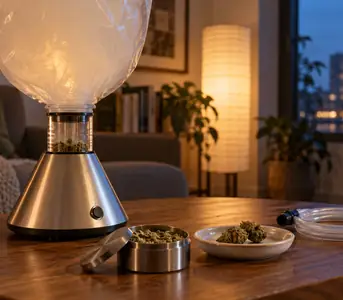
You walked into a storefront, paid thirty dollars for a sticker or a t-shirt or a piece of art nobody wanted, and the clerk handed you an eighth as a thank-you gift. Everyone knew what was happening. The clerk knew, you knew, and the city knew. That was the DC weed gifting economy, and it existed because DC voters legalized weed and Congress refused to let them sell it.
That era is basically finished. This guide covers what Initiative 71 actually did, why sales stayed illegal, how the gifting loophole worked, what shut it down, and what buying weed in Washington DC looks like in 2026.
Legal to have, not to sell
Possessing and growing weed in DC is legal for adults 21 and over. Selling it for money is not. The gap between those two facts is the entire story.
Unlicensed gifting shops have been padlocked by the hundred. The legal way to buy cannabis in the District now runs through licensed retailers under the medical program, and adults 21 and up can register for that program themselves without a doctor. Visitors can do the same thing online in about ten minutes.
What Initiative 71 actually legalized
DC voters passed Initiative 71 on November 4, 2014, with 70.06% of the vote, and it took effect on February 26, 2015. That is a landslide by any measure.
Adults 21 and over in DC can possess up to two ounces of cannabis, grow up to six plants at home with no more than three mature at once, and transfer up to one ounce to another adult 21 or over without payment.
That last clause is the famous one. The initiative permitted giving weed away. It said nothing about selling it, because it could not.
Why DC cannabis rules stopped short of sales
Initiative 71 was written to legalize possession only. Under the Home Rule Act, DC ballot initiatives cannot appropriate funds, so a tax-and-regulate scheme was off the table from the start. The Council intended to build the retail framework separately.
Then Congress stepped in. In December 2014, Maryland Representative Andy Harris attached a rider to the federal spending bill barring DC from using funds to legalize or reduce penalties on Schedule I distribution. Congress has renewed that rider in every annual spending package since, overriding the referendum result in a city with no voting representation in the body doing the overriding.
So DC got a legal product with no legal storefront. Anyone who has ever run a business can guess what happened next.
Feeling lost on how to start? Try taking our quiz!
Start a QuizHow the gifting loophole worked
Entrepreneurs read the text of Initiative 71 the way lawyers read anything, which is to say closely and creatively. Giving cannabis away is legal. Selling a sticker is legal. Do both in the same transaction and you have a business.
The formats multiplied fast. Some shops sold overpriced juice. Some sold digital art. Some sold "membership." Delivery services ran the same play with a courier. Pop-up markets took over event spaces on weekends and moved product by the pound under a banner that said "donations."
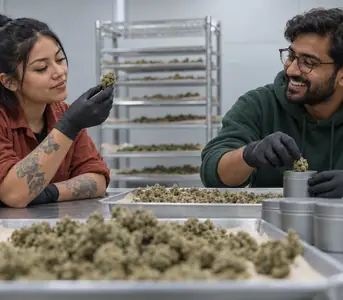
At its peak the District carried well over a hundred of these operations, and none of them tested anything, paid cannabis tax, or answered to a regulator. The quality ranged from genuinely good to genuinely alarming.
The unexamined day is a wasted opportunity. Reflect on what you did, what you learned, and how you can improve.
John Dewey
What shut it down
In July 2024 the DC Council gave the Alcoholic Beverage and Cannabis Administration real enforcement power, including the ability to padlock a storefront. Enforcement began that September, and it has not slowed since.
By January 2026, ABCA had shut down its 100th illegal cannabis shop. The running seizure tally from those operations included 710 pounds of cannabis flower, 5,304 pounds of THC edibles, more than 8,000 pounds of vape cartridges, oils and wax, and 12 firearms. Ninety-five former grey-market businesses took the other exit and converted to licensed status.
The city also made the legal route genuinely easy, which mattered more than the padlocks. When registering as a patient takes ten minutes and costs less than a delivery fee, the sticker shop loses its only real advantage.
Buying weed in Washington DC, legally, in 2026
There are two doors and both of them are open.
Adults 21 and over can self-certify. You fill out an adult patient application with ABCA, no healthcare provider recommendation required, and you get a digital registration by email that works immediately at any licensed retailer. Registrations issued since March 2025 run for two years. A physical card is optional and costs ten dollars.
Non-residents 21 and over can register online as a temporary patient and self-certify the same way. You pick a validity window of 3, 30, 90, 180 or 365 days, pay, and the digital registration arrives by email ready to use. The whole thing takes about ten minutes. If you already hold a medical card from another state, reciprocity generally covers you at no cost. Virginia residents are the exception and still need a written certification from a practitioner.
The scale of this is not small. In June 2026, DC's cannabis program moved $10,381,484 and counted 131,133 registered DC resident patients, on top of another 12,849 temporary registrations issued that same month. For a city this size, that is not a niche medical program. That is a legal market wearing a medical hat because Congress will not let it take the hat off.
Where you still cannot light up
Public consumption remains illegal in the District, and the penalties are real. A large share of DC is also federal land. The National Mall, the monuments, Rock Creek Park, federal buildings and the grounds around them all sit under federal jurisdiction, where cannabis is still a Schedule I controlled substance and a DC patient registration means nothing at all.
Consume at a private residence with the owner's permission. That is the safe answer, and the only one.
Six plants in a rowhouse basement
Here is the part of Initiative 71 nobody talks about, and the part we find most interesting.
The home grow allowance never went away. Six plants, three mature, per adult, in a household capped at twelve. In a city where retail took a decade to sort itself out, the legal right to grow your own has been sitting there untouched the whole time.
DC's growing conditions are specific and worth planning around. Summers are humid and hot, with July dew points that regularly sit in the low seventies. Outdoor growers in the mid-Atlantic lose more crops to bud rot than to any other single cause, and dense indica-leaning colonies are the ones that go first. Most DC housing stock is rowhouses and apartments, so the realistic grow space is a basement, a closet or a small tent, not an open backyard.
Two things follow from that. First, when you are capped at three mature plants, yield per plant carries the whole grow, so a strain that produces heavily under a light is worth far more to you than one that needs numbers. Gorilla Z is our answer to that math, pushing 700 to 800 grams per square meter indoors at around 32% THC while holding a manageable 100 to 140 cm indoor height. Three of those in a four-by-four tent will fill a household jar rotation for a long time.
Second, discretion and speed matter in shared walls. Pineapple Express Auto runs seed to harvest in 65 to 70 days without any light schedule change, staying around 90 to 110 cm, which suits a closet tent and a grower who does not want a five-month project visible to a housemate.
Forty years of breeding work goes into exactly this problem: getting a plant to do more in less space, in less time, in worse air. Selecting for structure that lets air move through a canopy is unglamorous work compared to chasing terpenes, and it is the difference between harvesting in a humid August and losing the lot.
What's left of the loophole
Weed is legal to hold and grow in DC and illegal to sell, and that has been true since 2015. The gifting shops filled the gap for nine years, and enforcement has now closed more than 110 of them. Adults 21 and up, residents and visitors alike, can self-certify into the medical program in minutes and buy from a licensed, tested, regulated retailer. The loophole is closed. The law that created it, the one letting you grow six plants at home, never was.
Barney's Farm has been developing premium cannabis genetics since the 1980s, with over 40 Cannabis Cup wins. Explore our full seed catalog and find strains bred for every climate and skill level.