The Barney's Farm Grow Shop Is Open: Kit From Seed to Jar
For forty years we have sold the start of the grow. Everything after the seed was your problem. You bought pots from one place, scissors from another and a drying rack from whoever had one in stock, and half of it was built for tomatoes.
That changes now. The Barney's Farm grow shop is open, with the gear we actually use between germination and the jar. Grow tents, LED grow lights and ventilation cover the setup. Fabric grow bags, a bud scope, grow room glasses, a drying rack, trimming scissors and plant labels cover the plant.
Here is the kit and why each piece earns its place.
Why grow cannabis in fabric pots?
Roots in a smooth plastic pot hit the wall and keep going around it. Over a full run that turns into a tight, circling mass that chokes the plant and makes it drink unevenly.
Fabric works differently. The walls breathe, so the edge of the root ball dries out and roots stop when they reach it. University of Florida research on nursery containers found that air drying the media at the outer edge of the root ball reduces circling roots. The plant responds by branching new roots back into the middle of the pot, which is where you want them.
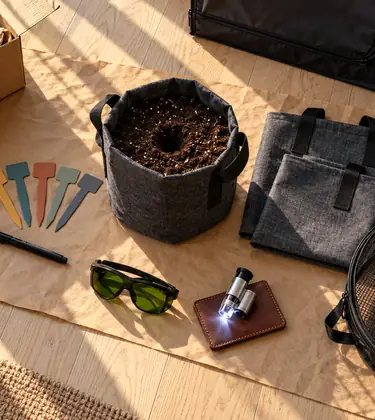
Our fabric grow bags come in five sizes: 5, 10, 17, 20 and 34 gallons. The 5 gallon bag suits a single plant in a 2x2 tent, on a balcony or on a windowsill, and an auto can live in it for its whole run. The big bags suit photoperiod plants you want to push bigger or take outdoors. Put autos straight into their final bag on day one, because transplanting costs them days they never get back. Reinforced handles make a full bag easier to move, and with ordinary handling a bag lasts several grows.
When is cannabis ready to harvest?
The calendar gives you a window. The trichomes tell you the day.
Trichomes are the tiny resin glands on the flowers and sugar leaves, and they change as the plant ripens. NC State Extension describes the sequence: trichomes start clear, turn opaque white as they mature, and then start turning amber. Clear heads mean the plant is not ready, so cut then and you lose potency. Cloudy heads are the peak, and most growers cut when the heads are mostly cloudy with 5 to 20 percent amber. Wait longer and the amber heads, where THC is breaking down into CBN, pull the effect toward a heavier, sleepier body high.
You cannot read any of that with the naked eye. Our bud scope is a pocket microscope with x60 magnification and a built-in LED, enough to see individual trichome heads and judge the ratio, even in a tent with the lights off. Read the flower itself, not the sugar leaves, because leaf trichomes ripen earlier and will tell you to cut too soon. Check buds from the top and the middle of the plant, because the top ripens first.
The scope earns its place in veg and flower too. At this magnification spider mites, aphids and eggs on the underside of a leaf show up weeks before the damage is obvious to the eye. It has a metal body with glass optics and ships in an embossed leather pouch inside a printed Barney's Farm box, so it works as a gift as well.
Do you need glasses in a grow room?
If you grow under LED panels, they make the job a lot easier. Most LED grow lights lean on red and blue diodes, which appear pink to purple to the human eye. A tent panel will not injure your eyes at normal working distances, but the brightness causes eye strain and headaches over a long session.
The bigger problem is the color cast. Under a purple-pink glow every leaf looks strange. Nitrogen, magnesium and phosphorus deficiencies all look roughly the same, and early pest damage and bud rot hide in that cast. Our grow room glasses have green-tinted, color-correcting lenses that pull the light back toward neutral. They are enough to tell pale green from yellow, to see a leaf edge starting to burn and to spot the stippling that means spider mites before the webbing appears.
Wear them for inspecting, training, defoliating and scouting with the lights on. Take them off before you judge trichome color or take photos, because the tint skews both. They are made for LED panels, so under HPS you need a different lens.
Feeling lost on how to start? Try taking our quiz!
Start a QuizHow should you dry cannabis?
Slowly, in the dark, with air moving. A fast, warm dry locks chlorophyll into the flower and gives you harsh, grassy smoke. A wet, still room gives you mold.
Oregon State University Extension recommends slow drying in a dark, well-ventilated room at 64 to 70°F and 50 to 55 percent relative humidity. Expect seven to fourteen days. The flower is ready for jars when a small stem snaps instead of bending.
Our 4 tier drying rack is a hanging mesh rack, 60 cm (about 24 in) across, with mesh on every side so air reaches every bud. Each tier has its own zip, so you can turn the harvest without lifting buds out and knocking off trichomes. Lay the buds in a single layer, not touching, and turn them once a day. Point any fan away from the rack, because a fan blowing on the buds dries the outside while the inside stays wet. Hang it from a hook or a tent bar, and it collapses flat into its own storage bag between grows.
This matters most on dense, cure-sensitive plants. Blue Cheese is the classic example: short and stocky with tight flower, easy to grow and easy to dry badly. It tests at 26 percent THC and flowers in 60 to 65 days. Rush the dry and you will taste it. Give it two weeks on a rack and the Cheese side comes through.
The unexamined day is a wasted opportunity. Reflect on what you did, what you learned, and how you can improve.
John Dewey
What makes good trimming scissors?
Straight blades, a light frame and a spring that does not tire your hand. Trimming a big harvest means thousands of cuts, and dull or heavy scissors crush the flower, knock off trichomes and wreck your hand before the job is done.
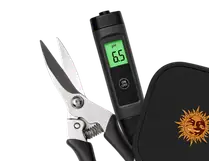
Our trimming scissors have straight stainless steel blades and weigh 67 g (2.4 oz), light enough to use for hours. The blades are short, which gives you control at the base of a bud where the tucked leaf sits. Stainless resists the resin build-up and rust that ruin cheaper pairs after one season, and the same pair handles defoliation and cuttings in veg.
Wipe the blades with isopropyl alcohol every twenty to thirty minutes, before the resin sets. On a heavy-resin plant like Gorilla Z Auto, whose GG4 side is famous for gumming up blades, you will be cleaning them constantly. Gorilla Z Auto runs 75 to 80 days from seed and tests at 25 percent THC, so it is a sticky harvest that comes around fast. Scrape the residue off the blades and keep it, because it is finger hash.
Why label your plants?
Because every grower who skipped it has regretted it. Two plants that look identical in veg can finish two weeks apart. Mix them up and you harvest one early and the other late.
Our plant labels are waterproof, UV-stable stakes in five seed types: feminized, autoflower, regular, F1 hybrid and F1 auto. Each one is color-coded by seed type and has write-on panels for the strain name and the key dates. They are sold in packs of three per seed type, and the plant label set covers all five types. Growing feminized seeds only? The Bag & Tag Kit pairs a fabric bag with feminized labels.
Write the strain, the germination date and anything you changed along the way with a permanent, fade-resistant marker. When you want to grow a plant again, the label is the notebook that tells you how.
What does the grow shop mean for your next run?
It means one order covers the whole grow. Seeds, bags, scissors and a rack arrive together, from people who have been growing since 1986 and know which kit makes a difference and which is just more plastic.
Start with the pieces that cause the most trouble when they are missing: a scope for harvest timing and a rack for the dry. Those two decide the quality of what goes in the jar more than anything else you can buy after the seed. The Harvest Kit puts the bud scope, trimming scissors, 4 tier drying rack and a permanent marker in one box.
Seeds ship as collectible souvenirs, and germination depends on your local law.