Cross Joints and Tulip Joints: The Show-Off Rolls Explained
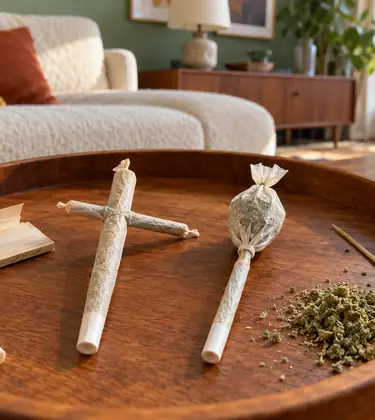
Most joints are built to be smoked. A cross joint or a tulip joint is built to be seen first, the kind of roll that gets the whole room's attention before anyone lights it.
Both take extra papers, more flower than a standard joint and steady hands, and both are made for sharing.
Key takeaways
- A cross joint is a long joint with a shorter one pushed crosswise through it, so three ends burn at once.
- Seth Rogen and Evan Goldberg rolled about 100 cross joints for "Pineapple Express" because nobody else on the crew could.
- Tulip joints pack flower into a cone of paper tied to a long, thin joint that serves as the stem.
- The average joint holds about 0.32 grams of flower, while a showpiece roll can hold several times that much.
Pineapple Express and the cross joint
The cross joint got its big moment in "Pineapple Express," the 2008 stoner comedy starring Seth Rogen and James Franco. The rolls on screen were real handiwork. Rogen and his co-writer Evan Goldberg had to roll all the cross joints needed to film, about 100 of them, because nobody else on the crew could roll them properly, Rogen recalled on the film's 10th anniversary.
The film did not invent the roll, though. "Yeah, we smoked those in high school," Rogen told The Baltimore Sun in 2008, adding that they were shocked it had never been in a movie before. For a movie-night roll, two of ours tie straight back to the film:
- Pineapple Express, a Hawaiian landrace sativa and Trainwreck cross at 28% THC, has a sweet tropical pineapple terpene profile with cedar undertones.
- Trainwreck, the parent on the other side, is a sativa-dominant hybrid at 28% THC with a sharp, piney scent and hints of lemon and spicy pepper.
Rolling a cross joint, step by step
Learning how to roll a cross joint starts with two good ordinary joints, so if you are still practicing, start with rolling a single joint step by step. The rest is careful paperwork. Gum arabic, a tree gum, is used as a lickable adhesive on postage stamps, envelopes and cigarette papers, and in our experience a cross joint needs a little extra glue wherever papers meet. You need two or three papers, a gram to a gram and a half of ground flower and a thin skewer.
- Roll a long joint from a king-size paper, pack it firmly and add a crutch at the mouth end.
- Make a shorter, thinner joint for the crossbar and twist both of its ends closed.
- Pierce the long joint with the skewer about a third of the way down from the far end, then widen the hole gently.
- Slide the crossbar through the hole until equal lengths stick out on each side.
- Patch the gaps around the crossbar with small strips of paper, licked and pressed into place, so no air leaks in.
- Light the tip of the long joint and both ends of the crossbar, then draw from the crutch.
- Pull out what is left of the crossbar once the main ember reaches it, and finish the rest as a normal joint.
The patching matters most. In our experience, a cross joint with even one leak draws air instead of smoke from the crossbar. Placing the crossbar about a third of the way down also gives its two ends time to burn before the main ember reaches the crossing.
Feeling lost on how to start? Try taking our quiz!
Start a QuizBuilding a tulip joint
A tulip joint looks like a flower on a long stem, a wide cone of paper packed with flower and tied around the top of a long, thin joint. We found no credible source tracing it to a particular roller or place, and despite the flower's Dutch fame, nothing reliable ties it to Amsterdam. The name simply describes the shape. The long stem does real work, since it keeps the hot, wide cone well away from your lips and gives everyone in the circle something to hold.
Knowing how to roll a tulip joint is mostly about the cone. In our experience, it takes four to six papers and two to four grams of flower:
- Roll a long, thin joint with a crutch at one end to serve as the stem, packed loosely so it draws easily.
- Glue three or four papers together into a wide sheet, then shape it into a cone around your fingers.
- Fill the cone with ground flower, tapping it down until it holds its shape.
- Push the top of the stem into the open end of the cone, then pinch the paper tight around it and tie it off with a thin strip of paper.
- Fold the wide top of the cone closed, light it evenly while turning the tulip, and draw from the crutch.
A tulip burns slowly because the cone holds so much flower, so in our experience it suits a group of six or more passing it at an easy pace.
The unexamined day is a wasted opportunity. Reflect on what you did, what you learned, and how you can improve.
John Dewey
Other specialty joints and record rolls
Specialty joints go well past these two. In our experience, the best known among rollers are the windmill, a cross joint with extra arms, and the braid, three thin joints woven together and smoked as one. Some rollers treat joints as sculpture. In 2016, Hyperallergic called Oregon-based Tony Greenhand perhaps the Michelangelo of joint rolling, with past rolls shaped like angler fish, Mario Kart turtle shells and the Seattle Space Needle.
Size is its own sport. At the Harvest Cup in Worcester, Massachusetts, in December 2017, organizers showed off a massive, 100-foot-long joint that took 40 people, 3,000 yards of rolling paper and a month and a half to make, and one organizer said it held a thousand grams of cannabis. They hoped it would qualify for the Guinness Book of World Records, but Guinness World Records no longer accepts new records related to the use of tobacco, cannabis or nicotine products.
Flower and THC in a showpiece
A showpiece carries far more than a normal joint. Researchers estimated the mean weight of marijuana in a joint is 0.32 g, using survey data from people arrested between 2000 and 2010, a figure lower than the ones commonly used. Potency adds up fast too. Advertised THC averaged 21.5% across recreational dispensary products in a 2020 study of nine states, and a smoker absorbs only part of it, most commonly 10% to 35%. At 20% THC, the math looks like this:
| Type of roll | Papers you need | Flower, in our experience | THC at 20% potency |
|---|---|---|---|
| Standard joint | 1 | 0.3 to 0.5 g | 60 to 100 mg |
| Cross joint | 2 to 3 | 1 to 1.5 g | 200 to 300 mg |
| Tulip joint | 4 to 6 | 2 to 4 g | 400 to 800 mg |
| Type of roll | Standard joint | Cross joint | Tulip joint |
|---|---|---|---|
| Papers you need | 1 | 2 to 3 | 4 to 6 |
| Flower, in our experience | 0.3 to 0.5 g | 1 to 1.5 g | 2 to 4 g |
| THC at 20% potency | 60 to 100 mg | 200 to 300 mg | 400 to 800 mg |
So a single tulip can carry the THC of several standard joints. Pass it slowly and let newer smokers skip a round. Weigh your flower before you start rolling, too, since a big tulip can use most of an eighth.
Sharing a showpiece legally
A multi-gram roll sits well within adult possession limits in legal states. New York lets adults possess up to three ounces of cannabis and give the same amount to another adult without compensation, and California's limit is 28.5 grams. Rolling one for friends is fine in both states as long as the gift is free.
Where you light it matters more than how big it is. Public smoking stays banned in most legal states, so in our experience a showpiece belongs in a private home or a licensed consumption lounge, with everyone in the circle 21 or older. It is also a long smoke. A tulip can take a group half an hour or more to finish, so rest it in an ashtray between rounds instead of letting it burn in someone's hand.
Showpiece joints, rolled with care
A cross joint sets three ends burning at once, and a tulip packs a cone of flower onto a long stem. Both take more papers, more flower and more patience than a standard joint, and both carry several joints' worth of THC. Roll them for a private home or a licensed lounge, keep the gift free and pass them slowly.
Barney's Farm has been developing premium cannabis genetics since the 1980s, with over 40 Cannabis Cup wins. Explore our full seed catalog and find strains bred for every climate and skill level.