What's Actually in a Vape Cart: Distillate, Terpenes and Cutting Agents
A cart that tastes of mango did not get that from a mango, and probably did not get it from the cannabis either.
Distillation strips a cannabis extract down to almost pure cannabinoid, removing the aromatic compounds along the way. Somebody then adds flavor back in. What they add, and where it came from, is the least regulated part of the whole product.
This guide covers how distillate is actually made, what gets destroyed on the way, what goes back in, what the cutting agent era did to people, and how little a label is obliged to tell you.
Stripped, then flavored back in
Most carts are highly refined cannabinoid oil with flavor added afterward. Whether that flavor came from cannabis, from oranges, or from a flavor house is usually not disclosed, and in most states nothing requires it to be.
How distillate is made
The process is industrial chemistry, and each step removes something.
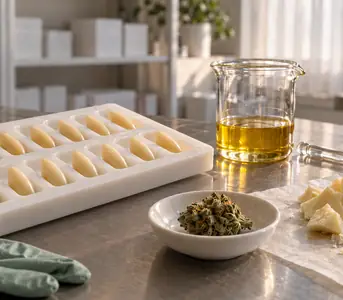
Extraction pulls the cannabinoids out with hydrocarbon, CO2 or ethanol. Solvent choice matters: ethanol drags along unwanted chlorophyll, while hydrocarbon avoids water and pigments. Then comes winterization, which involves the separation/sedimentation of the waxy fractions by the deep freezing of the crude for over 24 h and subsequent filtration, stripping out fats and waxes.
Next the extract is heated to around 104 degrees Celsius to decarboxylate, converting THCA into THC. Then distillation proper, run at roughly 160 to 180 degrees Celsius under vacuum, which is the boiling range of the cannabinoids.
The result is potency far beyond flower. Concentrates typically run above 50 to 95 percent THC compared with around 10 to 30 percent in plant material.
What gets stripped, and why it has to be
Terpenes are the casualty, and it is not an accident of sloppy processing. It is thermodynamics.
Myrcene boils at about 167 degrees Celsius. Limonene at about 177. Set those against a distillation cut running at 160 to 180, under vacuum that lowers boiling points further, and the terpenes come off as the light fraction long before the cannabinoids do.
Temperature drives the loss even at the extraction stage. One controlled study found terpene content decreased by 54.1 percent and 32.2 percent for extraction at minus 20 degrees and room temperature respectively, compared with extraction at minus 40.
So the industry does the obvious thing. In a typical workflow the terpene oil is extracted separately and then added back to the purified cannabinoid concentrate to restore flavor.
Nobody hides this. It is simply not what most consumers picture when they read a strain name on a cart.
Feeling lost on how to start? Try taking our quiz!
Start a QuizWhat goes back in
Here is where it gets interesting, because somebody measured real products. Researchers analyzed twelve California cartridges and found terpenes present at below 1 to 7 percent, and identified around 60 various terpenes, terpenoids, flavor and fragrance agents across the samples.
More telling, the same analysis found that some flavor and fragrance agents including valencene, menthone, benzyl alcohol, D-carvone and triacetin were purposely added. Menthone, benzyl alcohol and D-carvone are not cannabis terpenes. Triacetin is a food and fragrance solvent.
Loading can go much higher than the measured range. Toxicology work describes cartridges containing 10 to 20 percent terpenes by weight, serving double duty as flavor and as viscosity control.
The legal position is stranger than the chemistry. Washington permits a characterizing flavor in a cannabis vapor product if it is derived from botanical terpenes naturally occurring in the cannabis plant, regardless of source, and excludes synthetic terpenes.
Read that phrase again. Regardless of source. The law regulates which molecule, not which plant it came from. A limonene distilled from orange peel is legal in a Washington cart because limonene also occurs in cannabis.
The unexamined day is a wasted opportunity. Reflect on what you did, what you learned, and how you can improve.
John Dewey
The cutting agent era
The additives problem is not hypothetical. It killed people.
During the 2019 outbreak of lung injury, investigators collected fluid from the lungs of 51 patients across 16 states. Vitamin E acetate was identified in 48 of 51 case patients, and THC or its metabolites in 40 of 47. All samples from 99 healthy comparison subjects were negative for every priority toxicant tested.
The outbreak reached 2,807 hospitalizations and 68 deaths, and the CDC's conclusion was that vitamin E acetate is strongly linked to it, with THC-containing products from informal sources linked to most cases.
The cleanest evidence that this was a new adulterant comes from Minnesota. Products seized in a 2018 raid tested negative for vitamin E acetate and MCT. Cartridges seized in September 2019 all contained THC, vitamin E acetate and MCT.
Licensed markets responded by banning the additives by name. Colorado's rules prohibit polyethylene glycol, vitamin E acetate and medium chain triglycerides outright, and restrict other additives to those listed in the FDA's inactive ingredient database for the inhalation route specifically. Washington made its vitamin E acetate ban permanent in November 2020.
Less familiar adulterants have shown up too. Researchers identified pine rosin, a known airway toxicant, as a major component of a cannabis extract adulterant, the first documented use of it in North America after prior reports in Europe.
Terpenes are not automatically safe to inhale
This is the part almost no one covers, and it complicates the natural-flavor story considerably. Terpenes degrade under heat, and the products are not benign. Research on cannabis aerosols found that isoprene, 2-methyl-2-butene, 3-methylcrotonaldehyde and 3-methyl-1-butene derive from a common radical intermediate for both THC and myrcene, and that these four products make up 18 to 30 percent of the aerosol gas phase, with levels highly correlated to applied power.
Almost a third of the gas you inhale, at higher power settings, is degradation product. And one of those is an aldehyde.
Separate work found that users may be exposed to degradants including methacrolein, benzene and methyl vinyl ketone, and that added terpenes led to higher levels of gas-phase products compared with THC alone.
There is a genuine nuance worth stating. In cartridge vaping specifically, one study found that raising myrcene content from 7 to 14 percent actually decreased release of benzene, butadiene and isoprene and improved THC transfer, while the opposite happened when dabbing. Device and temperature change the answer.
What nobody has studied is the concentration question. Measured carts ran 1 to 7 percent terpenes, formulations run 10 to 20 percent, and flower is nowhere near that. Nobody has tested what inhaling terpenes at several times their natural concentration does over years.
What a label has to tell you
Less than you would hope. California requires ingredients listed in descending order by weight and requires artificial colorings to be disclosed. There is no requirement anywhere we found to distinguish cannabis-derived terpenes from botanical ones. Nor is the phrase cannabis-derived terpenes a defined regulatory term. California's own definition of terpenes is functional, covering naturally occurring phytochemicals contributing to aroma or flavor, with no origin requirement at all.
Terpene testing itself is usually optional. New Jersey's regulator lists the terpene profile on a certificate of analysis as optional, but important for aroma and effects, while microbials, heavy metals, pesticides, residual solvents, moisture and mycotoxins are mandatory.
Washington shows what full disclosure would look like, and who gets it. Processors must submit an ingredient disclosure form to the regulator covering every compound including additives, preservatives, thickening agents and terpenes. The state knows exactly what is in every cart. The buyer does not.
One more thing worth knowing: heavy metals can leach from the hardware into the oil after the compliance test was run. Minnesota's regulator now requires stability testing in final packaged form, noting that solutions stored in vape devices should be tested for heavy metals, with a default six-month expiration until evidence-based dates exist.
Why flower does not have this problem
Every issue in this article comes from taking a plant apart and putting a version of it back together. Strip the terpenes to get purity, add flavor back to fix what purity cost, thin the oil so hardware can wick it, and hope the additives are inert when heated.
Whole flower skips all of it. The terpene profile is whatever the plant made, at whatever concentration the plant made it, sitting on the trichomes where it grew. There is no formulation step, no flavor sourcing decision, and no additive.
That also means the genetics carry the entire flavor result, which is the part we can actually influence. Breeding for terpene expression is slower and less impressive on a lab report than pushing THC upward, and it is the thing people notice.
Mimosa EVO is our clearest example, Mimosa crossed with Orange Punch at 30% THC, a 60% indica running 65 to 70 days at 100 to 120 cm indoors, tropical lemon and orange over berry, happy and uplifting. Mimosa x Orange Punch Auto takes the same citrus line into an autoflower at 24%, 65 to 70 days from seed and compact at 80 to 100 cm, sweet mandarin and candy orange.
Neither needed a flavor house. Four decades of breeding is largely the work of getting a plant to smell like something on its own.
What the label leaves out
Distillate is made by stripping an extract down to 50 to 95 percent cannabinoid, which removes the terpenes because they boil at or below the distillation temperature. Flavor is then added back.
Measured California cartridges contained 1 to 7 percent terpenes and around 60 different flavor compounds, some demonstrably not from cannabis. Formulations can run 10 to 20 percent terpenes by weight. Washington law permits botanical terpenes regardless of source, and no state defines cannabis-derived terpenes as a regulated term.
Vitamin E acetate was found in 48 of 51 lung-injury patients in 2019 and is now banned by name in licensed markets. Terpene degradation products make up 18 to 30 percent of the aerosol gas phase, and nobody has studied long-term inhalation at these concentrations.
Barney's Farm has been developing premium cannabis genetics since the 1980s, with over 40 Cannabis Cup wins. Explore our full seed catalog and find strains bred for every climate and skill level.