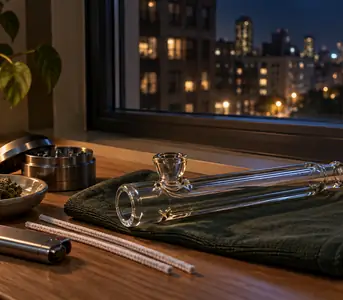
Gandalf, Sherlock, Spoon and Chillum: Hand Pipe Shapes Explained

Before bongs, vapes and dab rigs, there was the pipe, and it is still how a lot of people smoke. Four classic shapes cover much of the hand pipe shelf in any glass shop, with nicknames borrowed from a wizard, a detective, a kitchen drawer and the holy men of India.
The names sound like jokes. The shapes change how hot the smoke gets, how the pipe sits in your hand and how easy it is to clean.
Every weed pipe has the same four parts
Strip away the color and a weed pipe is simple. There is a bowl where the flower burns, a stem the smoke travels through, a mouthpiece, and usually a carb, a small hole on the side that you cover with a finger while you light and uncover to clear the smoke. No water, no chamber, no moving parts. Cover the carb, light the edge of the bowl, draw, let go of the carb, and the last of the smoke rushes in.
Simple still wins. In a 2014 national survey of US adults, published in the American Journal of Preventive Medicine, 49.5 percent of current users smoked from a bowl or pipe, slightly more than the 49.2 percent who used joints and far ahead of the 21.7 percent who used bongs or other water pipes.
The spoon is the standard glass pipe
The spoon pipe is the one most people picture: a bowl at one end, a flattened body that fits the palm, a carb on the side and a mouthpiece at the other end, shaped roughly like a kitchen spoon. Good ones are borosilicate glass shaped at a torch, and blown-glass pipes and bongs are often intricately and colorfully designed, so the same basic spoon can sell for the price of lunch or, as collectible glass, for hundreds of dollars.
A glass pipe adds no taste of its own, and because you can see through it, you can see when it needs cleaning. Its enemy is the floor, which is why many spoons get a flat spot or small glass feet so they rest bowl-up without rolling. One-hitters, often carried in a small box called a dugout, are the spoon's tiny cousins, built for a single serving of about 25 milligrams.
Sherlock pipes owe more to an actor than to Doyle
The Sherlock pipe has a long downward curve: the bowl hangs low in front of the chin and the stem sweeps back up to the mouth. The shape comes from the stage. Arthur Conan Doyle only described his detective smoking clay, cherrywood or briar pipes, and Sidney Paget, who illustrated the stories for The Strand Magazine, drew him with straight ones. In "The Red-Headed League," Holmes calls one case "quite a three pipe problem" and asks Watson not to speak to him for fifty minutes.
The curve arrived with William Gillette, the American actor who played Holmes more than 1,300 times over thirty years. He used a curved briar, most likely because a straight pipe wiggles or falls when you speak with it clenched in your teeth, and his portrayal stuck: the deerstalker cap and the curved pipe became enduring symbols of the character.
The curve does the same job for a cannabis smoker. The pipe hangs from the mouth without blocking it, and the bowl sits out in front where you can watch it burn. The catch is cleaning, since resin collects in the bend.
Feeling lost on how to start? Try taking our quiz!
Start a QuizGandalf pipes are churchwardens with a movie nickname
The Gandalf pipe is the long one: a small bowl at the end of a straight or gently curved stem, often a foot long or more. Glass shops sell it as a Gandalf pipe, a nod to the wizard's long pipe in the "Lord of the Rings" films, but the shape is centuries older. Tobacco smokers call it a churchwarden, a style that can run as long as 16 inches (40 cm), is traced to the late 18th or early 19th century and is reputedly named after churchwardens, the lay officials of a parish.
The length is the point. A churchwarden gives cooler smoke because the smoke has farther to travel from the bowl to the mouthpiece, and it keeps the heat of the bowl away from your face. The cost is fragility: a long stem snaps easily and puts extra strain on the joint where it meets the bowl. Cannabis has its own long pipe, too. Morocco's sebsi pairs a narrow clay bowl and a fine metal screen with a hardwood stem up to 18 inches long, and serves a small, low-temperature hit of about 25 milligrams.
The unexamined day is a wasted opportunity. Reflect on what you did, what you learned, and how you can improve.
John Dewey
Chillums are the oldest shape on the shelf
The chillum is the simplest pipe of all, a straight conical smoking pipe traditionally made of either clay or a soft stone, with no carb and no bend. It is widely used in Nepal and India to smoke cannabis, often with a small stone dropped into the stem as a stopper, and it has been known in the Americas since the 1960s. The word came into English from the Hindi and Urdu chilam, itself borrowed from Persian.
In India, sadhus, the wandering holy men, smoke charas, hand-rubbed hashish, in clay chillums with a cotton cloth over the smoking end and a pebble-sized cone of clay inside as a filter, and chant the many names of Shiva before they light it. Rastafari use the chillum in rituals too, including a water-cooled version called a chalice.
Glass shops now sell glass chillums in the same straight shape, often sized for one or two hits. Federal law even names them: the drug paraphernalia statute lists chillums and carburetor pipes right alongside glass and ceramic pipes.
Small bowls reward flavorful flower
A hand pipe gives you the most direct taste of the flower, especially in the first couple of hits, as our comparison of joints, blunts, bongs and pipes puts it. No water and no paper stand between you and the bowl, which makes a pipe the truest test of a harvest. Grind medium, pack loosely and light only a corner of the bowl, so the rest stays fresh for the next hit.
Two of ours with flavor that shows up in a small bowl:
- Critical Kush crosses Critical Mass with OG Kush. The flavor is brighter than the nose suggests, with fresh pine, lemon pie and a tangy finish, at 26 percent THC in 55 to 60 days of flowering.
- Dos Si Dos 33 crosses Dos Si Dos with Gelato #33. The flavor is cooler and sharper than the nose, with mint and lime up front and a spicy finish. At 28 percent THC, one or two draws is a sensible place to start, and it flowers in 60 to 65 days.
Hot smoke, shared glass and clean screens
Pipes skip the water, so the smoke reaches you hotter than it would through a bong. Dentists who see tobacco smokers know what repeated heat does: a white patch on the roof of the mouth called stomatitis nicotina is linked mostly to pipe and cigar smoking, and pipe smoking produces more heat on the palate than any other form of smoking. Health researchers who drafted the Lower-Risk Cannabis Use Guidelines put the bigger point bluntly: people can substantially reduce their risk if they refrain from smoking-routes for administration.
If you do smoke a pipe, a few habits make it better:
- Use a screen if the bowl hole is wide. Brass, stainless steel and glass screens hold back ash and embers.
- Clean glass with isopropyl alcohol and coarse salt in a sealed bag, then rinse with warm water. A Sherlock's bend and a Gandalf's long stem need a pipe cleaner too.
- Keep your own pipe when someone has a cold sore or a cough, since cold sores spread through shared personal items.
- Store glass in a padded case, because a long stem rarely survives a fall onto tile.
Same fire, different shapes
A hand pipe is about as common as a joint among American smokers, and every shape is a variation on a bowl, a stem and a carb. The spoon is the everyday glass pipe, the Sherlock hangs from your mouth thanks to a stage actor, the Gandalf stretches the smoke path like a churchwarden, and the chillum is the old straight cone from India and Nepal. None of them changes what burning does.
Keep the bowls small, the glass clean and the mouthpiece to yourself. Barney's Farm has been developing premium cannabis genetics since the 1980s, with over 40 Cannabis Cup wins. Explore our full seed catalog and find strains bred for every climate and skill level.