Was the Declaration of Independence Written on Hemp Paper?
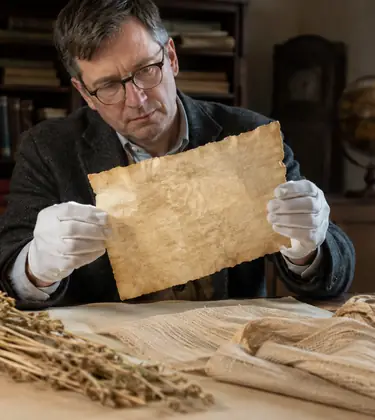
Short answer: no. And the question has a trick built into it, because the document everyone is picturing is not paper at all.
This is one of the most durable pieces of cannabis folklore in America. It shows up on T-shirts, in campaign speeches, in stoner trivia at 2am. It is wrong. But underneath it sits a genuinely interesting truth about hemp and the founding of the country, and that truth is more useful than the myth.
The engrossed Declaration is animal skin
The famous version, the one behind bulletproof glass in Washington with John Hancock's signature the size of a dinner plate, is written on parchment.
Parchment is not a type of paper. It is prepared animal skin, usually sheep or calf. The National Archives states it plainly: the Declaration, the Constitution and the Bill of Rights are all hand-written with iron gall ink on parchment. One sentence, three documents, myth over.
Congress voted on July 19, 1776 to have the Declaration "fairly engrossed on parchment." The engrosser was probably Timothy Matlack, the sheet measures about 24 by 30 inches, and signing began on August 2. The Constitution got the same treatment eleven years later, engrossed by Jacob Shallus on four sheets for a fee of thirty dollars. Iron gall ink was used because it bites into the parchment surface rather than sitting on top of it, which is a choice you make for skin, not for pulp.
But what about the drafts?
Fair question, and this is where the myth retreats when it gets cornered. Jefferson's rough draft was on paper. So were the Dunlap broadsides, the roughly 200 copies printed overnight on July 4 and 5 and posted around the colonies.
So was that paper hemp?
Almost certainly not. Monticello, which holds the deepest archive on Jefferson in existence, addresses the claim directly and answers no. The paper Jefferson used was most likely Dutch in origin, and Dutch papermakers overwhelmingly worked with flax and linen rags. An editor of Jefferson's papers at Princeton put it the same way: linen rags, primarily flax, not hemp. Some hemp fiber might have found its way into the mix, but there is no basis for a definitive claim.
As for the Dunlap broadsides, nobody knows. No fiber analysis of them has been published. They were rag paper by definition of the era, but which rags went into which sheet is not documented anywhere. If someone tells you the broadsides were hemp, they are guessing.
The part that is actually true
Here is the distinction the myth collapses, and it is the whole intellectual content of the question.
Eighteenth-century paper was not made from trees. Wood pulp did not take over until the 1840s. Before that, paper came from rags, meaning worn-out cloth beaten into pulp. A university library account of papermaking during the Revolutionary era describes it exactly: cotton, linen or hemp cloth mashed down to its smallest essence as plant fibers.
So hemp could be in colonial paper. But it arrived as recycled worn-out hemp cloth through the rag trade, not as a hemp crop grown and pulped for the purpose. Nobody in 1776 was farming hemp to make paper out of it. They farmed hemp to make rope, canvas and clothing, and when the clothing wore out, some of it eventually became paper.
That is a better story than the myth, because it is true and because it describes an economy where nothing got thrown away.
The 1776 paper shortage makes it vivid. By the start of that year there was almost no imported paper left in the colonies, and printing currency was draining what remained. Congress exempted papermakers from military service, and one skilled papermaker was pulled back from the army specifically to repair paper molds. Newspapers ran ads offering twelve pence a pound for clean white rags. The Revolution had a rag problem.
Feeling lost on how to start? Try taking our quiz!
Start a QuizWashington and Jefferson really did grow hemp
This part is not myth at all, and it is well documented by the institutions that own the primary sources.
Mount Vernon is unambiguous: George Washington grew hemp throughout his life across all five of his farms, and there is no truth to the claim that he grew marijuana. It was industrial fiber, used for rope, thread for sewing sacks, canvas, and repairing the seine nets at his fisheries. He mentioned hemp roughly 90 times in his diaries.
The diary entry that launched a thousand memes reads: "Began to seperate the Male from the Female hemp at Do. rather too late." Cannabis enthusiasts have been quoting that for forty years as proof Washington was growing sinsemilla.
It is not. Separating male from female plants is standard fiber agronomy. It controls seed for next year and improves fiber quality, since male plants yield coarser stalk. The tell is two days later, when Washington's own diary records putting hemp in the river to rot. That is retting, the standard first step in extracting bast fiber from a stalk. You do not ret a plant you intend to smoke.
Jefferson grew it too, documented at both Monticello and Poplar Forest from 1774 to 1821, mostly for cloth rather than rope. Three enslaved women, recorded as Aggy, Nanny and Isabel, worked as hemp spinners in the Monticello textile shop, expected to spin 400 pounds a year over 26 weeks. That detail gets left out of nearly every patriotic hemp article ever written, and it should not be.
The unexamined day is a wasted opportunity. Reflect on what you did, what you learned, and how you can improve.
John Dewey
The fake Jefferson quote
You have seen this one: "Some of my finest hours have been spent on my back veranda, smoking hemp and observing as far as my eye can see."
Jefferson never wrote it. It surfaced online around 2008, first appeared in print in 2013, got repeated by a presidential candidate on television, and spread through image macros from there. Monticello files it under spurious quotations. It has been found in none of his writings.
The second fake is subtler and more interesting. The line "hemp is of first necessity to the wealth and protection of the country" gets attributed to Jefferson constantly. It is a garbled version of something written by Gouverneur Morris in March 1791, in a document that happens to sit among the Jefferson papers. Morris actually wrote that the article in question was "of first Necessity to the Commerce and Marine in other Words to the Wealth and Protection of the Country", and separately noted that hemp, being a material for manufactures of various sorts, becomes a means of support to numbers of people.
Somebody compressed two Morris sentences into one Jefferson quote, and here we are.
Where the myth came from
Most of it traces to Jack Herer's 1985 book The Emperor Wears No Clothes, which sold something like 800,000 copies and became the founding text of the modern American legalization movement. It made a lot of claims. Some hold up. This one does not.
Two adjacent legends in the same cluster are real, which is probably why the hemp paper claim rode along with them. A February 1938 issue of Popular Mechanics did run an article headlined "New Billion-Dollar Crop," claiming hemp could produce 25,000 products ranging from dynamite to cellophane. And Hemp for Victory, the 1942 USDA film urging farmers to grow hemp for the war effort, is real, sitting in the National Archives and the USDA's own film collection at fourteen minutes of black and white 16mm. The stranger part is also real: before 1989, the federal government told inquirers no such film existed.
When two out of three legends check out, the third gets a free pass. That is how this works.
What forty years of breeding taught us about the fiber plant
We have been breeding cannabis in Amsterdam since 1986, and the founders' hemp is a different animal from anything in our catalogue in a way worth explaining.
Fiber hemp is bred for the stalk. Tall, thin, minimally branched, grown at high density so plants stretch toward light and put everything into a long clean bast fiber. It is planted like wheat and harvested like flax. Nobody is looking at the flowers.
Drug cannabis is bred for the flower, which means the opposite of everything above. Space between plants. Branching encouraged. Males removed rather than kept. A grower doing what Washington did in 1765, separating the sexes to preserve seed and improve stalk quality, would be destroying a modern sinsemilla crop on purpose.
The two lineages split a long time ago. What has survived from that older world is not fiber genetics but landrace genetics, the regional populations that developed in isolation before anybody was crossing anything on purpose. Those are the plants that still carry unmodified traits, and they are what we go back to when a modern line gets too inbred to hold up.
Hindu Kush is about as close to that as our US catalogue gets. Pure indica out of the Hindu Kush mountain range, 26 percent THC, 55 to 65 days in flower with an early October harvest, around 1,000g per plant outdoors. It purples hard in cold temperatures, which is a mountain trait rather than a designed one. Plants from that region had to finish before a hard alpine frost, and they still do.
Skunk #1 is the other end of the historical thread. Afghan crossed with Acapulco Gold and Colombian Gold, it is the cornerstone of modern cannabis breeding, and a startling share of what people smoke today has it somewhere in the family tree. Seventy-thirty indica, 26 percent THC, 65 to 75 days flowering with a late October harvest and about 800g per plant outdoors. If you want to hold a piece of actual cannabis history rather than a myth about one, that is where to start.
Seeds ship as collectible souvenirs, and germination is down to your local law.
The honest version
The Declaration of Independence was engrossed on animal skin. The drafts were on rag paper that was probably flax. Washington and Jefferson grew hemp for rope and cloth and never smoked it. The 1938 magazine article is real, the wartime film is real, the Jefferson veranda quote is not.
Hemp was woven into the colonial economy so completely that it did not need a legend attached to it. Rope, sailcloth, tents, sacks, shirts, and eventually, once the shirts wore out, paper. That is the actual history, and it is better than the T-shirt.
Barney's Farm has been developing premium cannabis genetics since the 1980s, with over 40 Cannabis Cup wins. Explore our full seed catalog and find strains bred for every climate and skill level.