
The Race to Breed THCV and CBG-Rich Strains
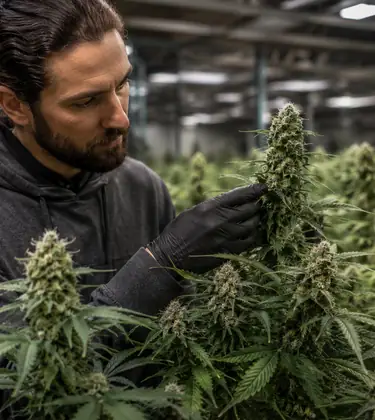
For thirty years the only number on a cannabis label that mattered was THC. Breeders chased it, growers bragged about it, dispensaries sorted by it. Somewhere around 30 percent the whole exercise started to feel silly, because a plant that tests at 32 does not get you meaningfully more stoned than one that tests at 26.
So the interesting work moved sideways. Two cannabinoids in particular have breeders, geneticists and a fair amount of venture money chasing them: THCV and CBG.
Here is what is actually going on, including the parts the marketing leaves out.
The chemistry, without the hand-waving
Everything starts with CBGA, the acid form of CBG, which is why people call it the mother cannabinoid. The plant builds CBGA from geranyl pyrophosphate and olivetolic acid, then enzymes convert it into THCA or CBDA. Whatever does not get converted stays as CBGA and decarboxylates into CBG.
That last sentence explains why CBG-dominant plants exist at all. A plant with a broken or absent THCA synthase and CBDA synthase cannot finish the conversion, so CBGA piles up. Chemotype IV, as the botanists call it, is essentially a loss-of-function outcome. It is a plant that failed to do the last step.
THCV is a completely different problem, and this is the part that almost nobody explains properly. THCV does not come from CBGA. It comes from CBGVA, which the plant builds from divarinolic acid rather than olivetolic acid. Divarinolic acid has a propyl side chain, three carbons, instead of the pentyl five-carbon chain. The varinic cannabinoids are two carbon atoms shorter all the way down the pathway.
So breeding for CBG means removing a step. Breeding for THCV means changing the raw material the plant starts with. One is subtraction. The other is a supply chain problem.
That asymmetry runs through the entire commercial story. High-CBG cultivars arrived quickly, flooded the market and commoditized. High-THCV cultivars are still rare, still expensive, and still mostly promises.
Where THCV actually comes from
Propyl chemotypes cluster in landrace populations from South and Southeast Asia and from Africa. That is why Durban Poison and the Malawi and Thai lines keep coming up in every THCV conversation. Those regional populations developed in isolation and some of them carry the trait at levels you simply do not find in the modern hybrid pool.
Which means the race to breed THCV is partly a race to go back to old genetics and pull something forward. Breeders are not inventing a trait. They are recovering one that four decades of chasing THC bred out.
What the research actually says
This is where you should get skeptical of every product page you have ever read.
The pitch for THCV is that it suppresses appetite and blocks the effects of THC at low doses while producing them at high doses. You have seen it called diet weed. The evidence for that is thinner and stranger than the marketing suggests.
A 2015 human imaging study gave twenty people 10mg of THCV and looked at brain response to food images. It did not find reduced reward processing. Activation actually increased in the putamen and anterior cingulate in response to chocolate, and subjective ratings did not shift significantly. Appetite and food intake were never measured.
A 2016 pilot in people with type 2 diabetes gave 5mg twice daily for thirteen weeks and did find improved fasting glucose and beta-cell function markers. Sixty-two participants. The authors called it a pilot, because it was one.
And a rodent drug-discrimination study published in 2025 found the dose relationship running in the opposite direction from the popular version. At 3mg/kg THCV partially substituted for THC. At 6mg/kg it antagonized it. Low dose acted more like THC, high dose blocked it. That is the reverse of what every retail page tells you.
CBG has less hype and, oddly, better recent evidence. The first controlled human trial of CBG, published in 2024, gave 34 people 20mg in a crossover design and found reduced anxiety and improved verbal memory with almost no intoxication. The authors noted the sample was experienced users and that they did not correct for multiple comparisons, which is exactly the kind of honesty you want and rarely get.
So the cannabinoid with the weakest pricing power has the strongest new clinical signal. Markets are not efficient.
Feeling lost on how to start? Try taking our quiz!
Start a QuizThe patents nobody talks about
Chemotype-level intellectual property already exists. A patent application with a 2013 priority date claims cannabis plants producing THCV above 1 percent and above 4 percent, and CBG above 1 percent and above 5 percent on a dry weight basis. Those thresholds sit at or above what most commercially announced cultivars report.
Which means the race to breed these plants is happening in a field where somebody already filed claims on the finish line. How enforceable that is remains an open question, and one that is going to get expensive to answer.
The unexamined day is a wasted opportunity. Reflect on what you did, what you learned, and how you can improve.
John Dewey
The regulatory twist that makes breeding the only legal route
Here is the development almost no one has connected.
Most THCV on shelves today is not bred. It is converted, usually from CBD, in a lab. That has been the cheap route. But federal enforcement has moved against exactly that method. A 2026 rule statement held that tetrahydrocannabinols produced through chemical conversion, even when hemp derived, count as synthetically produced under the Controlled Substances Act.
THCV is a tetrahydrocannabinol homolog. Converted THCV falls squarely inside that reasoning.
Then the hemp definition changes on November 12, 2026, capping total THC at 0.4 milligrams per container and banning cannabinoids synthesized outside the plant. CBG is untouched, because it is not a THC. THCV's fate depends on a forthcoming list of cannabinoids with pharmacologically similar effects.
Strip all that down and you get a strange conclusion. The regulatory tide is killing the cheap synthetic route while leaving actual plant breeding alone. The race to breed THCV is not purely a science story. It is partly regulatory arbitrage, and the breeders are going to win it by default.
What forty years of breeding teaches you about chasing a single number
We have been breeding cannabis in Amsterdam since 1986, which is long enough to have watched the industry fixate on three different numbers in sequence and be disappointed by all of them.
Here is what selecting for one compound actually costs. Every trait in a cannabis plant sits in a network. Push hard on a single cannabinoid and you drag everything else along for the ride: terpene expression, yield, flowering time, structure, resistance. A first-generation high-CBG plant is usually a bad plant that happens to make CBG. Making it a good plant that makes CBG takes another five or six generations, and that is where most programs quietly stop.
The second thing is stability. Announcing a cultivar that hit 8 percent THCV in one phenotype is not the same as having a line that does it reliably across a thousand plants in a stranger's tent. Breeders know the difference. Press releases do not.
The third is that landraces are the only real reservoir. When a modern line runs out of genetic room, you go back to the regional populations that developed in isolation and pull something out. That is why the interesting minor-cannabinoid work keeps circling back to Africa and South Asia.
Durban Poison sits right at the center of that conversation. It is a pure South African landrace sativa, and the South African population is one of the classic sources of propyl chemotypes. Our version is a precision F1 hybrid at 27 percent THC, 56 to 65 days in flower with an early October harvest, 600g per square meter indoors and around 700g per plant outdoors. It gets very tall, up to 350cm outside. Whatever the minor-cannabinoid industry ends up building, a lot of it will trace back through plants like this one.
G13 Haze in regular seed form is the other side of the coin. Regular seeds produce both males and females, which is the entire point. You cannot breed with feminized stock. If you want to actually select, cross and stabilize a trait rather than just grow somebody else's finished work, you need males, and this is one of the few lines we offer that way. G13 crossed with Hawaiian Sativa, 23 percent THC, 65 to 70 days flowering, 500 to 600g per square meter.
Seeds ship as collectible souvenirs, and germination depends on your local law.
Where this actually lands
CBG is easy to breed, already cheap, and just got its first decent human trial. THCV is hard to breed, expensive, mostly synthetic on shelves today, and about to lose the synthetic route.
If you want the honest one-line summary: the science on both is early, the marketing is well ahead of it, and the breeders who spend the next five years doing careful selection work with old genetics are going to end up owning a category that chemists briefly rented.
Barney's Farm has been developing premium cannabis genetics since the 1980s, with over 40 Cannabis Cup wins. Explore our full seed catalog and find strains bred for every climate and skill level.