THCB and THCJD: The Lab Cannabinoids Explained
THCB and THCJD sit on vape and gummy labels next to THCP, THCH and delta-8, usually with promises of a stronger high. Both are THC molecules with a tail of a different length, four carbons for THCB and eight for THCJD.
One has been found in cannabis in tiny amounts. The other has never been confirmed in the plant, and in a 2026 lab test, vapes sold under its name did not contain it at all.
Key takeaways
- THCB, short for tetrahydrocannabutol, is THC with a four-carbon side chain in place of the usual five.
- Italian researchers first isolated THCB from a medical cannabis variety in 2020, and it bound CB1 about as tightly as THC.
- THCJD carries an eight-carbon side chain, and no study has confirmed it in the cannabis plant.
- THCP, the seven-carbon version, binds CB1 about 33 times more tightly than THC and has far more research than THCJD.
- In a 2026 test of five US vapes labeled THCJD, none contained THCJD, and four held mostly delta-8 THC.
- THCB and THCJD on store shelves come from chemical synthesis, since hemp CBD cannot be turned into them.
- From November 12, 2026, federal hemp law excludes products with cannabinoids the plant cannot make, and more rules follow on December 11.
Tetrahydrocannabutol, the four-carbon cousin
THC has a tail, a chain of five carbon atoms on one side of the molecule. THCB is the same molecule with four, and structurally, they are only different by the pentyl side chain being replaced by a butyl side chain, meaning a five-carbon chain swapped for a four-carbon one.
So what is THCB, beyond the chemistry? A real but rare plant compound. Roger Adams studied it in the lab as early as 1942, and in a 2020 paper in the Journal of Natural Products, Italian researchers isolated it from FM2, a medical cannabis variety, and confirmed its structure against a lab-made sample. In their tests, THCB bound CB1, the brain receptor behind THC's high, with a Ki of 15 nM, and CB2 with a Ki of 51 nM, values comparable to THC. Ki measures how tightly a molecule binds, and a lower number means a tighter grip. In mice, THCB only partly switched CB1 on in the tetrad test, a standard set of checks for THC-like effects.
It is also scarce. THCB has rarely been isolated from cannabis samples and appears to be less common than THC or THCV. In a modern strain, THC carries the effect. White Runtz, a Gelato and Original Z cross, reaches 29% THC, and no flower on a dispensary shelf gets its high from THCB.
Eight carbons and no plant source
THCJD is THC with an eight-carbon octyl tail. In 2024, Japan's National Institute of Health Sciences identified delta-8 and delta-9 forms of it, which it called 3-octyl-THC, in an analysis of five oil products sold online in Japan that also turned up THCB, THCV and the six-carbon THCH.
The molecule is older than the brand name. The delta-8 version, known to chemists as JWH-138, was first made by Roger Adams and later studied by John W. Huffman, with a Ki of 8.5nM at the CB1 cannabinoid receptor, a lower number than THC's 40 nM in other tests. The same page notes that it is unclear whether the compound has ever been identified as a natural product.
No published study has given THCJD to people. The claim that it is 19 times more potent than THC, repeated on product pages, comes from marketing, and we found no study behind it.
Feeling lost on how to start? Try taking our quiz!
Start a QuizTHCJD vs. THCP, tail by tail
THCP, with seven carbons, is the better-studied relative. Chemists knew it as a lab-made homolog of THC, and in 2019 it was isolated as a natural product in trace amounts from Cannabis sativa for the first time. Its reported CB1 binding of 1.2 nM is about 33 times tighter than THC's, which does not make it 33 times stronger per milligram, and a 2021 study found 0.0023% to 0.0136% THCP in THC-dominant strains. On evidence, the THCJD vs. THCP comparison is lopsided:
| Feature | THCB | THC | THCP | THCJD |
|---|---|---|---|---|
| Side chain | 4 carbons | 5 carbons | 7 carbons | 8 carbons |
| Found in cannabis | Yes, rarely | Yes, the main cannabinoid | Yes, in trace amounts | Never confirmed |
| CB1 binding (Ki) | 15 nM | 40 nM | 1.2 nM | 8.5 nM, delta-8 form |
| Human studies | None | Many | None | None |
| Feature | Side chain | Found in cannabis | CB1 binding (Ki) | Human studies |
|---|---|---|---|---|
| THCB | 4 carbons | Yes, rarely | 15 nM | None |
| THC | 5 carbons | Yes, the main cannabinoid | 40 nM | Many |
| THCP | 7 carbons | Yes, in trace amounts | 1.2 nM | None |
| THCJD | 8 carbons | Never confirmed | 8.5 nM, delta-8 form | None |
A lower Ki means tighter binding. The figures come from different labs and, for THCJD, from the delta-8 form, so treat them as a rough guide.
The unexamined day is a wasted opportunity. Reflect on what you did, what you learned, and how you can improve.
John Dewey
Labels, lab tests and what is inside
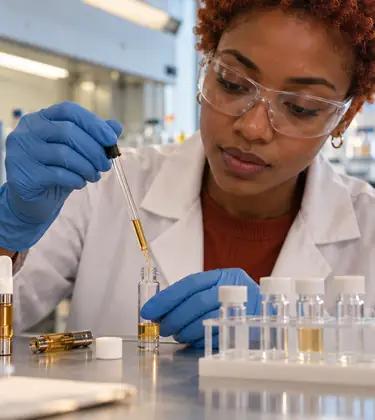
The bigger problem is what ends up in the cartridge. Lab analyses of these products have turned up:
- No THCJD at all in five US vapes sold as THCJD, with delta-8 THC as the main compound in four of them, in a 2026 study
- Two minor compounds that looked like byproducts of chemical synthesis in the five Japanese oils
- 5-heptylresorcinol, a common starting material for making THC-type molecules, plus lab side products, in a vape sold as 90% THCP
That THCP finding comes from a 2024 forensic analysis, which noted that the distributors of such products claim that the THCP in use originates from a natural source. The impurities inside pointed to a lab.
Hemp cannot supply these compounds either. A 2024 review in the Journal of Cannabis Research groups THCB with THCH and THCP as cannabinoids that cannot be made from CBD or THC and need full chemical synthesis, and THCJD's eight-carbon tail rules out CBD as a starting point too. Like THCH, the six-carbon homolog, they come out of a lab, not a plant.
Real flower and a known dose
In our experience, people reach for THCB or THCJD because they want a stronger or different high, and they end up guessing at what they bought. If you buy a hemp-derived product anyway, look for:
- An independent lab report that names the compound on the label
- Total THC that counts delta-8 along with the headline cannabinoid
- Matching batch numbers on the package and the report
- No promise of a high many times stronger than THC
Flower from a legal shop comes with a lab report, and THC has decades of research behind it. Sour Diesel Auto, a Sour Diesel and BF Super Auto #1 cross with 24% THC, runs from seed to harvest in 65 to 70 days and brings citrus, diesel and pine notes. Check your state's home-grow rules first, since not every legal state allows it.
November deadlines, state lists and drug tests
The legal gray zone is closing. Under the federal spending law signed in November 2025, hemp products with cannabinoids the plant cannot naturally produce are excluded from the hemp definition from November 12, 2026, and such products are to be classified as marijuana under federal law, the Congressional Research Service reported on September 28, 2026. The other portions of the new definition take effect December 11, 2026, and as of September 28, the FDA had not published its required list of naturally occurring cannabinoids.
THCJD, never confirmed in the plant, looks like a cannabinoid the plant cannot make. Lab-made THCB would fall under a separate exclusion for natural cannabinoids synthesized or manufactured outside the plant. Some states moved first. Colorado lists cannabinoids with an alkyl chain of four or more carbon atoms, including tetrahydrocannabiphorols, tetrahydrocannabioctyls, tetrahydrocannabihexols, or tetrahydrocannabutols as intoxicating cannabinoids, which covers THCB and THCJD, and it bars making or selling synthetic cannabinoids unless a rule allows it.
Drug tests are the last practical risk. In a 2025 lab study of 53 cannabinoid analogs and metabolites added to urine, compounds with two- to four-carbon tails, a group that includes THCB, cross-reacted more with standard THC screens than the others. The researchers added the compounds themselves, not the breakdown products a body makes, so the study cannot show that anyone passes a real test.
Four carbons, eight carbons and a short record
THCB is a real plant cannabinoid with a four-carbon tail, isolated in 2020 and about as tight a fit at the CB1 receptor as THC in lab tests, but rare in the plant and untested in people. THCJD has an eight-carbon tail, a binding figure from old lab work and no confirmed natural source, and vapes sold under its name have turned out to hold delta-8 instead. THCP is the homolog with the most data. Whatever the label says, these products come from synthesis, and the federal hemp rules that start on November 12 and December 11, 2026, are written to treat such products as marijuana.
Grow the cannabinoid with decades of research behind it. Barney's Farm has been developing premium cannabis genetics since the 1980s, with over 40 Cannabis Cup wins. Explore our full seed catalog and find strains bred for every climate and skill level.