Farnesene and Valencene: The Fruity Terpenes Explained
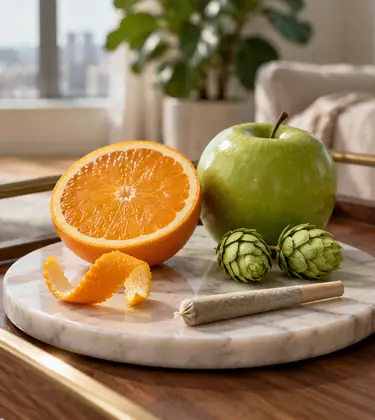
Limonene gets most of the credit for citrus, and myrcene for the musky base of many strains. Further down a lab report sit two heavier molecules with fruit in their story: farnesene, a compound in the waxy coating of apples, and valencene, named after the Valencia orange.
Both are sesquiterpenes, bigger and less volatile than the usual cannabis terpenes. Both also have careers outside cannabis, one in aphid alarms and jet fuel, the other in grapefruit-scented bug spray.
Key takeaways
- Farnesene is a family of six closely related sesquiterpenes, and its alpha form gives apples their green-apple smell.
- Oxidized alpha-farnesene has long been blamed for scald in stored apples, though that theory is now debated.
- Beta-farnesene is the alarm signal of many aphids, and wheat engineered to release it repelled aphids in the lab but not in field trials.
- Valencene is a citrus sesquiterpene named after Valencia oranges and used widely as a flavor and fragrance.
- Valencene is the raw material for nootkatone, the grapefruit compound the EPA approved as an insect repellent in 2020.
- In cannabis, farnesene ranks among the main sesquiterpenes of some hemp, and one cannabis enzyme makes valencene.
- We found no human study of either compound, and a 2020 lab study found that common terpenes do not act on cannabinoid receptors.
Farnesene, from apple peel to aphids
Farnesene is less one molecule than a small family. The term “farnesene” refers to a set of six closely related chemical compounds which all are sesquiterpenes, terpenes built from 15 carbon atoms, half again as many as limonene or pinene. The alpha form, in its most common shape, is the one you can smell. It sits in the coating of apples and other fruits, gives apples their green-apple scent and is the main scent compound of gardenia. The farnesene terpene is also a major component of some hops.
Apple scald and aphid alarms
Fruit growers know farnesene for a less pleasant reason. Superficial scald, the brown patches that appear on apple skin after cold storage, has long been blamed on it, since early studies linked the oxidation of alpha-farnesene in the fruit's wax to the damage. A 2020 study in Frontiers in Plant Science notes that this theory is now debated.
Aphids use the beta form to warn one another of danger, and several plants, including potato species, make it as a natural insect repellent. In 2015, British researchers engineered wheat to release beta-farnesene, the aphid alarm pheromone, using a synthetic gene based on a sequence from peppermint. Three species of cereal aphids were repelled in the lab, but field trials showed no drop in aphid numbers, in a season with few insects and erratic weather. Two forms of alpha-farnesene, meanwhile, serve as alarm signals in termites and as a lure for the codling moth, an apple pest.
Yeast-made farnesene and jet fuel
Farnesene even had a run as fuel. In 2011, MIT Technology Review reported that the biotech company Amyris was starting commercial production of farnesene, made with genetically engineered yeast and usable in cosmetics, lubricants, and diesel and jet fuel. Amyris filed for Chapter 11 bankruptcy in August 2023, Reuters reported.
Valencene and the Valencia orange
The valencene terpene is the fresh, sweet side of citrus. A 2024 review sums it up: valencene, a sesquiterpene with the odor of sweet and fresh citrus, is widely used in the food and fragrance business. The molecule takes its name from Valencia oranges, an inexpensive source. Commercial valencene from orange fruit still exists, but citrus holds only low concentrations of it, so companies also brew it with engineered microbes. Both compounds are used as flavorings, and the Joint FAO/WHO Expert Committee on Food Additives, the food-additive panel of two United Nations agencies, last reviewed farnesene and valencene in 2004 and found no safety concern at current levels of intake when used as flavoring agents.
From valencene to grapefruit bug spray
Valencene also matters as a raw material. It is used to make nootkatone, the most valuable aroma compound of grapefruit, which was first isolated from the wood of the Alaskan yellow cedar. In August 2020, the EPA announced that it had approved a new ingredient, called nootkatone, that repels and kills mosquitoes and ticks, the first new one since 2009, after the CDC worked with the biotech company Evolva to develop it. Studies suggest it may work as well as repellents such as DEET, and the EPA expects protection to last several hours. The two molecules compare like this:
| Feature | Farnesene | Valencene |
|---|---|---|
| What it is | A family of six sesquiterpenes | A single sesquiterpene |
| Smell | Green apple, from the alpha form | Sweet, fresh citrus |
| Best-known natural source | The coating of apples | Valencia oranges |
| Life outside the jar | Aphid alarm signal and yeast-made fuel | Raw material for nootkatone repellent |
| In cannabis | Among the main sesquiterpenes of Finola hemp | Made by at least one cannabis enzyme |
| Feature | What it is | Smell | Best-known natural source | Life outside the jar | In cannabis |
|---|---|---|---|---|---|
| Farnesene | A family of six sesquiterpenes | Green apple, from the alpha form | The coating of apples | Aphid alarm signal and yeast-made fuel | Among the main sesquiterpenes of Finola hemp |
| Valencene | A single sesquiterpene | Sweet, fresh citrus | Valencia oranges | Raw material for nootkatone repellent | Made by at least one cannabis enzyme |
Feeling lost on how to start? Try taking our quiz!
Start a QuizBoth terpenes in cannabis flower
Cannabis makes both, usually in small amounts. In a 2017 study of terpene synthases, the enzymes that build terpenes, the authors note that bouquets of different monoterpenes and sesquiterpenes are important components of cannabis resin. In the Finola hemp they studied, farnesene was among the most abundant sesquiterpenes, alongside beta-caryophyllene, alpha-humulene and bergamotene. One cannabis enzyme made valencene as 19.6% of its output.
Farnesene also tracks the labels people put on strains. A 2021 Nature Plants study of 297 drug-type samples found farnesene, which it describes as fruity, rising with a strain's Sativa rating, and a 2021 Canadian study of 21 strains found trans-beta-farnesene higher in THC-dominant strains. Some states do not require terpene testing at all, so the terpene section of a cannabis lab report may be missing.
The unexamined day is a wasted opportunity. Reflect on what you did, what you learned, and how you can improve.
John Dewey
Fruity strains and a gentle cure
In our experience, the fruit in a jar comes from the whole mix of terpenes and other aroma compounds, so your nose is a better guide than any single number. Seed banks cannot promise a farnesene or valencene figure, and neither page below lists them, but both strains carry the apple and orange notes these molecules are known for:
- Apple Fritter, an Animal Cookies and Sour Apple cross with 30% THC, brings fresh and baked apple over citrus and a thin line of diesel.
- Mimosa x Orange Punch, a Mimosa Evo and Orange Punch cross at 32% THC, has a sweet orange-citrus profile with berry undertones.
Sesquiterpenes also hold up better in the drying room. A 2024 study found monoterpenes more sensitive to drying than sesquiterpenes and put it down to their higher volatility, so a slow dry and cool, airtight storage keep more of both.
Effects, evidence and the entourage question
Claims about what these two compounds do in people run ahead of the research. The lab record is thin and early. In a 2022 cell study, farnesene from the essential oil of tarragon, Artemisia dracunculus, blocked calcium flow into human neutrophils, immune cells that drive inflammation, and in a 2016 mouse study, valencene applied to the skin eased eczema-like symptoms. Neither result shows what a few puffs do in a person. The wider evidence looks like this:
- No human trial of farnesene or valencene that we could find
- A 2020 lab study in which five common cannabis terpenes showed no direct effect at the CB1 or CB2 receptors
- A 2025 sensory study of 91 samples in which terpinolene was the only compound consistently tied to citrus aromas
That 2020 study concluded that the putative entourage effect cannot be explained by direct effects at CB1 or CB2, the receptors THC works through. Farnesene did help separate one group of strains in the 2025 sensory study, but neither terpene nor sulfur-compound profiles strongly predicted what tasters smelled.
Apple peel, orange peel and cannabis resin
Farnesene is a family of six sesquiterpenes behind the green-apple scent of apples, an aphid alarm signal and a yeast-made biotech product. Valencene is the sweet citrus note named after Valencia oranges and the starting point for nootkatone bug spray. Cannabis makes both in small amounts, farnesene tracks strain labels in some studies, and we found no human study of either. Choose by smell, cure slowly and store cool to keep the fruit.
Let your nose pick the next strain. Barney's Farm has been developing premium cannabis genetics since the 1980s, with over 40 Cannabis Cup wins. Explore our full seed catalog and find strains bred for every climate and skill level.