Is Smoking Weed Worse Than Smoking Cigarettes?

Ask this in any smoke circle and you get two confident answers, both of them wrong. One person swears weed is medicine and cigarettes are poison. Another read a headline about joints being worse than packs and now vapes out of guilt.
The evidence is messier and a lot more interesting than either camp lets on. Here is what the research actually shows about weed vs cigarettes, including a study published in January 2026 that most articles on this topic have not caught up with yet.
Is smoking weed worse than smoking cigarettes?
For most people, no. Cigarettes cause vastly more disease and death than cannabis does, mostly because of how much and how often people smoke them.
Cigarette smoking and secondhand smoke exposure cause more than 480,000 deaths every year in the United States. Nothing in the cannabis research comes anywhere near that figure.
A lot of the gap is simple volume. A pack-a-day smoker burns 20 cigarettes daily for 30 or 40 years. Even a committed weed smoker rarely puts that much plant material through their lungs, and the average consumer smokes far less than they think.
Nicotine explains the rest. It is one of the most addictive substances on the legal market, and it is what keeps someone smoking for four decades straight. Cannabis dependence is real, but it does not look like a two-pack habit.
None of that makes weed smoke clean. Less harmful than cigarettes is a very low bar to clear.
What is in cannabis smoke compared to tobacco smoke?
Both produce tar, carbon monoxide, and many of the same carcinogens, because both involve setting dried plant material on fire.
Combustion is the villain here, not the plant. Burning any leaf at several hundred degrees creates polycyclic aromatic hydrocarbons, ammonia, hydrogen cyanide, and benzene. Cannabis smoke carries more of some of these compounds and less of others, but the overlap is large.
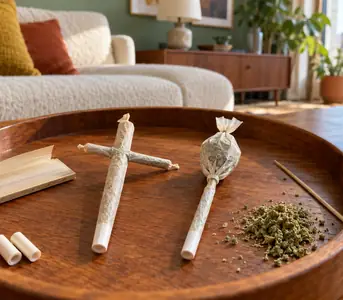
The delivery is where things diverge. Joints and blunts are usually unfiltered. Smokers pull harder, inhale deeper, and hold the smoke longer, then finish the roach where tar has concentrated. Cigarettes are filtered, standardized, and smoked in short shallow puffs.
What cannabis smoke does not contain is nicotine, along with the burn accelerants and flavor additives that tobacco companies engineer into a pack.
There is one more variable nobody controls for in a lab. Tobacco is a mass-manufactured product with a fixed spec, while weed is agricultural. Two grams of the same strain can smoke completely differently depending on how they were dried, cured, and stored, and that difference is something you can taste on the first pull.
How many cigarettes is one joint?
For airflow obstruction specifically, researchers have estimated that one joint is roughly equivalent to 2.5 to 5 cigarettes.
That number comes from a New Zealand team that measured lung function against joint-years, then converted the result into cigarette equivalents. It applies to one narrow measure, airway obstruction, and not to cancer risk, heart risk, or anything else.
The far scarier claim that one joint equals 20 cigarettes came from a separate lung cancer study with a small sample, and it was never a general rule about lung damage. It stuck around because it makes a great headline.
Treat any single ratio with suspicion. Joints vary wildly in size, density, potency, and how hard they get smoked. A pinner shared between four people is not a blunt to the face.
Feeling lost on how to start? Try taking our quiz!
Start a QuizWhat does long-term weed smoking do to your lungs?
Occasional smoking does not appear to reduce lung function. Heavy, sustained smoking does.
Researchers tracked more than 5,000 people for two decades and found that smoking about a joint a week caused no measurable loss of lung function, with a few measures even improving slightly. That bump is almost certainly a mechanical side effect of deep inhalation rather than any benefit from the smoke itself.
The same work found decline setting in past roughly 10 joint-years, which works out to a joint a day for a decade. Past that point the curve starts bending in the wrong direction.
Long before any of that, you get bronchitis. Chronic cough, morning phlegm, wheeze, chest tightness. It is the single most consistent finding across the entire body of cannabis research, and the good news is it clears up when people stop or switch methods.
The unexamined day is a wasted opportunity. Reflect on what you did, what you learned, and how you can improve.
John Dewey
Does smoking weed cause emphysema or lung cancer?
The lung cancer evidence stays unclear. The emphysema evidence is getting harder to wave away.
A 2022 imaging study became famous for finding that 75% of the marijuana smokers scanned had emphysema, compared with 67% of heavy tobacco-only smokers. Headlines ran with it. Buried in the paper was the detail that 50 of the 56 marijuana smokers also smoked tobacco, which makes the comparison much less clean than it looked.
On cancer, the large population studies have not turned up a clear signal once tobacco use is accounted for. That is not a clean bill of health. Cannabis was illegal almost everywhere for most of the last century, so the long-term data set is thin next to the mountain of tobacco research.
Part of the problem is that almost nobody smokes only weed. Tobacco co-use runs high in every study population, spliffs are standard in much of the world, and blunts are wrapped in tobacco leaf by definition. Untangling one exposure from the other is the central headache of this entire field.
The honest position is that heavy smoke exposure damages airways, the mechanism is not in dispute, and the cancer question is still open.
What does the newest research say about cannabis and lung health?
A study published in January 2026 found measurable airway changes in cannabis smokers even at low exposure levels.
The CANUCK study compared 139 cannabis smokers against 57 never-smokers using lung function tests, CT scans, xenon-enhanced MRI, and airway tissue samples taken by bronchoscopy. Higher joint-year exposure lined up with worse respiratory symptoms and reduced small airway flow.
What makes it worth your attention is the small airways angle. Standard spirometry, the tube you blow into at a clinic, misses early damage in the deepest parts of the lung. This team went looking there specifically and found immune and mucus changes in the tissue.
It is one cross-sectional study, and it cannot prove cause and effect. But it is the most detailed look anyone has taken so far, and it points the same direction as 40 years of bronchitis findings.
How can you smoke weed with less damage to your lungs?
What you smoke and how you smoke it changes your exposure more than which plant is in the paper.
We have been at this since the Amsterdam coffeeshop days, and 40 years of breeding teaches you things that never make it into a research paper. Derry went through Afghanistan and the Himalayas in the early 1980s collecting landrace genetics by hand, and the plants that came back were selected on flavor and effect long before anyone was chasing a THC number on a label.
That matters for your lungs more than most people realize. Rushed, badly dried flower burns hot and harsh and scratches on the way down. Properly cured flower burns cooler and cleaner, and a full terpene profile does more for smoothness than another three percentage points of THC ever will.
A few things worth doing:
Grind properly. Uneven material burns in patches, which means hot spots and harsher smoke.
Use a crutch. A tip keeps the burn steady and stops you inhaling loose plant matter.
Ditch the roach. The last inch is where tar collects. It is the worst part of the joint and you already know it.
Stop holding it in. Holding a hit adds tar deposition without adding much to the effect. Absorption happens fast.
Clean your glass. Resin-caked bongs add a layer of burnt residue to every pull.
If you want flower that goes down easy, look at what the plant was bred for. Blue Cheese is an old-school indica built around aged cheese and sweet blueberry, and it stays smooth when it is cured with patience. Pineapple Express runs tropical and bright, with a sativa lift and none of the throat-shredding sharpness some high-test genetics bring.
So what is the actual answer?
Cigarettes are worse. That is not close, and the mortality numbers settle it. But the comparison flatters cannabis in a way it has not fully earned, because most weed smokers are being measured against people smoking 7,000 cigarettes a year.
Smoke damages airways. The 2026 research suggests it starts earlier and deeper than anyone assumed. If you smoke daily, the bronchitis, the cough, and the small airway changes are real risks worth taking seriously, and switching methods or cutting back are both reasonable moves.
Smoke good flower, smoke less of it, and stop pretending the plant makes the smoke harmless.
Barney's Farm has been developing premium cannabis genetics since the 1980s, with over 40 Cannabis Cup wins. Explore our full seed catalog and find strains bred for every climate and skill level.