
Is It Safe to Use Weed While Taking Antidepressants?
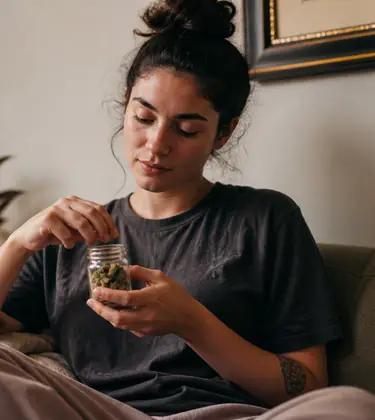
You're on Lexapro. Your buddy passes the joint. You hesitate.
Welcome to one of the most-asked, least-discussed questions in modern cannabis culture. In 2023, 11.4% of American adults reported taking prescription medication for depression. A whole lot of those folks also smoke. The medical literature, though, has been quietly dragging its feet on giving anyone a clean answer.
Here's what we actually know in 2026, based on real research, real case reports, and a couple of decades of breeding cannabis for the people who actually use it. No fearmongering. No corporate hand-wringing. Just an honest look at what the science says, what it doesn't, and how to think about it if you're stuck somewhere in the middle.
How common is mixing weed and antidepressants?
Way more common than your prescriber probably thinks. From 2005 to 2016, adults with depression were 130% more likely than others to report any past-month cannabis use, and 216% more likely to report daily use. That gap kept widening as state legalization rolled out and stigma around weed dropped.
A sizable chunk of these folks are on prescribed medication at the same time. They just don't tell anyone. People skip mentioning it because they're worried about getting lectured, having their script pulled, or being slotted into some "substance abuse" file. So the people who could actually answer questions about combining the two often have no idea their patient is doing it.
That information gap is part of why solid clinical research on the combo is still so thin.
What actually happens when THC meets your meds?
Two main things, biochemically. First, THC and CBD both go through the liver's cytochrome P450 enzyme system on their way out of your body. So do most antidepressants. The CYP450 system handles the metabolism of over 90% of conventional medications, which means cannabis can compete for the same metabolic pathways. The result is that your antidepressant might hang around longer, hit harder, or behave differently than your prescriber planned for.
Second, cannabinoids appear to nudge serotonin signaling. Your SSRI is already cranking serotonin levels up. Throw THC in and you've got two systems pushing the same chemical in the same direction. In most people, nothing dramatic happens. In a small number of people, things go sideways.
CBD is its own animal here. It's a known inhibitor of several CYP enzymes, which is why epilepsy patients on CBD-based pharmaceuticals have to be monitored carefully when they're on other meds. CBD-heavy products aren't the harmless wellness add-on the wellness aisle makes them out to be when you're already taking something serotonergic.
The honest answer is that the research is still patchy. Most of what we have is small studies, case reports, and animal data. That's some signal, but not the kind of evidence base your psychiatrist can hand you and say "here's the answer."
Which antidepressants carry the most risk with weed?
The general pattern across the literature looks like this:
SSRIs (Prozac, Lexapro, Zoloft, Celexa). Most popular class. Risk appears low to moderate for most users. The concern is that cannabis can increase blood levels of the SSRI and dial up serotonin further. Adverse interactions show up rarely, but they do show up.
SNRIs (Effexor, Cymbalta, Pristiq). Similar profile to SSRIs. Same caveats apply.
Tricyclics (Elavil, Pamelor, Tofranil). Older drugs, narrower safety margin. Combining with cannabis can amplify side effects like rapid heartbeat, sedation, and disorientation. More caution warranted.
MAOIs (Nardil, Parnate, Marplan). Rarely prescribed anymore, and for good reason. Nasty interactions with all kinds of stuff. Mixing with weed is not advised.
Atypicals (Wellbutrin, Remeron, trazodone). Mixed bag. Wellbutrin can lower seizure threshold and cannabis use has been associated with rare seizure cases in vulnerable people. Trazodone plus weed tends to make you a couch zombie.
If you don't know what class your med is, look at the bottle and Google it before lighting up.
Feeling lost on how to start? Try taking our quiz!
Start a QuizWhat is serotonin syndrome and should you actually worry about it?
Serotonin syndrome is the worst-case scenario people throw around in this conversation, so it deserves a clear explanation. It happens when too much serotonin builds up in your central nervous system, and it shows up in roughly 15% of SSRI overdoses. Symptoms range from agitation, sweating, and rapid heartbeat at the mild end to seizures, dangerously high body temperature, and in rare cases death at the severe end.
Can weed alone trigger it? Almost certainly not. Can high-THC concentrate use combined with an SSRI trigger it? There are documented case reports of exactly that, most involving young patients ripping dab pens or using high-potency vapes while on prescribed serotonergic meds. These cases are rare. They are also real.
The signal in the literature is pretty clear. Higher THC dose plus more concentrated form equals more interaction risk. Smoking a moderate-strength joint puts way less drug into your system than ripping 90% concentrates all afternoon.
The unexamined day is a wasted opportunity. Reflect on what you did, what you learned, and how you can improve.
John Dewey
Why your doctor probably won't have a clean answer
Here's the punk rock truth nobody likes to say out loud. Most prescribers were trained before legalization went mainstream. Many of them are still working off pharmacology textbooks that treated cannabis as an afterthought. When you ask, you might get a flat "don't do it," a vague "be careful," or a shrug.
None of those are particularly useful.
What you actually want is a doctor who'll have an honest conversation about dose, frequency, format, and how you're feeling. If your current prescriber isn't open to that, finding one who is will serve you a lot better than guessing in the dark. Cannabis-aware physicians and harm-reduction-friendly psychiatrists exist in pretty much every state with a medical program, and a fair number outside those states too.
Tell them everything. Don't lie about how often, how much, or what form. The whole point of asking is getting useful information back.
Mention your delivery method. A 5mg edible at night and chasing dabs are not the same input. Be specific.
Ask about timing. Some interaction risk drops if you space out your meds and your weed by a few hours.
If you've been cleared, what should you actually look for?
This part is on us. Barney's Farm has been breeding for predictable, consistent effects since 1986, with 40+ Cannabis Cup wins to show for it. Three decades of selecting parents that produce reliable phenotypes, and a catalog built around the idea that you should know roughly what you're getting before you spark.
When you're combining anything with prescribed meds, predictability matters more than peak THC numbers. The strains that have a lot of clinical-style horror stories attached to them tend to be high-percentage concentrates and unknown street weed. The strains that don't tend to be cultivated flower with a documented terpene profile and a stable lineage. There's a reason serious medical patients usually settle into a couple of cultivars and stick with them. Familiar effects, familiar dose response, fewer surprises.
Lean toward mellow indica-leaning genetics if anxiety is part of your picture. Heavy sativa strains can dial up racing thoughts in people whose anxiety is already elevated. Something like our Blue Cheese leans 80% indica and lands as a relaxed, body-centered experience instead of a head-racing one.
Avoid the high-THC concentrate rabbit hole. Dabs, shatter, and 90%+ vape oils are exactly the format showing up in those case reports. Flower with a known THC range gives your body a smaller, slower input to process. A classic like Critical Kush brings the calm without requiring you to chase potency at any cost.
Start lower than you think. Tolerance shifts on antidepressants. The amount that used to be your normal might hit completely differently now. One hit, wait twenty minutes, see how you feel, then decide.
The real bottom line
Weed and antidepressants are a daily reality for millions of Americans. Most of them are fine. Some of them aren't, and the people who aren't tend to share a few patterns: high-THC concentrates, unknown product, mixing with multiple other meds, or doses way above what their body's used to.
You don't need a medical degree to make a smart call here. You need an honest conversation with your prescriber, a sense of what your medication actually does, a product whose effects you can roughly predict, and the discipline to start small.
Science is still catching up. Until it does, treat the combo with the same respect you'd give any other meaningful interaction in your body. Slow, mindful, informed. The herb has been around for ten thousand years. It can wait while you figure out your dose.
Barney's Farm has been developing premium cannabis genetics since the 1980s, with over 40 Cannabis Cup wins. Explore our full cannabis seed catalog and find strains bred for every climate and skill level.