From Cheech and Chong to Today: How the Stoner Comedy Grew Up
In 1978, two guys drove a van built entirely out of weed across the Mexican border and accidentally invented a movie genre. There were no dispensaries. Getting high was a felony. And a pair of longhairs playing lovable burnouts as the good guys, with the cops cast as bumbling villains, felt genuinely dangerous on a movie screen.
Almost fifty years later, that same genre streams on every platform, racks up awards, and sells out theaters on 4/20. Weed went from contraband to a legal business across most of the country, and the movies grew up right alongside it. Here is how the stoner comedy went from midnight-movie outlaw to Saturday-night mainstream, and who lit the fuse.
Who invented the stoner comedy?
Cheech Marin and Tommy Chong met in Vancouver in 1969. Chong ran a scrappy improv group out of his family's club, and Marin had moved north to dodge the Vietnam draft. They built an act around two characters, a Chicano wannabe rock star and a bandana-wearing burnout, and turned it into gold records before they ever picked up a movie camera.
There was an edge to them that gets forgotten now. Two comedians of color sending up a mostly white hippie culture, opening for soul acts like the Isley Brothers and Ray Charles, working blue in an era that wanted its comedy clean. They were counterculture before counterculture became a marketing category.
Record producer Lou Adler, the man behind Carole King's Tapestry, caught their act and signed them in 1971. He blasted their sketch work out to radio, and their line "Dave's not here" became one of comedy's first true catchphrases. Four gold records in four years followed. By the time they reached film, they already had an army of fans who knew every bit by heart.
Then came Up in Smoke in 1978. Shot on a shoestring, it grossed over $44 million and turned two stand-ups into box-office stars. The plot barely mattered. Two potheads hunt for weed, dodge an undercover narc, and stumble toward a battle of the bands. What mattered was the point of view. The stoners were the heroes. The cops were the joke. In a country where a joint could mean handcuffs, that flip was the entire rebellion.
What made Up in Smoke so influential?
Cheech and Chong wrote the blueprint every stoner comedy still runs on. Start in an altered state. Need more weed. Let the chaos handle the rest. The plot is just an excuse for two friends to bounce off each other while the world keeps throwing obstacles at them.
You can trace that DNA straight through the genre. Salon has pointed out that Harold & Kumar Go to White Castle owes its whole existence to Up in Smoke, right down to the ampersand in the title. Two stoners, one absurd craving, a night that spirals completely out of control. Swap the weed van for a White Castle run and the skeleton is identical.
That is the trick of a good stoner comedy. The weed is the engine, but the friendship is the car. Take the drugs out of Cheech and Chong and you still have a buddy comedy about two outsiders against a square world. That structure is why the genre outlived the era that spawned it.
It also gave weed a new face on screen. For decades, cinema treated the plant as a warning label, all cautionary tales and wrecked lives. Cheech and Chong made it funny, human, and harmless. That shift in tone did quiet work for the culture long before any state put legalization on a ballot.
How did stoner movies change after Cheech and Chong?
The 1980s slammed the door shut. Reagan's War on Drugs made weed radioactive on screen, and the genre went quiet for the better part of a decade. The tropes survived in disguise. Bill and Ted and Wayne's World kept the lovable-burnout energy and quietly dropped the joint.
The 90s and 2000s kicked the door back open, harder. Friday, Half Baked, Dazed and Confused, The Big Lebowski, and the Harold & Kumar movies built an entire canon on the Cheech and Chong template. Each one leaned on the same formula: laid-back leads, loose plots, and a hangout energy that rewards a rewatch. The Dude and Jeff Spicoli joined Pedro and Man in the small hall of fame of characters who made doing nothing look like an art form.
What changed was the ambition. These films used the stoner frame to smuggle in real filmmaking. Dazed and Confused nailed a whole era. The Big Lebowski wrapped a noir mystery in a bathrobe. Friday turned a South Central block into a lived-in world. The couch was still the destination, but the road there got a lot more interesting.
Ice Cube told Rolling Stone he wanted Friday to become a hood classic in the same way Up in Smoke had become a classic to its own community. Then in 2008, Seth Rogen and James Franco bolted the genre onto a full action plot with Pineapple Express, proving stoner comedy could carry a car chase and still make you laugh.
Feeling lost on how to start? Try taking our quiz!
Start a QuizThe plant behind the punchline
Here is the part Hollywood tends to skip. The jokes are fiction. The plant is very real.
Pineapple Express took its name from that 2008 comedy, but the strain in our US catalog is the genuine article. Pineapple Express crosses a landrace Hawaiian sativa with Trainwreck, pushes 28% THC, and throws off a tropical, fresh-cut-pineapple nose that earns the name on flavor alone. A movie can make a word famous. Only breeding makes the plant worth smoking.
We have been at this since 1986, back when Amsterdam coffee shops were about the only place on earth where cannabis culture could grow out in the open. Four decades and more than forty Cannabis Cups later, the genetics we built quietly shaped what ended up on dispensary shelves across the map. Every hype strain you see today stands on work breeders were doing while the culture was still underground.
If you want the fuller story of how famous names and real flower collide, we broke it down in our piece on why every celebrity has a weed brand now.
The unexamined day is a wasted opportunity. Reflect on what you did, what you learned, and how you can improve.
John Dewey
What are the best modern stoner movies?
The 2020s handed the genre a second wind. Streaming platforms took the risks the big studios wouldn't, and the couch-locked male burnout stopped being the only face on the poster. Women lead now. The plots got stranger. Edibles and mushrooms show up as often as the classic joint, and the humor swings from gentle to pitch-black depending on the film.
Legalization is a big reason why. Once weed became a store you drive to instead of a felony you hide, the old outlaw energy needed somewhere new to go. The genre answered by getting weirder and more personal, trading shock value for character. The rebellion moved from the substance to the storytelling.
Hulu's Pizza Movie sent two college roommates spiraling through a special-effects bad trip in 2026, swinging for the fences as the next Pineapple Express for a younger crowd. It is proof the formula still prints laughs when you hand it new faces and a bigger effects budget.
And the originals finally got their send-off. Cheech and Chong's Last Movie, a documentary tracing their five decades together, hit theaters in 2025, with an early screening on 4/20 because of course it did. The form they invented as an act of rebellion is now, in their own words, about as mainstream as the cannabis outlet down the block. The outlaws won.
Roll one and press play
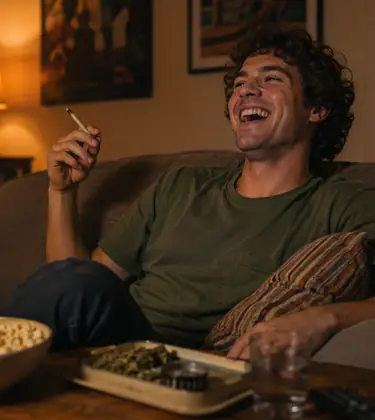
Every stoner comedy ends the same way the culture does. Back on the couch, movie on, good weed within reach. The best films in the genre earned their spot by making that ritual look like the best seat in the house.
If you are building the night from scratch, genetics matter as much as the watchlist. LSD, our Skunk #1 and Mazar cross that took a High Times Cannabis Cup back in 2008, delivers the kind of trippy, euphoric couch-lock a double feature was made for. The Barney's crew named it for its head-spinning high, and it grows tough enough that plenty of first-timers have tried and failed to kill it.
From two guys and a van made of weed to a genre that streams worldwide, the through-line never moved. Good company, good laughs, good flower. Cheech and Chong just happened to film it first.
Barney’s Farm has been developing premium cannabis genetics since 1986, with more than 40 Cannabis Cup wins. Explore our full cannabis seed catalog and find the genetics that fit how you actually medicate.