How Long After Smoking Weed Should You Wait to Drive?
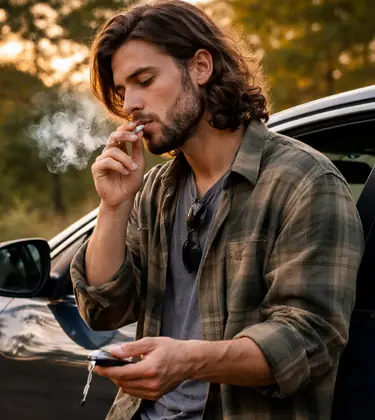
If you have ever stood next to your car after a session and thought “I’m fine, I can drive,” this article is for you. The honest answer to how long after smoking weed you should wait to drive is longer than you think, and probably shorter than what the law in your state will accept. Both things are true at once, which is why this question keeps trippin’ people up.
Here is what the research actually says, what the law actually does, and how to handle this without ruining your day or anyone else’s.
What is the safe wait time after smoking weed?
The cleanest answer comes from a UC San Diego team that put 191 regular cannabis users through driving simulators after they smoked joints of varying potency. Driving performance started improving around 3.5 hours after smoking, but full recovery was not seen until 4.5 hours post-smoking. Roughly: give yourself at least four to five hours after a normal joint before you touch a steering wheel.
Public health agencies tend to round up. The Colorado Department of Transportation tells consumers to wait at least six hours after smoking marijuana containing less than 35 mg of THC before driving, biking, or other safety-sensitive activities, and longer if more was consumed.
Six hours is the safer round number. Four and a half is the floor. Anything under four hours is a coin flip, and the coin is loaded against you.
How long do edibles last before it is safe to drive?
Edibles are a different beast. They take longer to hit, peak later, and stay in your system longer. Colorado’s official cannabis guidance notes that the effects of cannabis can peak up to four hours after eating or drinking and can last up to 10 hours, with a recommended wait of at least eight hours after consuming less than 18 mg of THC before driving.
For anything stronger than a low-dose gummy, add hours, not minutes. If you ate a 50 mg cookie at midnight, your morning commute is still a question mark. If you doubled up because the first one “wasn’t hitting,” you already know the answer: do not drive in the morning.
Why “I feel fine” is a dangerous lie
Here is the part nobody likes to hear. The same UCSD study found something almost funny if it were not so dangerous. Cannabis users dramatically misjudge when they are sober enough to drive.
Although THC participants felt impaired and were hesitant to drive at 30 minutes, by 90 minutes they believed the impairment was wearing off and were more willing to drive, even though their actual driving performance had not significantly improved. Researchers called this a possible false sense of safety, and described those first few hours as the period of greatest risk because users are doing the self-evaluation themselves.
Translation: you feel sober before you actually are. That second wind of “okay I’m good” hits at exactly the wrong moment.
The reason this matters is simple. Cannabis impairs reaction time, lane position, and your ability to track multiple things at once. None of those skills feel impaired when you are sitting still on the couch deciding whether to grab the car keys. They show up only when a kid runs into the road or somebody brakes hard in front of you.
Feeling lost on how to start? Try taking our quiz!
Start a QuizDoes the law care if you are actually impaired?
Less than you would hope. Cannabis DUI laws in the United States are a patchwork, and “I waited four hours” is not a legal defense in most states.
The federal traffic safety agency states clearly that driving impaired by any substance, alcohol or other drugs, whether legal or illegal, is against the law in all 50 states and the District of Columbia. So far, so reasonable. The problem is how impairment gets defined and tested.
According to the Governors Highway Safety Association, 18 states have zero tolerance or non-zero per se laws for marijuana, with 10 of those states having zero tolerance for THC or a metabolite. In those states, any detectable trace of THC, even from a session days earlier, can technically land you a charge. Other states use impairment-based laws where prosecutors have to prove you were actually affected at the time of the stop.
The catch: THC sticks around in the body long after the high is gone. Heavy users can test positive for THC days or even weeks after their last session while being completely sober behind the wheel. That is why developing a reliable, alcohol-style breathalyzer for cannabis has been so slow, and why the legal system has not caught up to the science.
If you live in a per se or zero-tolerance state and you use regularly, the only fully safe legal strategy is to not drive after consuming, full stop, with extra caution even on sober days when you have used recently.
The unexamined day is a wasted opportunity. Reflect on what you did, what you learned, and how you can improve.
John Dewey
What about microdoses, CBD, or just one little hit?
CBD by itself does not cause psychoactive impairment and does not trigger the same warnings. THC does, even at low doses. A few things that change your personal timeline are worth knowing.
Tolerance matters, but not the way smokers want it to. Heavy users may feel less subjectively high on the same dose, but their motor skills still take a hit. Worse, they are more likely to test positive for residual THC during a genuinely sober period.
Concentrates and dabs are not joints. Flower at 18% THC is one thing. A dab pulling 70%+ THC is another category entirely. Higher dose in, longer wait out.
Mixing with alcohol is a multiplier, not an addition. Combining the two impairs driving more than either does alone, and crash risk climbs steeply. The old plan of smoking to sober up from drinking is folklore that ends nights in handcuffs or worse.
Body composition affects clearance. THC is fat-soluble, which means it stores in body fat and releases slowly. Two people with the same dose can clear at very different rates depending on weight, metabolism, and how often they consume.
The Barney’s Farm take on consuming responsibly
We have been breeding cannabis in Amsterdam for over 30 years, and we have watched the culture grow up alongside the plant. The smartest cannabis enthusiasts we know all share one habit: they plan transportation before they plan the session. The session itself takes care of itself once the weed is good. The ride home is the part that needs forethought.
Whether you are sampling a new harvest of something heavy like Purple Punch or unwinding with friends after work, decide your ride before you spark up. If you are at home, park the keys somewhere annoying to reach. If you are at someone else’s place, sort the rideshare in advance so you are not making decisions while high. If you are heading out to a dispensary or a friend’s grow, treat the trip back like the trip back from a bar.
Strain awareness helps too. A heavy indica is going to flatten you for the night, so do not pretend you are driving anywhere. A lighter, sativa-leaning hybrid like Tangerine Dream might feel more functional shared between friends, but the wait time still applies. That subjective “functional” feeling is exactly the false sense of safety the research warns about.
Cannabis culture has matured way past the point where “I drive better stoned” is a thing anyone serious actually says. The plant deserves respect. So does everyone else on the road. Treating both seriously is part of why legalization keeps moving forward in the first place.
Quick reference: how long to wait before driving
After smoking flower: 4 to 6 hours minimum, longer for heavy doses or potent strains.
After vaping concentrates or dabs: At least 6 hours, more if you went hard.
After edibles: 8 to 12 hours, depending on dose and how much you ate beforehand.
After mixing with alcohol: Do not drive that night. Sleep, hydrate, deal with it tomorrow.
If you are a heavy daily user: Even after the high wears off, residual cognitive effects can linger. Build in extra time before long highway drives or anything mentally demanding.
When in doubt, do not drive
The safest answer to how long after smoking weed you should wait to drive is simple: longer than you want to. The science points to four and a half hours as the floor for flower. Public health agencies say six. Edibles need eight or more. The law in many states will punish you regardless of how careful you were, because most testing is built around THC presence rather than actual impairment.
Plan ahead, wait it out, and pick up your car in the morning. A good session is worth a few hours of patience on the back end. A DUI is worth nothing at all.
Barney's Farm has been developing premium cannabis genetics since the 1980s, with over 40 Cannabis Cup wins. Explore our full cannabis seed catalog and find strains bred for every climate and skill level.