F1 Hybrid Vigor: Why Some Cannabis Crosses Hit Harder Than Their Parents
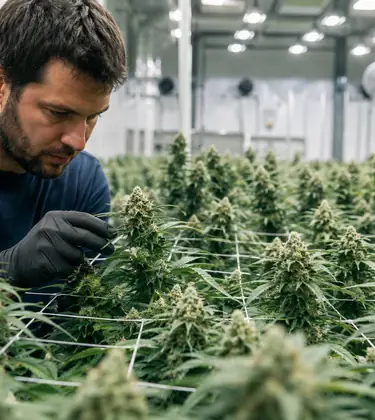
Every grower has lived this. You crack open a fresh pack of seeds, baby them through germination, and the plants come up looking like total strangers to each other. One bolts for the ceiling. One sulks as a runt in the corner. One reeks of diesel, the one right next to it smells like wet cardboard. Same strain name on the label, completely different plants in the tent.
Then once in a while the opposite happens. You run a cross where every single seed comes up swinging, grows like it has a train to catch, and finishes harder, frostier, and more potent than either parent that made it. That second thing is not luck. It has a name. It is called hybrid vigor, and it is the whole reason F1 hybrids are the loudest topic in cannabis genetics right now.
What is hybrid vigor in cannabis?
Hybrid vigor, which scientists call heterosis, is when the offspring of two genetically different parents turn out stronger, bigger, faster, and more productive than both of them. Not the average of mom and dad. Better than both. The idea goes back to the early days of genetics, when researchers were scratching their heads over why mongrel plants kept outrunning the carefully purebred ones in the next row.
In practical, in-the-tent terms, hybrid vigor tends to show up as:
Faster, more explosive early growth and quicker establishment after the seedling stage.
Bigger, denser yields than either parent line could manage on its own.
Better natural resistance to pests, mold, and general environmental stress.
Plants that come up uniform, so the whole canopy grows and finishes together.
It is one of the most dependable tricks in all of farming. Corn, rice, tomatoes, sorghum, cattle, all of them lean on it. Cannabis is just the new kid at the table, because for most of its modern life weed got bred by enthusiasts crossing whatever smelled good in the room, not by long programs chasing a true first-generation cross. That is changing fast.
Why do F1 hybrids hit harder than their parents?
The answer lives in the parents, not in the cross itself.
To build a real F1, a breeder first has to create two inbred lines. You take a strain and breed it back into itself over and over, generation after generation, until its traits stop drifting and lock into place. Height, flowering time, terpene profile, potency, all of it stable and repeatable. That kind of consistency is gold for a breeder.
There is a cost, though. All that inbreeding also quietly stacks up genetic baggage. Inbred lines tend to become homozygous for mildly harmful recessive genes, which drags down their vigor and yield over time. Breeders call that slow slide inbreeding depression, and it is the toll you pay for locking traits in.
Now for the payoff. When you cross two different inbred lines, each F1 plant inherits one set of genes from each parent. The healthy dominant genes from line A cover for the weak recessive ones hiding in line B, and line B returns the favor. The flaws get masked, the strengths stack up, and the plant comes out swinging harder than either parent ever could. Two stable but slightly tired parents, one explosively vigorous kid. That is heterosis in a nutshell.
There is one catch worth knowing. Hybrid vigor only really fires when the two parents are genuinely different from each other. Cross two lines that are already close cousins and you get almost none of the boost, which is why serious breeders go hunting for parents from completely separate genetic corners before they ever make the cross.
What is the difference between F1 and F2 seeds?
F1 stands for first filial generation, which is just a technical way of saying the direct children of two distinct parent lines. Later generations get numbered F2, F3, and so on down the line. Because both parents are stable and uniform, every seed in an F1 pack gets dealt the same genetic hand, so the plants come up looking and growing almost identically. No pheno lottery.
F2 is where the magic unravels. Save seeds off your F1 plants, or cross two F1 siblings back together, and the next generation shuffles the deck all over again. Those masked recessive genes start pairing back up, traits split off in every direction, and the gorgeous uniformity falls apart. Some plants will be killer, some will be junk, and you are right back to a tent full of strangers. That scatter is not a flaw in the seeds. It is just genetics doing what genetics does the moment you stop controlling both parents.
This is also the line between a true F1 and the polyhybrids that fill most seed menus. A polyhybrid is a cross of a cross of a cross, with so much tangled ancestry that no two seeds ever fully agree. We pulled that whole messy family tree apart in our breakdown of polyhybrid strains if you want the long version. The short version: real F1s are clean and predictable, polyhybrids are a grab bag.
Feeling lost on how to start? Try taking our quiz!
Start a QuizHow did corn prove hybrid vigor works?
Cannabis breeders did not invent any of this. Corn did the heavy lifting more than a century ago.
Charles Darwin himself noticed how dramatically corn benefited from crossing different plants instead of self-pollinating. In 1908, two American scientists, George Shull and Edward East, independently worked out the method that still runs modern agriculture: build pure inbred lines first, then cross them to set off hybrid vigor in the F1. It worked so well it became the backbone of commercial corn farming, and yields climbed steadily once growers made the switch.
That is the receipt F1 cannabis is cashing in. The science is old, boring, and bulletproof. The only new part is aiming a hundred-year-old breeding method at a plant people actually want to grow and smoke.
The unexamined day is a wasted opportunity. Reflect on what you did, what you learned, and how you can improve.
John Dewey
How does Barney's Farm build its F1 hybrids?
This is where forty years in the breeding room stops being a bragging point and starts being the actual job. You cannot fake a true F1. Slapping the letters on a label means nothing if the parents behind it were never properly stabilized. The real work is years of inbreeding and ruthless selection to get two parent lines running dead stable, plus the hard-won experience to know which two will actually spark when you bring them together. Get either piece wrong and you do not have an F1, you have an expensive disappointment in a fancy package.
Our Precision F1 Hybrid line is what that grind produces. Take Durban Z. It crosses Durban Poison, a pure African landrace sativa with serious history behind it, against the sweet, candied genetics of Original Z. Two parents from completely different planets, each one locked into a stable line, then joined so that every seed in the pack delivers the same energetic, fruity, fast-finishing plant.
RS11 runs the same playbook on the indica side. We paired Pink Guava with OZK to land a dessert-flavored, resin-caked plant that comes up uniform across the entire pack, with the kind of bag appeal that does not need explaining. No pheno hunting, no culling weak runts, no crossing your fingers over which seed turns out to be the keeper. That predictability is the entire reason to do F1 the slow, expensive way instead of the easy one.
Are F1 hybrid seeds worth growing?
Honest answer: it depends on what you are after.
If you live for the hunt, popping a wild polyhybrid pack and chasing that one unicorn phenotype is half the fun, and F1 seeds are going to feel a little too tidy for your taste. They also make poor breeding stock, since the F2s scatter the second you try to reproduce them.
But if you want every plant in the room to grow the same, finish the same week, and actually hit the potency printed on the label, F1 is the most dependable bet on the shelf. You get the vigor, the uniformity, and a harvest you can plan around almost down to the day. For commercial growers that consistency is straight-up money. For home growers it is one less thing to stress about.
The hype around F1 right now is loud, and yeah, some of it is just marketing noise. But the genetics underneath are the real deal, the science behind them is over a hundred years old, and when the breeding is done properly, the plants genuinely do hit harder than the parents that made them. Call it whatever you want. Underneath the label, it is just biology finally pointed at the right plant.
Barney's Farm has been developing premium cannabis genetics since the 1980s, with over 40 Cannabis Cup wins. Explore our full cannabis seed catalog and find more Amsterdam classics, USA-bred hybrids, and award-winning strains.