Dab Tools: Dabbers, Scoops and Paddles Explained
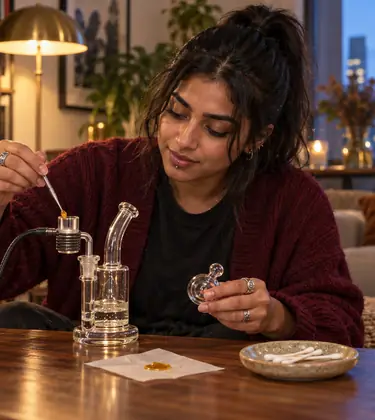
A dab is a tiny amount of a very strong product, and getting it from the container to a hot surface, usually a quartz bowl called a banger, is harder than it looks. Concentrates can be sticky like honey, brittle like glass or soft like frosting.
That is the job of the dab tool, a slim wand of metal, quartz or glass with a shaped tip. The right tip turns a messy dab into a clean one.
Key takeaways
- Dabbing means inhaling heated concentrated cannabis, and 14.6% of current users in a 2022 CDC survey said they dabbed.
- Dab tool types follow the texture of the concentrate, with scoops for runny oils and points for brittle shatter.
- Titanium tools resist corrosion and melt at 1,668°C, far above any dab temperature.
- Lower nail temperatures cut methacrolein, an irritant that was undetectable at 322°C in one experiment.
Concentrates and why they need a tool
A dab tool exists because of dabbing, which the CDC describes as inhaling heated concentrated cannabis. In its 2022 survey across 22 states and two territories, 14.6% of current cannabis users said they dabbed, and among users aged 18 to 24 the figure was 28.4%.
Concentrates are strong, which is why the doses are so small. A 2025 review defined a concentrate as a product with at least 50% cannabinoids by weight. In a 2020 University of Colorado study, concentrate users were randomly assigned products with 70% or 90% THC, while flower users got 16% or 24%, and the concentrate group ended up with higher THC in their blood.
Textures vary just as much. In our experience, shatter is brittle and glassy, budder is soft and creamy, live resin sauce runs like thick syrup, and rosin is pressed from flower with heat and pressure instead of solvents. If you press your own rosin, our washing collection is designed for hash makers seeking strains that deliver superior yields, and two of its strains make good starting points:
- Watermelon Z, a Watermelon and Original Z cross at 28% THC, tastes of fruity watermelon and grapes.
- Sour Diesel, a Super Skunk and Chemdawg cross at 26% THC, brings a sour, diesel and earthy aroma.
Dab tool types and their tips
Dab tool types are named for their tips, and each tip suits a different texture. A dabber can be as simple as a single point or as clever as a tool with a different tip at each end.
Pointed dabbers
The classic dabber ends in a fine point or a narrow blade. In our experience, it is the right pick for shatter and other brittle concentrates, since the point chips off a piece and holds it without crumbling the rest. Some pointed dabbers bend slightly near the tip, which keeps your fingers farther from a hot banger.
Scoops and spoons
A scoop has a small cupped tip that carries runny or saucy concentrates, such as live resin sauce or oil, without dripping on the way to the banger. A deep scoop holds more, so in our experience a shallow one keeps beginners from loading too big a dose.
Paddles and flat blades
A paddle or flat blade lifts soft textures like budder and wax, and it spreads them evenly across the floor of a banger. A wide paddle also scrapes leftover concentrate off parchment paper, so less goes to waste.
Multi-tip tools
Many dab tools carry a point on one end and a scoop or paddle on the other, so one tool handles most textures. In our experience, a two-ended tool is the easiest way to start.
Feeling lost on how to start? Try taking our quiz!
Start a QuizTitanium, quartz, glass and ceramic
Dab tools come in titanium, quartz, glass, ceramic and stainless steel. Titanium is the workhorse. Grade 5 titanium, known as Ti-6Al-4V, is one of the most commonly used titanium alloys, with a high specific strength and excellent corrosion resistance, and titanium melts at 1,668°C (3,034°F), far above any dab temperature. In our experience, each material has its place:
- Titanium is strong, light and almost impossible to break, which makes it the best dab tool for most people.
- Quartz is smooth and heat resistant, since fused quartz has high working and melting temperatures, but it cracks if dropped.
- Glass looks good and costs little, though the thinnest tips snap easily.
- Ceramic is smooth and neutral in taste, but brittle.
- Stainless steel is cheap and tough, a fine first tool.
The unexamined day is a wasted opportunity. Reflect on what you did, what you learned, and how you can improve.
John Dewey
How to use a dab tool
Learning how to use a dab tool takes a few sessions. In our experience, this routine keeps dabs small and clean:
- Chill sticky concentrate in the fridge for a few minutes so it firms up and lifts cleanly.
- Pick up a dab the size of a grain of rice, scooping saucy textures and spearing brittle ones.
- Heat the banger and let it cool to a lower temperature, or set an electronic nail to a low setting.
- Touch the dab to the inside wall of the banger and roll the tool so it slides off, then cap it and inhale slowly.
- Wipe the tip while it is still warm, and clean it with isopropyl alcohol at the end of the session.
A carb cap, the small lid placed over the banger, traps heat and vapor, so in our experience even a low-temperature dab vaporizes fully under it. A quick dip of the tool in isopropyl alcohol and a wipe after each session keep residue from building up, and titanium and stainless steel handle that daily without complaint.
Temperature and your lungs
Temperature matters more than the tool. A 2025 review of cannabis concentrate vaping chemistry found that emissions contain a substantial proportion of harmful aerosol toxicants, and the dabbing work it gathered shows why lower heat helps. In one experiment, methacrolein, an irritant, measured 185 ppb per 40 mg dab at 526°C (979°F), 131 ppb at 403°C (757°F) and was undetectable at 322°C (612°F). The researchers in that work switched to an electronic nail because it made temperature easier to control. In our experience, a torch makes it easy to overshoot, which is why an electronic nail with a set temperature is the easier way to dab low.
The review's authors add that research into the specific health risks of these products has significantly lagged their widespread use. In our experience, a lower setting, a smaller dab and a slow breath make for a smoother hit as well.
Home extraction and the law
Dab tools are ordinary accessories for adults in legal states, but making your own solvent concentrate is another matter. Colorado makes it a level 2 drug felony to manufacture marijuana concentrate using an inherently hazardous substance without a license, a term that covers butane, propane and other chemicals with a flash point at or below 100°F, though not alcohol. Butane vapor builds up fast in a closed room and needs only a spark, which is why home extraction labs explode so often. Solventless rosin, pressed from flower or hash with heat and pressure, skips the explosive solvents entirely.
Possession and potency limits
Concentrates also come with tighter limits. California lets adults carry 8 grams of concentrated cannabis, Massachusetts allows 1 ounce of marijuana but no more than 5 grams of it as concentrate, and New York allows 24 grams.
Some states cap potency as well. Ohio's Senate Bill 56, signed in December 2025 and in force 90 days later, was written to reduce the THC levels in adult-use marijuana extracts from a maximum of 90% to 70%. Connecticut went the other way, and since October 1, 2026, its concentrates, vape cartridges and kief have no potency limit, while flower stays capped at 35% THC. Vermont splits the difference, since its stores cannot sell solid or liquid concentrates above 60% THC to the public, except vape oil prepackaged for battery-powered devices.
Picking the right dab tool
A dab tool carries a small, strong dose from the container to the banger, and the tip should match the texture: a point for shatter, a scoop for sauce and a paddle for budder. Titanium suits most people, quartz and ceramic stay smooth, and glass looks good but breaks. Keep the heat low and the dabs small, buy your concentrates from licensed stores, and check your state's limits on how much you carry.
Barney's Farm has been developing premium cannabis genetics since the 1980s, with over 40 Cannabis Cup wins. Explore our full seed catalog and find strains bred for every climate and skill level.