Trimmer's Lung and OSHA: The Health Risks of Working in Cannabis
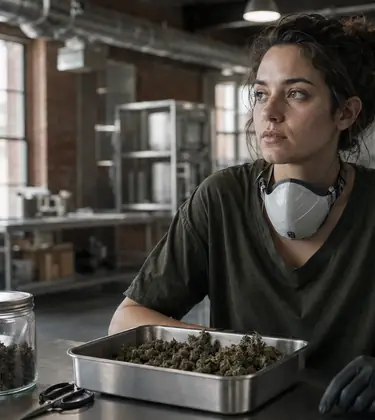
Lorna McMurrey started work at a Massachusetts cannabis facility in May 2021 and moved to flower production that October. In November she was taken to hospital from work, unable to breathe. In January she went into cardiac arrest at her workstation and died three days later. She was 27.
She was wearing an N95 respirator she had bought herself.
This guide covers what killed her, what the exposure measurements showed, why the legal limits did not protect her, and what any of it means for someone trimming a few plants at home.
A legal limit that missed the hazard
Cannabis dust is a respiratory sensitizer, and the federal exposure limits do not account for allergens at all. Dust in her breathing zone measured hundreds of times below the legal ceiling. The limit was never designed to measure the thing that was hurting her.
What actually happened
The clinical account was published by the CDC, which recorded that in 2022, the first death attributed to occupational asthma in a U.S. cannabis production worker occurred in Massachusetts.
The timeline is short. She began in May, moved to flower production on October 1, was hospitalized on November 9, and on January 4 began sneezing and coughing at work, deteriorated despite repeated inhaler use, and suffered cardiopulmonary arrest. Brain death was diagnosed on January 7.
She had not had asthma before this job. Sensitization took roughly five weeks in the grinding role.
The CDC report is careful about what it could not prove, noting that although her course is consistent with fatal asthma triggered by cannabis allergy, this was not confirmed by skin testing or specific antibody tests. That caution matters. What supports the conclusion is the pattern around her: of ten coworkers with similar duties, four reported respiratory or skin symptoms, and five of ten employees with allergy symptoms had skin prick testing consistent with cannabis sensitization.
The correction worth making to the popular version: a California cannabis worker died the same way in 2020, and the case only surfaced later through state surveillance. Hers was the first documented and published death, not necessarily the first to happen.
What OSHA said
The enforcement language is the clearest official statement that exists on cannabis dust, and it is worth reading in full. OSHA cited the employer because it did not evaluate whether ground cannabis dust, produced in the workplace by commercial processing, was required to be classified as a hazardous chemical due to hazards including, but not limited to, skin and respiratory sensitization by an allergen.
Two further citations covered the absence of a safety data sheet and the absence of training on symptoms. The proposed penalty across all three was $35,219. On formal settlement two citations were deleted and the total came to $14,502.
The state regulator hit harder than the federal one. Massachusetts fined the company $350,000, roughly twenty-four times the OSHA penalty, for failures including not reassessing the job after her first hospitalization and not offering her a different position when she returned to work.
Feeling lost on how to start? Try taking our quiz!
Start a QuizThe limit that measured the wrong thing
Here is the fact that turns this from a company story into a policy story. Air sampling during grinding found respirable dust in the operator's breathing zone at 0.012 milligrams per cubic meter. The federal permissible exposure limit is 5 milligrams per cubic meter. She was working at roughly one four-hundredth of the legal ceiling.
The CDC's conclusion is the sentence to remember: airborne respirable dust and endotoxin levels below occupational exposure limits do not exclude a sufficient level of airborne allergen to trigger asthma.
That is not a loophole. It is what the standard is. Cannabis has no substance-specific exposure limit, so it falls under particulates not otherwise regulated, and the footnote defining that category says it covers all inert or nuisance dusts, whether mineral, inorganic, or organic, not listed specifically by substance name.
Nuisance dust. A category built for grit, applied to a protein that a fifth of exposed workers develop antibodies to.
The unexamined day is a wasted opportunity. Reflect on what you did, what you learned, and how you can improve.
John Dewey
How common this is
Two datasets give the shape of the problem, and they point in different directions. A four-state surveillance study covering California, Massachusetts, Michigan and Washington identified 30 work-related asthma cases: two cases were fatal. Both were exposed to cannabis dust. Cannabis dust or plant material was the primary exposure in almost 40 percent of cases, and 70 percent of those affected worked in cultivation and processing. Thirteen cases were new-onset asthma in people who had not had it before.
Federal investigators found the same pattern in facilities. A NIOSH health hazard evaluation of a Colorado grow found employees exposed to airborne endotoxins above the Dutch occupational exposure limit, with symptoms among trimmers running to stuffy nose in 72 percent, back pain in 60 percent and hand or wrist pain in 44 percent.
Against that, Washington's workers' compensation data found the cannabis greenhouse injury claim rate slightly lower than ordinary greenhouse work, with respiratory and allergen claims a small fraction of the total. Most cannabis workers do not get sick. A minority become sensitized, and for them the risk is serious and permanent.
The training picture explains a lot. OSHA's Colorado emphasis program found that only 15 percent of surveyed workers received continuous structured safety training and 23 percent never received any.
The other hazards nobody mentions
Respiratory sensitization gets the headlines. The measured injuries are more mundane. Trimming is repetitive hand work at high speed. Federal investigators clocked an experienced trimmer at an average of 1.91 hand motions per second, peaking at 3.2. That is a recipe for tendon injury, and the symptom surveys reflect it.
Nobody at home is doing that for eight hours, which is the whole difference. A few plants of something like White Widow - Regular, the original line in regular form for growers who keep their own mothers, is an afternoon of work spread over a week, not a shift.
Washington's claims data recorded five fingertip amputations and one avulsion at bud trim saws. Noise near processing equipment has been measured at 81 to 97 decibels. Enriched rooms carry carbon dioxide asphyxiation risk, which is why Oregon requires an alarm above 5,000 parts per million.
What a home grower should take from this
The honest answer starts with dose, and a state health official has already said it plainly. The Massachusetts Department of Public Health put it plainly when it published the case: levels of exposure to cannabis dust at work are much higher than what is present during recreational use. McMurrey ground cannabis as a full-time job. Somebody trimming three plants twice a year is in a different exposure regime entirely.
That said, the mitigations transfer cleanly, and they are all things a home grower already half-does.
Ventilation at the source is the one that matters most. The failure in the fatal case was a grinder vacuum with no HEPA filter that let visible dust escape, and her own respirator was not enough to make up for it. Personal protection is the last line, not the first.
Humidity control does double duty. Oregon OSHA's guidance for cannabis growers is to keep relative humidity below 50 percent and temperature under 77 degrees Fahrenheit, and to use local exhaust ventilation during grinding and trimming. That is mold prevention and dust control in the same instruction, which is why a properly run dry room protects your lungs and your harvest at once.
Never dry sweep. HEPA vacuum instead, because sweeping puts settled dust back into the air you are standing in.
And know the pattern that identifies occupational asthma: symptoms that get better away from the work and worse when you go back. Congestion, cough, breathlessness, itching or hives that follow that rhythm are worth a doctor's attention, and for anyone already sensitized, the official advice is complete cessation of exposure, not reduction.
The dry room is where most harvests are won or lost, and it turns out the same room decides whether the air is worth breathing. Two habits make it easier, and both come down to reducing how long you spend over the plant. Keeping the plant count and the room small is the first, since less canopy means less trimming and less trimming is the whole exposure question. Northern Lights - Regular suits that well, staying at 90 to 110 cm and finishing in 55 to 60 days, 100% indica at 26% THC, sweet citrus and pine over honey and musk. The second is handling the harvest once instead of twice: wet trimming puts you over the plant for hours in a humid room, while dry trimming after a slow hang is quicker per plant and puts less material into the air.
What to carry away from this
A 27-year-old Massachusetts cannabis worker died in January 2022 after developing occupational asthma roughly five weeks into a grinding role, in the first such death documented in the US literature. OSHA cited her employer for failing to evaluate ground cannabis dust as a respiratory sensitizer, proposing $35,219 and settling at $14,502, while the state regulator fined the company $350,000.
Respirable dust in her breathing zone measured 0.012 milligrams per cubic meter against a legal limit of 5, because cannabis has no specific exposure limit and falls under nuisance dust, a category that ignores allergens entirely.
A four-state study found 30 work-related asthma cases including two deaths, with cannabis dust the primary exposure in almost 40 percent. For home growers the exposure is far lower, and the controls that matter are HEPA capture at the grinder, humidity under 50 percent, local exhaust while trimming, never dry sweeping, and watching for symptoms that improve away from the plants.
Barney's Farm has been developing premium cannabis genetics since the 1980s, with over 40 Cannabis Cup wins. Explore our full seed catalog and find strains bred for every climate and skill level.