Cannabis Tattoos: The Leaf, the Culture and the Regret Rate
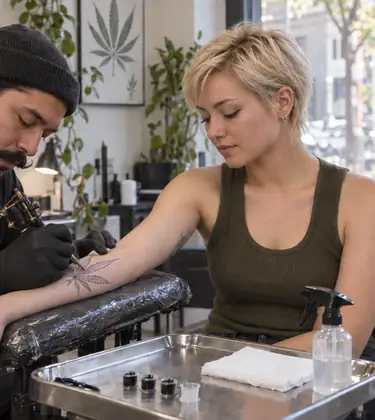
A cannabis leaf is one of the easiest tattoos to recognize from across a room. That is the reason people get one, and for some of them it is also the reason they later wish they had not.
The leaf carries more meanings than most designs, the culture around it has its own stock of images, and the regret numbers are clearer than you might expect. So are the rules about getting tattooed while high.
A pot leaf says several things at once
There is no single pot leaf tattoo meaning, because most people who wear one mean more than one thing. For some it is a political flag from the years of legalization campaigns. For growers, trimmers, budtenders and breeders it is a work tattoo, the way a chef might wear a knife. For others it is a plant they love, or a reminder of who they were at 19.
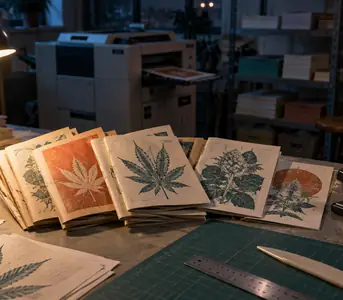
The design itself is more stylized than it looks. Draw one from memory and you will almost certainly give it seven leaflets, and we have covered how a botanical drawing became a global symbol in detail. For a tattoo, what matters is that the classic leaf is an icon. Real leaves rarely look exactly like it.
Stoner tattoos come with a familiar set of images
Stoner tattoos borrow from a small stock of images the culture has used for decades. The Grateful Dead's dancing bears are a good example. Bob Thomas drew them for the back cover of the band's 1973 album known as Bear's Choice, as a nod to Owsley "Bear" Stanley, who later insisted they were marching, not dancing.
The number 420 is the other constant, and it has an unusually specific origin. Five high school students in San Rafael, California, who called themselves the Waldos, coined it in 1971 while searching for an abandoned cannabis crop, and 4:20 in the afternoon was their meeting time. The overlap between the two cultures shows up in research, too. A 2010 survey of 1,753 American college students found that those with four or more tattoos were significantly more likely to report regular marijuana use.
If you want weed tattoo ideas that will still feel like yours in twenty years, a few choices help:
- Draw from a real fan leaf, bud or seedling instead of a sticker-style icon.
- Keep it fine-lined and small, somewhere clothing can cover it if a job ever requires that.
- Tie it to something personal, such as a first harvest, a favorite strain or a date that mattered.
- Favor black and gray over large areas of green, for reasons that come up at the removal stage.
Draw the plant, not the sticker
As breeders, we look at cannabis leaves every day, and real ones vary far more than the icon. Leaflet count changes as the plant grows: a seedling's first true leaves usually have a single serrated blade, the count climbs through three and five to seven or more on mature fan leaves, and it drops again near the flowers. Broad-leaf indica types carry wide, dark leaflets, narrow-leaf sativa types carry long, thin ones, and some genetics turn purple in the leaves and buds, especially when the nights run cool.
A tattoo artist can work from any of that, and a photo of a real plant makes a better reference than a stock icon. Two of our strains make good starting points for very different pieces:
- Master Kush for the classic broad leaf. Its dark green, sometimes bluish-purple leaves are wide and glossy, typical of indica varieties, on a broad, bushy, pyramidal plant.
- Ayahuasca Purple for color. A cross of Red River Delta and Master Kush, its buds show vibrant hues of deep purple and green, with striking orange pistils weaving through them.
If you are bringing your own reference, photograph a mature fan leaf from the middle of the plant, laid flat on white paper in daylight and shot from directly above. That gives the artist the real leaflet count, the serrated edges and the proportions without any guesswork. A leaf drawn from a living plant also tells anyone who knows cannabis that you know it too.
Feeling lost on how to start? Try taking our quiz!
Start a QuizAbout a quarter of tattooed Americans regret one
Pew Research Center found in 2023 that 32 percent of American adults have a tattoo, including 41 percent of adults under 30 and 46 percent of those aged 30 to 49. Most do not regret them, but about a quarter, 24 percent, say they ever regret getting one or more of their tattoos.
Other surveys land in the same range. A 2015 Harris Poll put regret at 23 percent, up from 14 percent in 2012. The top reason was that people had been too young, followed by a design that no longer fit their personality or lifestyle, and a partner's name they were no longer with.
We could not find any survey that measures regret for cannabis tattoos specifically. What researchers have measured is who regrets a tattoo in general. A 2023 study of 3,033 US adults, published in the journal Cureus, found that these factors predicted regret:
- More years spent living with the tattoo.
- A tattoo on the face, neck, hands, wrist or fingers.
- Getting it because of peer pressure.
- Being impaired when getting a tattoo
- A bad reaction to the tattoo afterward.
Older age, and getting a tattoo to remember someone or something, predicted the opposite.
The unexamined day is a wasted opportunity. Reflect on what you did, what you learned, and how you can improve.
John Dewey
Getting inked while high is against the rules in many states
Several states put it in writing. Colorado, where adult-use cannabis has been legal since 2012, prohibits body art procedures performed on any person who is noticeably impaired by drugs or alcohol. Oregon bans tattooing anyone who shows signs of being inebriated or appears to be incapacitated by the use of alcohol or drugs.
Cannabis tattoo artists, the ones whose portfolios are full of buds and leaves, work under the same rules as everyone else, and a visibly high client should expect to be sent home. The law is only part of it. A client who cannot sit still ruins linework, and consent given while impaired is not the kind a professional wants to rely on.
Does being high make it hurt less? The evidence is thin. A 2013 study in the journal Pain found that THC reduced how unpleasant ongoing pain felt without reducing how intense it was, and that pain came from a chili pepper compound on the skin, not a tattoo needle. We could not find any published study on cannabis and bleeding during a tattoo, whatever the forums say.
Green ink is the hardest to take back
If regret does arrive, the classic green pot leaf is a hard tattoo to erase. Laser treatment can usually remove black and other dark inks completely, while lighter colors, such as yellows and greens, are very difficult to remove. Complete removal takes numerous sessions, typically spaced eight weeks or more apart, and a 2009 study of 100 patients found it took 10 treatments on average, with a range of 3 to 20.
Some careers read the leaf literally. Navy rules prohibit tattoos that advocate illegal drug use, and when the Navy rewrote its tattoo policy in 2016, Navy Times reported that no waivers would be given for prohibited content. The Marine Corps bans tattoos that are drug-related, according to Marine Corps Times. Whether a particular leaf crosses that line is a judgment made by a recruiter, not by the person wearing it.
Outside jobs with rules like these, the fear is often bigger than the evidence. A 2019 study in the journal Human Relations found that tattooed workers in the United States earned wages statistically indistinguishable from those of workers without tattoos, and were just as likely to be employed.
Ink it like you plan to keep it
A cannabis tattoo can stand for politics, work, love of a plant or a younger version of yourself, and the culture around it has a deep stock of images to draw from. The regret data is general, but it points one way: visible placements, peer pressure and being impaired in the chair all raise the odds of wishing it gone, and green is among the hardest inks to remove.
So get it sober, draw it from a real plant, think about where it sits, and choose an artist who will turn you away on a bad day. Barney's Farm has been developing premium cannabis genetics since the 1980s, with over 40 Cannabis Cup wins. Explore our full seed catalog and find strains bred for every climate and skill level.