
The Cannabis Leaf: How a Botanical Drawing Became a Global Symbol
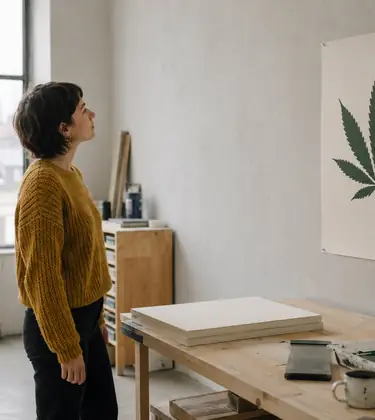
Draw a cannabis leaf from memory and you will draw seven leaflets. Almost everybody does, on stickers, on flags, on packaging, on skin.
That number is not a design convention that somebody invented. It is a measurement, and it was taken in a Harvard garden.
Why the drawing has seven points
Cannabis leaves are palmately compound, which means the leaflets radiate from a single point like fingers from a palm. The count is not fixed. The first pair of leaves on a seedling usually carries a single leaflet, the number climbs as the plant matures, and at the top of a flowering plant it drops back to one again.
The range runs wider than the drawings suggest. Standard botanical descriptions of the genus put the maximum at about thirteen leaflets per leaf, usually seven or nine, depending on variety and growing conditions.
So why does every drawing settle on seven? Because seven is the answer you get if you count.
In 1980 the botanist Loran Anderson grew cannabis from several origins in a controlled garden at Harvard and counted leaflets across the plants. For Cannabis sativa the modal leaflet number was 7, with a mean of 6.35. Indica-type plants came in at a mode of 9, and ruderalis at 5.
The symbol is a statistical average that escaped into graphic design. Whoever drew the first one drew the most common leaf, and everyone copied it afterward.
What the leaf shape tells you about where a plant came from
The same study measured leaflet width against length, which is the number behind the whole narrow-versus-broad distinction people repeat without a source. Anderson's ratios, and remember these are width over length, so lower means narrower:
- Sativa-type: central leaflet lanceolate, ratio around 0.09 to 0.12
- Indica-type: central leaflet oblanceolate, ratio around 0.17 to 0.21
- Ruderalis: elliptic, ratio around 0.16 to 0.21
An indica-type leaflet is roughly twice as wide relative to its length as a sativa-type one. That is the difference your eye is picking up when a plant reads as broad or as skinny, and it tracks latitude more than anything else. Plants from equatorial regions run long and narrow; plants from the mountains of Central Asia run short and wide.
Durban Poison is a clean illustration of the first type, a South African landrace whose narrow-fingered leaves and long, spear-shaped flowers are visible from across a room. Nothing about that shape is decorative. It is what a plant looks like when it evolved under a day length that barely changes.
From a Byzantine manuscript to a screen print
The marijuana leaf design history runs a great deal longer than the argument attached to it, and for most of it the plant was drawn accurately. The Vienna Dioscurides, made around 515 AD in Constantinople for a Byzantine imperial princess, contains 383 surviving full-page plant illustrations. One of them, folio 167v, is cannabis. The manuscript sits in the Austrian National Library and has been on the UNESCO Memory of the World register since 1997. That is a painted cannabis plant roughly 1,240 years before Linnaeus formally named the species in 1753.
The English herbalist Elizabeth Blackwell engraved and hand-colored a plate titled The Female Hemp between 1737 and 1739, sixteen years before Linnaeus, for a herbal she produced to pay her husband's debts.
The point of all of these was identification. A herbal existed so that a reader could recognize a plant correctly, which meant the leaf had to be drawn as it actually is. The cannabis leaf symbol we use today is descended from illustrations whose entire purpose was accuracy.
Feeling lost on how to start? Try taking our quiz!
Start a QuizWhen the leaf became an argument
Somewhere in the 1960s the weed leaf meaning changed. The drawing stopped saying "this is the plant" and started saying "I think this should be legal."
The Victoria and Albert Museum holds a screen print by Martin Sharp from 1967, made to advertise a rally at Speaker's Corner in Hyde Park that July, under the words Legalise cannabis. The Wisconsin Historical Society holds American protest posters from the same era, including a decriminalization rally poster featuring a marijuana leaf at the top. Duke University holds a 1975 poster reading Legalize Marijuana with a leaf drawing at its center.
The organizational scaffolding arrived at the same time. NORML was founded in 1970, and High Times launched in 1974 with a cannabis plant where a magazine of that era would have put a centerfold.
What changed was not the drawing. It was that reproducing it became a position. That is also the layer most people are reaching for on skin, since the cannabis leaf tattoo meaning almost everyone intends is the 1967 one and not the 515 one.
The unexamined day is a wasted opportunity. Reflect on what you did, what you learned, and how you can improve.
John Dewey
The leaf as a legal warning symbol
Here is the turn nobody expects. In several places a pot leaf icon is now a mandatory government warning mark.
Maine adopted a universal symbol shared with Massachusetts: a red triangle above the words CONTAINS THC, with a black cannabis leaf superimposed on a field of white inside the triangle. It has to appear at a minimum size on packaging.
Canada went further and made the leaf national. Health Canada's standardized cannabis symbol is a red octagon containing a white cannabis leaf and the letters THC, required on any product above a defined THC concentration. The regulation specifies the exact Pantone red. It also prohibits displaying anything that resembles or could be mistaken for the symbol, which means the leaf is now so official that imitating it is an offense.
Colorado deliberately went the other way. Regulators proposed a red octagon, manufacturers objected that a stop sign implied the product was dangerous, and the final symbol became a triangle with the letters THC and no leaf at all.
And the state that banned it from the window
Washington wrote a legal definition of a cannabis leaf so that it could prohibit one. Outdoor advertising signs may not contain depictions of cannabis plants or cannabis products, and the rule defines a depiction as an image or visual representation of a cannabis leaf, plant, or the likeness thereof that explicitly suggests or represents a cannabis leaf or plant.
The state's own guidance draws the line precisely: you may use a leaf in your logo, you may not put that logo on your signage. The same drawing is legal on a business card and illegal on the front of the building.
Same image, three regulatory outcomes. Required in Maine, forbidden on a Washington storefront, deliberately avoided in Colorado.
What a breeder sees in the drawing
Forty years of looking at these plants changes how the symbol reads. The leaf is the part of cannabis that does none of the work people care about. Cannabinoids and terpenes are made in the glandular trichomes, which sit overwhelmingly on the flower and its surrounding bracts. Fan leaves run the photosynthesis and then get removed at harvest and composted. The most recognizable thing about the plant is the part nobody smokes.
What a leaf does tell a grower is health and history. Color, margin, the angle of the fingers and the way it holds through week seven say more about a feed schedule than any label does. Hindu Kush shows the other end of Anderson's range from the Durban above, a mountain landrace with short, broad, dark leaflets that evolved under a hard, short season, and you can read its origin off the leaf shape before you read anything else about it.
That is the useful version of the symbol. Not an emblem, a diagnostic.
Why the drawing outlasted everything
A botanical illustration made for identification became a protest poster, then a merchandise print, then a federal warning label in one country and a banned image in one American state.
None of that changed the plant. The seven points on the sticker are still just the most common number of leaflets on a mature Cannabis sativa, counted in a garden in 1980 and drawn accurately for fifteen hundred years before that.
Barney's Farm has been developing premium cannabis genetics since the 1980s, with over 40 Cannabis Cup wins. Explore our full seed catalog and find strains bred for every climate and skill level.