Cannabis in American Writing: From the Beats to Now

American writers were putting cannabis on the page long before it was legal, and the page got them into trouble more than once. The Beats made it famous, but the story starts a century earlier and it has not stopped since.
Cannabis has gone from scandal to shelf category. Along the way it picked up jazz slang, a moral panic, a landmark obscenity ruling and a whole genre of stoner novels.
Cannabis in literature starts in 1857
One of the first American books about getting high came out four years before the Civil War. The Hasheesh Eater, published in 1857, is an autobiographical book by Fitz Hugh Ludlow describing the author's altered states of consciousness while he was using large doses of cannabis tincture. It created a short-lived popular interest in hashish, cannabis edibles and tincture in the United States, and a century later the Beats rediscovered it. In 1960 a Beat literary journal, The Hasty Papers, devoted most of its pages to reprinting the whole first edition.
Even Louisa May Alcott wrote the drug into fiction. In her 1877 gothic thriller A Modern Mephistopheles, one character secretly gives a young woman hashish.
Jazz carried the next wave. Really the Blues, the 1946 memoir by jazz musician Mezz Mezzrow, written with the novelist Bernard Wolfe, follows him to Harlem, where he sold marijuana and became known among his customers for his command of jive slang. The stronger Mexican marijuana he brought to the Harlem jazz scene came to be known simply as "Mezz," and "viper" was Harlem slang for a pot smoker. Cannabis in literature was still underground, but it now had a vocabulary.
Reefer madness was American writing too
The other side wrote just as hard. The reefer-madness era leaned on one case above all: Victor Licata's killing of his family with an axe in Tampa, Florida, in October 1933, reported by the media as the work of an axe-murdering marijuana addict. Harry Anslinger, the federal narcotics chief, used the case in his influential 1937 article "Marijuana, Assassin of Youth," the same year Congress passed the Marihuana Tax Act. Hollywood joined in with a 1936 film originally titled Tell Your Children, financed by a church group to warn parents about the supposed dangers of cannabis, and later known as Reefer Madness. Pulp followed. In 1941 Cornell Woolrich, writing as William Irish, published the dime novel Marihuana: A Drug-Crazed Killer at Large.
The case did not hold up. Later research found that marijuana was never referenced in any of Licata's psychiatric reports, nor considered a factor in the killings.
The Beats wrote high and said so
Beat Generation marijuana use was never a secret, because the writers put it in the work. Kerouac's Mexico City Blues, a long poem of 242 choruses, was largely created under the influence of cannabis and morphine, and he described the routine himself: "I'd come every day with my marijuana and my note pad." Few pieces of cannabis poetry wear their method so openly. Even the plot of On the Road heads for Mexico, where the police are laid back and cannabis is readily available. The rest of the circle left the same kind of record:
- William S. Burroughs replaced his opioid use with cannabis and later said he "wrote nearly the whole of Naked Lunch on cannabis."
- San Francisco police and US Customs seized copies of Allen Ginsberg's Howl, and in 1957 Judge Clayton W. Horn ruled that it was not obscene. The Howl and Naked Lunch trials together helped to liberalize publishing in the United States.
- Neal Cassady, the model for Dean Moriarty in On the Road, served two years in San Quentin after a 1958 arrest for offering to share a small amount of marijuana with an undercover agent.
- Ginsberg then turned to activism. After attending a rally of LEMAR, the first organization in the US dedicated to ending cannabis prohibition, he went home to New York and founded its first East Coast chapter.
The poet John Sinclair, who founded LEMAR's Detroit chapter, paid a heavier price. He was given ten years in prison for possessing two marijuana cigarettes, and he was released shortly after a December 1971 freedom rally in Ann Arbor where John Lennon and Yoko Ono appeared.
Not every Beat high was cannabis, either. Ginsberg claimed he wrote the second part of Howl with peyote and Kaddish with amphetamines. The movement is now auction-house material: in 2026 the singer Zach Bryan paid $12.1 million for Kerouac's original On the Road scroll.
Feeling lost on how to start? Try taking our quiz!
Start a QuizStrain names borrow from the same shelf
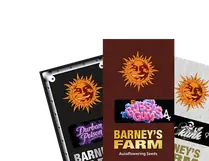
From where we sit, cannabis and books have always traded names. Breeders name strains after novels, films and moods, and two of ours carry that literary streak:
- Moby Dick shares its name with Melville's 1851 novel, Moby-Dick, which came out six years before Ludlow's book. It is a 75 percent sativa cross of G13 Haze and White Widow at 27 percent THC, with a high that will catapult you fiercely into a separate reality of creativity and production.
- LSD takes its name, in the Barney's crew's own words, from its powerful trippy high. Despite the name, it is 70 percent indica, a cross of Original Skunk #1 and Afghan Indica at 30 percent THC.
That last detail is worth remembering whenever a name seems to promise an effect. The name tells you about the breeder's sense of humor. The genetics tell you about the high, and that is what the numbers on a seed page are for.
The unexamined day is a wasted opportunity. Reflect on what you did, what you learned, and how you can improve.
John Dewey
Stoner novels grew up after the sixties
After the Beats, drug writing turned into comedy, journalism and eventually genre. The stoner novels and their cousins that followed tend to take one of four shapes:
- The drug-fueled road trip: Hunter S. Thompson's Fear and Loathing in Las Vegas (1972), first serialized in Rolling Stone. Thompson backed the cause off the page too, serving on NORML's advisory board for more than 30 years.
- The New Journalism trip: Tom Wolfe's The Electric Kool-Aid Acid Test (1968), in which Ken Kesey is arrested for possession of marijuana and flees to Mexico to avoid jail.
- The grow-op farce: T. C. Boyle's Budding Prospects (1984), whose narrator plans to get rich quick by illegally growing marijuana.
- The stoner detective: Thomas Pynchon's Inherent Vice (2009), a darkly comic mystery set in 1970s California in which
Books about weed went mainstream
Nonfiction followed the same curve. In 1971 Harvard University Press published Lester Grinspoon's Marihuana Reconsidered, a book about marijuana's effects and its place in society, and Carl Sagan contributed an essay to it about smoking cannabis under the pseudonym "Mr. X." In it he explained that marijuana had helped inspire some of his work, and Grinspoon revealed who wrote it only after Sagan died. Michael Pollan's The Botany of Desire (2001) gave cannabis one of its four parts, as the plant grown for intoxication.
As legalization spread, books about weed started coming from historians and etiquette writers. The historian Emily Dufton, author of Grass Roots: The Rise and Fall and Rise of Marijuana in America, dug through old issues of High Times and traced the paraphernalia boom of the 1970s to a dozen states decriminalizing the possession of up to an ounce of marijuana between 1973 and 1978. In 2019 Ten Speed Press published Higher Etiquette, Lizzie Post's guide to the world of cannabis, from dispensaries to dinner parties.
Journalism caught up as well. Eric Schlosser won a National Magazine Award for his two-part 1994 Atlantic Monthly series "Reefer Madness" and "Marijuana and the Law," and his 2003 book Reefer Madness returned to the marijuana trade. At The Denver Post, Ricardo Baca became the first full-time marijuana editor at a major American newspaper, producing The Cannabist until December 2016.
Every generation writes its own high
American writing has treated cannabis as a mystery, a menace, a muse and finally a subject like any other. Ludlow wrote an early trip report, Mezzrow brought the slang, Anslinger's side wrote the panic, the Beats wrote high and won the right to publish, and the stoner novels turned it all into comedy.
The books about weed now come from historians, scientists and etiquette writers, which may be the surest sign that legalization has arrived. Barney's Farm has been developing premium cannabis genetics since the 1980s, with over 40 Cannabis Cup wins. Explore our full seed catalog and find strains bred for every climate and skill level.