Cannabis Cultivation Licenses: What It Actually Takes to Get One

The application fee is the number everybody looks up first, and it is the least important number in the process.
In Illinois, 87 craft grower licenses were awarded to social equity applicants. Four years later, 21 of them were operating. Nothing about that gap is explained by the fee.
This guide covers what states actually charge, the money you need before you apply, the local veto that decides most applications, and the market those licenses now compete in.
The fee is the cheap part
Getting a license costs thousands. Using one costs millions. Fees vary by a factor of forty between states, capital requirements are often written into the rules, and the binding constraint in most of the country is a city council that has banned cannabis businesses entirely.
What states charge
The spread is wider than any other part of this industry. California prices cultivation by canopy tier, with application fees running from $135 for specialty cottage outdoor to $8,655 for medium indoor, and annual license fees from $1,205 up to $77,905 before the per-square-foot additions for large licenses kick in.
Oklahoma built the cheap end. A grower license starts at $2,500 for up to 10,000 square feet indoor or up to 2.5 acres outdoor, rising through seven tiers, and the same schedule now applies at renewal after the state ended its flat-fee era in June 2023.
Illinois built the expensive end. A craft grower pays $5,000 to apply and $40,000 for the license, halved for social equity applicants, while an adult use cultivation center pays $100,000 to apply, $100,000 for the license and $100,000 to renew.
Ohio charges Level I cultivators $20,000 to apply, $180,000 for the certificate of operation and $200,000 a year to renew. Colorado tiers by plant count instead of canopy, starting around $2,440 for the first thousand-plus plants.
Forty times the price for the same activity, depending on which side of a state line the greenhouse sits on.
The money you need before you apply
Several states require you to prove you have capital, and the numbers are the real barrier.
Ohio requires at least five hundred thousand dollars in liquid assets for a Level I cultivator provisional license, unencumbered and convertible within thirty days. Michigan sets capitalization thresholds by grower class, from $150,000 for Class A to $500,000 for Class C, with at least 25 percent held in liquid assets and the whole thing attested by a CPA. Oklahoma requires a $50,000 surety bond per grower license unless you have owned the property for five years.
Then there is the build. One Illinois craft grow licensee put the figure at nine million dollars to get fully up and running, and the state's own commissioned analysis concluded that the 5,000 square foot craft canopy cap does not generate sufficient profit necessary to secure financial backing.
None of this can be borrowed normally. Federal illegality keeps most banks and the SBA out, and Section 280E denies growers ordinary business deductions, so a cultivation company pays tax on gross profit while a tomato farm pays tax on net.
Feeling lost on how to start? Try taking our quiz!
Start a QuizThe gatekeeper nobody budgets for
Here is where most applications actually die, and it has nothing to do with the state.
In California, the regulator's own data shows 53% of cities and counties do not allow any type of cannabis business (284 out of 540). More than half the map is closed before you fill in a form, and state law preserves local authority to prohibit cannabis businesses outright.
Colorado calls it dual licensing and says so plainly: a state license is conditioned on local approval, and operating without both is prohibited. Illinois requires proof of zoning compliance inside the craft grower application, bans craft grows from residentially zoned areas and imposes a 1,500 foot separation from other grows. Massachusetts requires a signed host community agreement before an application is even complete.
Which means the sequence most applicants imagine is backwards. You do not get a state license and then find a building. You find a jurisdiction that permits cultivation, secure a property with correct zoning, hold it while the process runs, and only then does the state matter.
The unexamined day is a wasted opportunity. Reflect on what you did, what you learned, and how you can improve.
John Dewey
How long it takes
Long enough that the holding costs become the story.
California's own legislative report puts the average processing time at 327 days for cultivation licenses, against 177 days for retail and 703 for testing labs. The state ran an eight-year provisional license workaround precisely because annual licensing could not keep up, and that workaround finally ended on January 1, 2026.
Illinois missed its own statutory deadlines by roughly eighteen months on both craft grower rounds, and has since extended the deadline by which craft growers must actually be operating more than once.
Through all of that, someone is paying rent on a building that grows nothing.
The market waiting at the end
Assume you clear every hurdle. This is what you walk into. Colorado's Department of Revenue sets an official wholesale rate for tax purposes, and as of April 2026 it stands at $607 per pound for retail bud. The same schedule was $2,007 in January 2015. That is a fall of roughly 70 percent.
Growers absorbed it worse than shops. Colorado's registered cultivations dropped by over 44 percent since January of 2021, from 1,179 to 659, while dispensary licenses fell just under 9 percent over the same stretch.
Oklahoma shows the other failure mode. Active grower licenses have fallen from a peak of 5,752 in October 2023 to 1,801 by August 2026, and the state has had a moratorium on new grower licenses since August 2022, now extended to August 2028.
In Illinois, of 87 craft grow licenses issued, 21 were operational as of the state's September 2025 report, even after roughly $20 million in forgivable state loans went to craft growers, infusers and transporters.
What this looks like from the other end
We have watched this cycle from a seed company's seat since long before any of these programs existed, and one pattern repeats.
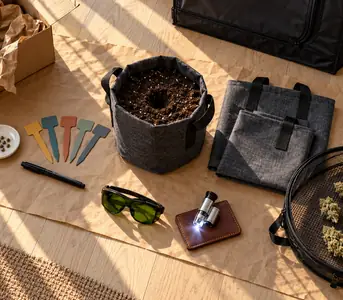
The people who survive commercial cultivation are the ones who were good at growing before they were good at paperwork. Licensing rewards capital and patience. Cultivation rewards knowing your room, your genetics and your failure modes, and no application fee teaches that. The cheapest place to learn it remains a tent with a few plants in it, where a mistake costs a harvest instead of a business.
That is also the honest reason home growing exists as a legal category in most adult-use states. Personal cultivation rights were written to let ordinary people participate without any of the above, and they remain the only route into this plant that does not require a lawyer.
MAC 1 is a plant that teaches you things, Alien Cookies crossed with Miracle 15, a 50/50 at 27% THC, flowering in 63 to 70 days at 120 to 160 cm indoors with 600 grams a square meter, citrus and creamy vanilla over pine and earthy spice, euphoric and focused. Frosted Zinn x Cookie Dog Auto is the forgiving one, an auto crossed to an auto at 25%, 70 to 75 days from seed at 90 to 110 cm, diesel and vanilla over pepper and pine, and unusually responsive to gentle training.
Four decades of breeding has taught us that the growing is the hard part, whatever the license says.
Fees, capital and the odds
Cultivation license fees range from $2,500 in Oklahoma to $100,000 to apply in Illinois, with California pricing by canopy tier from $135 to $8,655 and annual fees reaching $77,905.
The fees are the smallest cost. Ohio requires half a million dollars in liquid assets before a provisional Level I license, Michigan requires up to $500,000 in capitalization with CPA attestation, and one Illinois craft grower estimated nine million dollars to open. Banks and the SBA stay out, and Section 280E taxes growers on gross profit.
Local government decides most of it: 53 percent of California jurisdictions permit no cannabis business at all. California averages 327 days to process a cultivation application. And the market at the end has seen Colorado's wholesale rate fall from $2,007 to $607 a pound, with registered cultivations down 44 percent since 2021.
Barney's Farm has been developing premium cannabis genetics since the 1980s, with over 40 Cannabis Cup wins. Explore our full seed catalog and find strains bred for every climate and skill level.