
Cannabis Packaging: Why Legal Weed Generates So Much Plastic

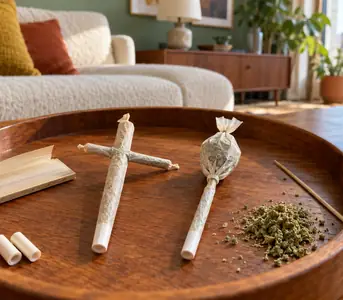
Buy an eighth in a licensed shop and you carry home a plastic jar, a label, an exit bag and, if you added a pre-roll, a plastic tube with a cap engineered to defeat a four-year-old.
Everyone who has done it has had the same thought at the bin. The interesting part is that almost none of it is the shop's decision.
This guide covers where the plastic actually comes from, the test that shapes every container, why the recycling system rejects it even when you do everything right, and the exemption that makes the whole problem circular.
Required by law, rejected by recycling
The packaging is a legal requirement, written into state rules that in some cases specify plastic by thickness.
Then the recycling infrastructure rejects it on size, and at least one state's recycling law exempts it by name. The waste is a policy output, not a consumer choice.
The test that designs the container
Every child-resistant cannabis container in America traces back to one federal standard, and the numbers in it explain the engineering.
To qualify, a package must have child-resistant effectiveness of not less than 85 percent without a demonstration and not less than 80 percent after a demonstration of the proper means of opening such special packaging. The same rule requires senior adult use effectiveness of not less than 90 percent.
Read those together, because they are the whole design problem. The container has to defeat 85 percent of small children and open for 90 percent of adults aged 50 to 70. Real children are used for the test, in panels aged 42 to 51 months, working in pairs with five minutes on the clock.
The only cheap way to satisfy both constraints at once is a rigid molded closure with a push-and-turn or squeeze-and-lift action. That means thick plastic, multiple parts, and no paper.
Where states specify plastic outright
Some rules do not merely tolerate plastic. They name it. Washington's regulations give concentrate producers two compliance paths: certified child-resistant packaging under the federal standard, or packaging in plastic that is two mil or greater in thickness, heat sealed without an easy-open tab, dimple, corner, or flap. California's version of the same alternative sets the bar at four mils.
A regulation whose compliance path is measured in mils of virgin plastic film is a regulation that has chosen a material.
The multiplier sits elsewhere in the rules. California requires edibles to stay child-resistant for the life of the product, and permits a multi-serving package to skip child resistance only if every individual serving is separately child-resistant. So a ten-pack of gummies is either one heavy container or ten small wrappers. There is no third option.
Add opaque packaging mandates, which nine states had in 2022 and more than a dozen have now, and the exit bag that several states require on top of a container that is already compliant.
Feeling lost on how to start? Try taking our quiz!
Start a QuizWhy recycling does not catch it
Here is the mechanical fact that undoes every good intention at the bin. Materials recovery facilities sort by size, and small items fall through the screens meant for glass fragments and grit. Reporting on Maryland's cannabis packaging take-back program found that because area recycling systems tend to filter out items smaller than four inches in diameter, most cannabis packaging isn't making it through.
Now picture the category. Pre-roll tubes, gummy tins, eighth jars, vape cart boxes, dram vials. Almost every one is under four inches.
The mylar pouch has a second problem. It is a laminate of plastic film, foil and sealant layers that cannot be separated at melt temperature, which puts multilayer film outside mechanical recycling regardless of size.
And the baseline was never good. The EPA's data puts the national picture at three million tons for a 8.7 percent recycling rate in 2018 across all plastics, with 27 million tons landfilled that year.
The unexamined day is a wasted opportunity. Reflect on what you did, what you learned, and how you can improve.
John Dewey
The exemption that closes the loop
This is the part that turns an annoyance into an absurdity. Colorado has an extended producer responsibility law, the kind that makes packaging producers fund recycling for what they put on the market. Its exemption list covers packaging material used to contain a product that must be sold in packaging meeting the standards of the Poison Prevention Packaging Act of 1970. The state-appointed producer responsibility organization spells out what that means in practice, citing the Colorado Department of Public Health and Environment: the exemption applies to packaging required under state law which is limited to marijuana products. Cannabis is the only category the exemption reaches.
So the child-safety rule that generates the plastic is the same rule that exempts the plastic from the recycling program built to deal with it. Cannabis packaging is the one category written out of the fix.
The state that simply banned it
Vermont did the obvious thing, and it is worth knowing that the obvious thing is possible. The Cannabis Control Board's rules state that retail packaging shall be reusable and shall not be plastic. Compliant materials are cardboard, glass, metal, bamboo and wood. Child-resistant containers may be reused as child-resistant containers where they still meet the standard, and the Board stopped accepting new waiver applications in February 2026, with no new waivers until 2027.
One state proved the packaging can be plastic-free and child-resistant at the same time. Every other state has decided otherwise.
The case for the rules, stated fairly
The plastic exists for a reason, and the reason is not imaginary.
Pediatric cannabis exposures rose sharply as legal edibles spread. New York's cannabis regulator reported nearly 670 emergency department visits for cannabis-related poisonings involving children ages 0-17 in New York State in 2024 alone, with roughly a quarter of children who ingested cannabis requiring hospitalization.
Child-resistant packaging also has a measured track record in pharmaceuticals, where the Poison Prevention Packaging Act is credited with cutting childhood poisoning deaths substantially. Nobody serious is arguing for a return to unmarked bags.
The honest criticism is narrower. Rules written for a bottle of aspirin were applied to a category of small, frequently purchased, mostly single-use items, and nobody has since asked whether reusable containers, refill programs or deposit schemes could hit the same safety target with a fraction of the material. Vermont asked. Almost nowhere else has.
What a grow tent does to this problem
We are a seed company, so here is the version of this we can speak to directly, and it is the shortest section in the article.
A plant produces no packaging. A harvest goes into a glass jar you already own, and that jar gets used again next year and the year after. There is no exit bag, no dram vial, no heat-sealed pouch, no label printed in a font size set by regulation. The entire waste stream described above simply does not exist in a home grow, and that is a structural difference, not a marketing claim.
One plant also replaces a great many small containers. Cookie Casket is The Hearse crossed with Thin Mint Cookies, a 70% indica at 30% THC, flowering in 63 to 70 days at 100 to 120 cm indoors and capable of up to 2,000 grams a plant outdoors, diesel and spice over earthy pepper, creative with a heavy body finish. Lemon Cherry Cookies Auto is the quick option, Lemon Cherry Cookies crossed into our Super Auto line at 28%, 65 to 75 days from seed at 80 to 110 cm, lemon and cherry over earthy florals, calming and uplifting.
Four decades of breeding has taught us that the jars people love are the ones they refill.
The waste is the policy
Cannabis packaging is heavy because federal child-resistance standards require a container that defeats 85 percent of preschoolers while opening for 90 percent of seniors, and the cheapest way to do both is rigid plastic. Several states name plastic thickness as a compliance path outright.
Recycling then fails it twice: sorting screens reject anything under four inches, which covers nearly all cannabis packaging, and multilayer mylar pouches cannot be mechanically recycled at any size. The national plastics recycling rate was 8.7 percent to begin with.
Colorado's producer responsibility law exempts cannabis packaging by name, because the packaging is legally required. Vermont banned plastic retail cannabis packaging entirely and it works. The pediatric poisoning numbers behind the rules are real, which makes this a design problem, and one almost no state has tried to solve.
Barney's Farm has been developing premium cannabis genetics since the 1980s, with over 40 Cannabis Cup wins. Explore our full seed catalog and find strains bred for every climate and skill level.