Durban Poison: The Landrace That Became America's Daytime Strain
Ask an American budtender for something for the morning and there is a decent chance you get handed Durban Poison. It has been the default answer to that question for two decades.
The plant behind the reputation spent several centuries being farmed by smallholders on the South African coast, for a purpose nobody in a dispensary ever mentions. Its route from there to here is worth knowing, and so is the fact that almost none of what gets said about it has ever been measured.
This guide covers where the plant actually comes from, what the country did to it, what the research says about the compound it is famous for, and why the daytime label is folklore with one small piece of evidence behind it.
Real plant, folklore reputation
Durban Poison is a South African drug landrace, and it was a deliberate agricultural product long before any breeder touched it.
The daytime reputation is real as a market phenomenon and weak as a scientific claim. The one peer-reviewed chemical profile of a plant sold under the name does not match what the name is supposed to mean.
Where the plant actually comes from
The cannabis of KwaZulu-Natal grew where farmers planted it. It was a crop. The UN's own 1961 survey of South African cannabis is unusually blunt about this, recording that cannabis in the region is always cultivated and that the supply of dagga is thus not from wild, but from cultivated plants, which are grown for no other purpose than for sale to cannabis habitués. The same survey notes it was never grown there for fiber, seed or oil. It was a drug crop, grown by farmers, sold to consumers, with a market.
The word dagga is older than the colony. It comes from Khoekhoe rather than Zulu, and its first written appearance in Dutch records dates to the 1650s. Smallholder cultivation along the Eastern Cape and KwaZulu-Natal coastal belt has continued unbroken since, and a 2024 review counts more than 900,000 small-scale farmers still growing cannabis in those two provinces.
So the honest framing of Durban Poison runs the other way around. Generations of South African farmers selected it, and Western breeders received the results.
The origin story nobody can document
The American half of the story is told constantly and sourced almost nowhere. The industry version has a High Times figure collecting seeds in South Africa in the late 1970s, passing them to a second grower who stabilized the line over successive generations, after which the plant reached Amsterdam and then the seed catalogs. It is repeated on menus, in strain databases and in trade press.
It also does not appear in any newspaper archive, biography, encyclopedia entry or published book we could check, and the one first-person account on record credits the stabilization work to a different person than the collecting. Treat the whole 1970s narrative as industry oral history. It may well be true. It has never been documented, which is a fairly typical situation for cannabis heritage claims and worth saying out loud.
Feeling lost on how to start? Try taking our quiz!
Start a QuizWhat the country did to it
South Africa did not merely ban dagga. It exported the ban. The first prohibition was explicitly racial: an 1870 Natal law aimed at Indian indentured laborers. National prohibition followed in 1922, and full criminalization in 1928. Then came the part with global consequences. It was at South Africa's wish, expressed by Secretary to the Prime Minister J. C. Van Tyen in 1923, that dagga was included in a list of prohibited narcotics at the international level, which fed into the Geneva convention that became the template for cannabis prohibition worldwide.
The country that gave the world Durban Poison is also the country that put cannabis on the international control list.
It came back around in 2018, when the Constitutional Court struck down the ban on private adult use, holding the laws invalid to the extent that they prohibit the cultivation of cannabis by an adult in a private place for his or her personal consumption in private. Parliament passed implementing legislation in 2024, and draft regulations setting private possession and plant limits were still working through public comment in early 2026. Nearly a century to criminalize, and the unwinding is still in progress.
The unexamined day is a wasted opportunity. Reflect on what you did, what you learned, and how you can improve.
John Dewey
THCV, and what it does not do
Durban Poison's scientific claim to fame is tetrahydrocannabivarin, and the marketing around it has run well ahead of the evidence. THCV is genuinely a marker of African and South Asian landraces, it has been detected in African-grown cannabis by gas chromatography, and there is a peer-reviewed claim that South African selection for appetite suppression produced cultivars carrying high amounts of it. That much is defensible.
The diet weed story is not. A controlled study in mice reported that THCV did not significantly affect food intake or body weight gain in any of the studies, but produced an early and transient increase in energy expenditure, and a human trial in type 2 diabetes found the oral dose had no effect on body weight or food intake either. What THCV did do in that human trial was improve fasting glucose and pancreatic beta cell function, which is a more interesting result than appetite suppression and gets a fraction of the attention.
One more caution: no peer-reviewed measurement of THCV content in Durban Poison exists that we could find. Every percentage in circulation traces back to a dispensary menu or a seed listing, not a laboratory paper.
Why daytime is folklore with a footnote
Here is the part that will annoy people, including us. The sativa and indica labels do not survive genetic testing. The largest chemical study of the US market, covering roughly 90,000 samples across six states, found commercial labels do not consistently align with the observed chemical diversity, and sorted the market into three real chemotypes instead: caryophyllene-limonene, myrcene-pinene, and terpinolene-myrcene.
There is one genuine exception, and it happens to favor this article. Of those three, only the terpinolene group tracked the marketing: Cluster III (high terpinolene) did show a significant difference, with approximately twice as many Sativa-labelled products and half as many Indica-labelled products as expected from the full population. Terpinolene is the one terpene that actually predicts a sativa label.
Then the footnote turns on itself twice. The only published gas chromatography profile of a Durban Poison chemotype found β-Myrcene 100.00 as the dominant terpene, with terpinolene nowhere in the top ten. And terpinolene's own experimental literature describes it as sedative in mice, not stimulating.
The daytime reputation is a market fact built on a chemotype association that this particular cultivar, when someone finally measured one, did not display.
Why landraces are worth keeping
This is the part where a seed company has standing, because holding genetics is the job. Botanists classifying cannabis landraces described them as critically endangered reservoirs of germplasm from which modern cannabinoid strains originated, and which are in urgent need of conservation, with hybridization, not eradication, doing the damage. Every landrace crossed into a modern hybrid dilutes something that took centuries to accumulate.
South Africa shows the cost precisely. A 2024 review found that of the cannabis genome assemblies then held by the National Center for Biotechnology Information, none of these are representatives of African samples, and that no study had compared an African genome against the published ones. The continent that supplied one of the most recognizable names in the industry is close to absent from its genomic record.
Which is the argument for stabilized seed lines in one sentence: a cutting passed hand to hand loses its history, and a seed line keeps it.
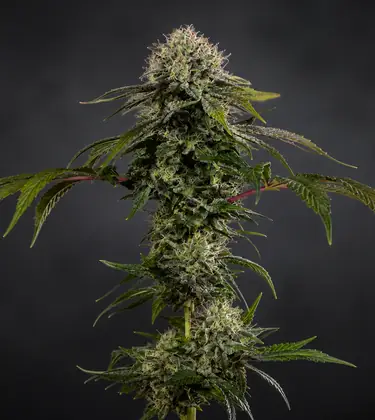
Durban Poison is our Precision F1 take on the original, a 100% sativa at 27% THC, 56 to 65 days flowering, tall at 150 to 200 cm indoors, anise and licorice over pine, citrus and pepper, energetic and clear-headed. Tropicana Cookies Auto is the modern easy option in the same register, Tropicana Cookies crossed into our Super Auto line, a 60% sativa at 27%, 70 to 75 days from seed and compact at 90 to 110 cm, tropical citrus and cookie dough, uplifting and creative.
Four decades of breeding has taught us that the landraces are the library, and hybrids are what you write with it.
The plant, the myth and the paperwork
Durban Poison descends from South African drug cannabis that smallholders in KwaZulu-Natal and the Eastern Cape cultivated deliberately for centuries, never for fiber or seed, and it reached the West through a 1970s origin story that circulates everywhere and is documented nowhere.
South Africa criminalized dagga in stages from an explicitly racial 1870 law to full prohibition in 1928, and pushed for cannabis to enter the international control lists in 1923. Its Constitutional Court legalized private adult use and cultivation in 2018, with regulations still being finalized in 2026.
The THCV story is real as chemistry and overstated as marketing, with controlled studies finding no appetite or weight effect. The daytime reputation rests on terpinolene, the one terpene that genuinely predicts a sativa label, and the only published profile of a Durban Poison sample was myrcene-dominant with no terpinolene in the top ten.
Barney's Farm has been developing premium cannabis genetics since the 1980s, with over 40 Cannabis Cup wins. Explore our full seed catalog and find strains bred for every climate and skill level.