Can Weed Stop a Migraine? Relief, Rebound Headaches and the Evidence

For years the honest answer to whether cannabis helps a migraine was that nobody had tested it properly. Millions of people were using it anyway, and the research consisted of surveys, chart reviews and conference abstracts.
That is no longer true. There is now a real randomised controlled trial, and it produced a result specific enough to be useful and awkward enough to be believable.
This guide covers what that trial found, why the CBD arm failed, the rebound headache signal that sits alongside the benefit, and what the dose in the study tells you about what is actually on dispensary shelves.
What the trial found
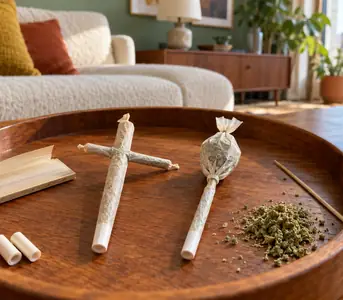
Researchers at UC San Diego ran a four-way crossover study, which is the strongest design available for something like this. Ninety-two people were randomised, and 247 separate migraine attacks were treated with one of four vaporised flower preparations: THC-dominant, CBD-dominant, both together, or a placebo flower with the cannabinoids extracted.
Pain relief at two hours, the primary outcome:
- THC plus CBD: 67.2% versus 46.6% for placebo
- THC-dominant alone: 68.9% versus 46.6%
- CBD-dominant alone: no better than placebo
- Pain freedom at two hours: 34.5% versus 15.5%
- Freedom from the most bothersome symptom: 60.3% versus 34.5%
No serious adverse events were reported. The final published analysis in 2026 confirmed the pattern and added that freedom from the most bothersome symptom held at 24 and 48 hours, with more than 60% of people returning to normal activity within two hours.
The CBD result is the important one
Read that list again. The CBD-dominant arm did nothing that placebo did not also do.
This matters because CBD is the version people reach for when they want relief without impairment, and it is the version marketed most aggressively for headaches. In the only properly controlled test of it, it failed.
The researchers' explanation is mechanistic: CBD acts as a negative allosteric modulator at the CB1 receptor, which means it dampens the signalling that appears to produce the effect instead of driving it. Whatever is helping migraine here, it is the THC doing it.
The dose was much lower than you think
The study used flower at roughly 6% THC, delivered as four puffs from a research vaporiser within four hours of onset.
Six percent. That is a fraction of what any dispensary sells, and lower than most cannabis grown anywhere in the last twenty years. The trial is not evidence that a 30% THC cartridge treats migraine. It is evidence that a small, measured dose of a low-potency preparation beat placebo.
Anyone treating a headache with the strongest thing on the shelf is not doing what the study did.
Feeling lost on how to start? Try taking our quiz!
Start a QuizRoute matters more than people expect
The trial used a vaporiser, and that choice was not incidental.
A migraine attack has a window. Most acute treatments work best taken early, and the study required treatment within four hours of onset. Inhaled cannabis reaches peak blood concentration within minutes, which is why it can plausibly function as an abortive treatment at all.
Edibles do the opposite. Oral THC passes through the liver first, onset commonly runs 30 to 120 minutes, and the effect is longer and less predictable. By the time a gummy takes hold, an attack that was going to escalate has already escalated. Nothing in the trial supports edibles for acute migraine, and the pharmacokinetics argue against them.
There is also the nausea problem. Migraine frequently comes with it, and swallowing anything during an attack is unreliable when your stomach has stopped emptying properly. That is the same reason injectable and nasal triptans exist.
The unexamined day is a wasted opportunity. Reflect on what you did, what you learned, and how you can improve.
John Dewey
The rebound headache problem
Here is the part that rarely makes it into cannabis-and-migraine articles. Medication overuse headache is a real and well documented phenomenon where the thing treating your headaches starts causing them. It happens with triptans, codeine and over-the-counter painkillers taken too often. Cannabis appears to belong on that list.
A Stanford study of 368 people with chronic migraine found that cannabis users were roughly six times more likely to have medication overuse headache than non-users. A separate systematic review reported the split as 81% of cannabis users versus 41% of non-users.
Both of those are observational, and observational data cannot prove direction. People with worse headaches use more of everything, so the arrow could point either way. But the effect size is large, it has turned up twice independently, and no trial has been designed to rule it out. Treat it as a live risk, not a settled one.
The rest of the evidence is thinner than the headlines suggest
Before the 2024 trial, the literature was mostly noise. A systematic review covering 12 publications and 1,980 participants found only seven were peer-reviewed, with the rest conference abstracts or case reports. Its authors wrote plainly that high-quality research on medical cannabis for migraine was lacking.
The positive numbers from that body of work are worth knowing and worth discounting. Monthly migraine frequency dropping from 10.4 to 4.6. Cannabis aborting an attack in about 12% of users. Roughly comparable frequency reduction to amitriptyline. Adverse events in around 44% of people using oral preparations.
There is still no controlled trial of cannabis for migraine prevention. Every claim about reducing how often you get them traces back to uncontrolled observation.
The gap between what patients report and what trials measure is wide across the whole cannabis literature, and it is worth understanding why instead of picking a side. Uncontrolled studies capture regression to the mean, since people enrol when their symptoms are worst and would have improved anyway. They capture expectation, which is powerful in pain and enormous in headache. And they capture selection, because the people who stayed on cannabis long enough to be surveyed are the ones it worked for. None of that makes the reports dishonest. It makes them unusable for estimating an effect size.
The vomiting nobody expects
Chronic heavy cannabis use can produce cannabinoid hyperemesis syndrome, a condition of stereotyped episodic vomiting that resolves only on stopping cannabis. Standard antiemetics usually do not work. Hot showers relieve symptoms in about two thirds of people, which is the odd diagnostic signature clinicians look for.
It is relevant here for a specific reason. Migraine already involves nausea and vomiting, so someone who escalates cannabis use to control attacks and then develops cyclical vomiting may spend a long time attributing it to the migraine.
Why there is no 6% strain to sell you
We want to be straightforward about something the trial exposes. The dose that worked in that study does not exist in the modern catalogue. Not ours, not anyone's. Six percent THC was ordinary flower in 1985 and it is essentially unobtainable now, because forty years of selective breeding pushed the number in exactly one direction. Growers wanted potency, breeders delivered potency, and the whole gene pool moved.
You cannot easily breed backwards either. Once a line is stabilised for high cannabinoid expression, dialling it down means either reintroducing older genetics and losing everything else that came with the modern work, or accepting a plant that yields poorly. The industry solved a problem so thoroughly that the low end of the range is now a gap.
What a home grower can control instead is dose per session, which is the variable the trial was actually manipulating. Four measured puffs of moderate flower is a completely different intervention from a bowl of something at 30%.
If you want the lower end of what is realistically available, Tangerine Dream Auto sits at 21% with CBD enhancement built into the line for a more balanced effect, finishes 70 to 75 days from seed, and stays between 70 and 90 cm indoors, which makes it about the most manageable plant we produce. Afghan Hash Plant Auto runs at 22%, traced back to hash plant genetics from the Mazari Sharif region of northern Afghanistan, heavy and full-bodied at a level that leaves room to stop.
Both are still three to four times the trial dose. That is the honest framing, and it says more about the last four decades of breeding than it does about either plant.
Small dose, real limits
A proper randomised trial found vaporised THC and THC-plus-CBD beat placebo for acute migraine at two hours, and CBD on its own did not. The effect was real, the trial was small, single-centre, and used flower at about 6% THC.
Set against that: a six-fold association with medication overuse headache, no controlled evidence at all for prevention, and a vomiting syndrome that develops in heavy chronic users and mimics the condition being treated. The researchers themselves say to try established acute migraine treatments first. That is not a dodge, it is what the evidence supports.
Barney's Farm has been developing premium cannabis genetics since the 1980s, with over 40 Cannabis Cup wins. Explore our full seed catalog and find strains bred for every climate and skill level.