
Can Cats Get High? Cannabis, Catnip and Your Cat
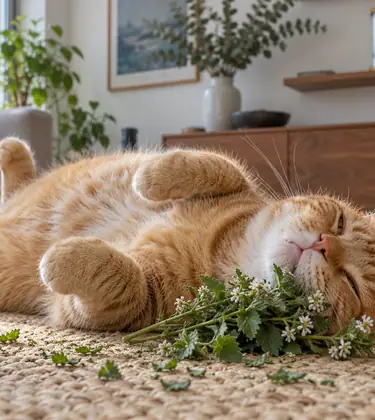
Catnip turns a sleepy cat into a rolling, cheek-rubbing mess for a few minutes. Cannabis can leave the same cat wobbly, glassy-eyed and frightened for a day or more.
The two plants get compared all the time, and the comparison falls apart quickly. One is a toy that most cats handle fine, and the other is a common reason for a call to the vet.
Nepetalactone and the cat nose
Catnip is an herb in the mint family. Wikipedia's entry notes that it is named for the intense attraction that about two-thirds of cats have to the plant, caused by a compound called nepetalactone. Cats pick it up through the nose. The usual response, rolling, rubbing and bursts of play, lasts 5 to 15 minutes before the cat's sense of smell tires, and kittens younger than six months may not react at all. The trait is inherited, which is why some cats ignore catnip completely.
Catnip is not the only plant that does this. In a 2017 study of 100 cats, the share that responded to each plant was:
- Silver vine, almost 80%
- Tatarian honeysuckle, about 50%
- Valerian root, about 50%
- Catnip, about two in three
Of the cats that ignored catnip, almost 75% responded to silver vine.
Two plants, two different highs
Is catnip like weed? Only on the surface. NPR summed up a 2021 study from Japan by saying that cats act high on catnip because they are high. Catnip and silver vine produce a chemical that activates their opioid reward systems, the brain's own pleasure circuit. In cats exposed to nepetalactol, the silver vine compound, levels of beta-endorphin, one of the body's natural feel-good chemicals, rose in the blood. The rolling may even have a purpose, since rubbing spreads the compound onto the cat's face and head, where it repels mosquitoes.
Not every scientist accepts the word "high" here. The authors of the 2017 study later wrote that catnip is not addictive or unhealthy for cats, and that cats enjoying it are not "tripping" or "getting high."
THC works through a different system. It acts as a partial agonist at CB1 and CB2 cannabinoid receptors, which means it switches them on partway, and cats carry cannabinoid receptors too. So can cats get high on cannabis? THC clearly changes how they move and behave. In a 2021 study of 20 healthy cats given rising doses of cannabis oils, lethargy, low body temperature and wobbling were more common with the oils that contained THC. The study was paid for by a cannabis company, and every side effect it saw was mild and passed on its own, with measured doses and vets watching.
Whether a cat enjoys it is another matter. "Animals can't understand they're being intoxicated, therefore it can cause considerable anxiety," a vet from the Cornell Feline Health Center told Popular Science.
The only real overlap is the smell. Catnip belongs to the mint family, and some cannabis smells minty to people too. Girl Scout Cookies, an OG Kush and Durban Poison cross at 28% THC, lists mint next to baked dessert and fruit in its aroma. The resemblance ends at the human nose, and the THC in that bud is what can make a cat sick.
Catnip for humans, from tea to a 1969 mix-up
Catnip for humans is mostly tea. Wikipedia notes that it is used in herbal teas for its sedative and relaxant properties, and that people have taken it as tea, juice, tincture or poultice, and have also smoked it, for complaints from stomach cramps and fevers to nervous conditions. That medical use has faded with modern medicine.
Smoking it does not deliver a weed-style high. In the late 1960s, as Popular Science later put it, some researchers reported catnip gave people a marijuana-like high, but they had mixed up the two plants. After the Journal of the American Medical Association published a 1969 paper on people who smoked catnip, readers wrote in to point out that its photo labeled as cannabis actually showed catnip. The same Popular Science article warns that too much catnip, smoked or drunk as tea, can cause headaches and vomiting.
Feeling lost on how to start? Try taking our quiz!
Start a QuizIf your cat ate weed
If your cat ate weed, signs usually start within 1 to 2 hours, or within minutes if it breathed in smoke. THC toxicity in cats tends to look like this:
- Lethargy and sleepiness
- Wobbling and poor coordination
- Vomiting
- Dilated pupils and drooling
- Dribbling urine
- Jumpiness at sounds or movement
- Low body temperature and a slow heart rate
Among Pet Poison Helpline cases from 2018 to early 2023, lethargy showed up in 30%, wobbling in 21% and vomiting in 15%, according to Merck. The ASPCA lists marijuana as toxic to cats, and its list of signs runs from vomiting and dilated pupils to, in rare cases, seizures, coma and death.
Most cats recover with supportive care, the signs wear off within one to three days, and the Merck Veterinary Manual notes that death is extremely rare. Rare is not never, so call your vet or ASPCA Poison Control at (888) 426-4435, which may charge a consultation fee, and say exactly what the cat got into.
Do not try to make your cat vomit at home. The ASPCA's guidance for vets warns that decontamination is often unnecessary and may do more harm than good, and most cats need only supportive care, such as fluids and close monitoring. Edibles bring their own problems because of the amount of THC they carry. Xylitol, the sweetener that is so dangerous for dogs, has been reported to poison only dogs among domestic animals, according to Merck.
The unexamined day is a wasted opportunity. Reflect on what you did, what you learned, and how you can improve.
John Dewey
Calls rose, then started to fall
Pet cases climbed as legal cannabis spread. A 2022 survey of 251 veterinarians in Canada and the United States found that cases rose significantly in both countries after Canada legalized recreational cannabis in October 2018. Cannabis toxicosis was most commonly reported in dogs, edibles were the most suspected cause, and the signs vets saw most were urinary incontinence, disorientation and poor coordination. The vets also reported 16 deaths, though other toxins or illnesses could not be ruled out.
The ASPCA's poison control team took almost 11% more marijuana calls in 2022 than the year before, and nearly 300% more than five years earlier. By 2024, the ASPCA reported that exposures to THC-based drugs were decreasing.
Cat-proofing a grow and a stash
Cats are more attracted by marijuana in its bud form, according to the ASPCA, which makes harvest the riskiest time in a grower's home. London Pound Cake Auto, a London Pound Cake and BF Super Auto #1 cross at 28% THC, is a good example, since its page describes an aroma that slowly fills a room and lingers long after you have left. In our experience, a few habits keep a cat out of trouble:
- Keep the tent zipped. A curious cat can climb in and chew leaves and buds.
- Dry behind a closed door. Hanging branches are too tempting for paws and teeth.
- Seal the cure. Store finished buds in airtight containers inside a cabinet the cat cannot open.
- Bin the scraps. Trim, leaves and joint ends belong in a lidded trash can.
- Smoke elsewhere. Inhaled THC reaches a cat within minutes, so keep smoke out of the room the cat is in.
Give the cat something of its own to chew on, too. A pot of catnip or a few silver vine sticks well away from the grow tent gives a curious cat its own plant to obsess over.
Never give a cat cannabis on purpose. Merck notes that the FDA has not approved any THC, CBD with THC or full-spectrum products for use in veterinary patients, and our look at CBD for dogs and cats covers what vets say about CBD on its own.
Play with one, lock up the other
Catnip excites about two-thirds of cats for a few minutes through the nose and the brain's reward system, and silver vine works on even more of them. Cannabis acts on cannabinoid receptors instead, and cats get wobbly, sleepy and anxious on it, usually recovering in one to three days with a vet's supportive care. Catnip does little for people beyond a cup of tea. Store buds, trim and edibles where no cat can reach them.
Give the cat the catnip and keep the stash locked. Barney's Farm has been developing premium cannabis genetics since the 1980s, with over 40 Cannabis Cup wins. Explore our full seed catalog and find strains bred for every climate and skill level.