CBDA: The Raw Form of CBD and What Research Shows
Fresh hemp flower holds very little CBD. What the plant makes and stores in its resin is CBDA, an acid that becomes CBD only after heat, or a long time on the shelf, breaks off part of the molecule.
That makes CBDA the most common form of CBD in nature and one of the least tested. In rats it has worked against nausea and pain at doses where CBD did little, and in dogs and people it reaches higher blood levels than CBD. Controlled human trials of CBDA as a treatment are still scarce.
CBD before the heat
So what is CBDA? Cannabidiolic acid is CBD in the form the plant actually makes. Cannabis builds it inside its trichomes, the tiny resin glands on the flowers, starting from CBGA, the same parent molecule behind THCA. An enzyme called CBDA synthase turns CBGA into CBDA. A different enzyme, THCA synthase, turns the same starting material into THCA, and a plant's genes decide which one does most of the work.
Chemically, CBDA is CBD with an extra cluster of atoms, a carboxyl group, attached to its ring. Heat breaks that cluster off as carbon dioxide in a reaction called decarboxylation, and what remains is CBD. Two Czech researchers first isolated CBDA in 1955, and its structure was worked out a decade later.
The living plant keeps almost all of it in that raw form. In a 2024 study of Cherry Wine, a CBD-rich hemp variety, the ratio of CBD to CBDA inside the resin glands was close to 1 to 99. After the flowers dried for 15 days in the dark at room temperature, it was about 1 to 20. Drying and storage push the conversion along, but slowly.
Heat, time and the 0.877 rule
Heat does the job much faster. In a 2022 study in the Journal of Analytical Science and Technology, most of the CBDA was converted into CBD after 20 minutes at 130 °C (266 °F). The researchers also watched part of that new CBD change again into THC isomers, which can be intoxicating, so longer and hotter is not automatically better.
The carbon dioxide that leaves also changes the math on a lab report. CBD is lighter than CBDA, so when the carboxyl group goes, about 12% of the weight goes with it. Labs therefore count total CBD as CBD plus 0.877 times CBDA, and California's cannabis testing rules apply the same 0.877 factor to every acid form. Flower that tests at 10% CBDA and almost no CBD can yield, at most, about 8.8% CBD once heated.
Time works, too, only slower. Even without an oven, CBDA in stored flower and oils keeps turning into CBD, and warmth speeds it up.
Nausea and pain in animal studies
Nausea is the strongest research thread, and almost all of it comes from animals. Rats cannot vomit, so researchers watch for gaping, a wide mouth movement rats make when they feel sick. For vomiting itself, they use house musk shrews. Linda Parker's team at the University of Guelph in Canada ran most of these studies:
- Vomiting and nausea, 2013. CBDA was more potent than CBD in both shrews and rats, working through 5-HT1A, a serotonin receptor.
- Anticipatory nausea, 2014. CBDA reduced the queasiness rats learn to expect in a place linked with sickness, and the standard anti-nausea drug ondansetron did not.
- Paired with THC, 2015. Doses of THC and CBDA too small to work alone helped together against acute nausea.
- Inflammatory pain, 2018. In rats with inflamed paws, a low dose of CBDA reduced pain sensitivity and swelling, and the same low dose of CBD did not ease the pain.
Anticipatory nausea matters because some chemotherapy patients start feeling sick before treatment even begins, and the 2013 paper noted that no specific therapy for it existed. The 2014 authors concluded that CBDA has therapeutic potential as a highly potent and selective treatment for AN, their shorthand for anticipatory nausea, with no sign of psychoactive effects in the rats. Most of the CBDA benefits you see claimed online trace back to these rodent results.
Feeling lost on how to start? Try taking our quiz!
Start a QuizAbsorption in dogs, mice and people
CBDA seems to get into the blood more easily than CBD. In a 2020 study, six beagles took a hemp extract with about equal amounts of CBD and CBDA, plus traces of THC and THCA, twice a day for two weeks. Their CBDA and THCA concentrations were 2- to 3-fold higher than CBD and THC concentrations, and one oil with a partial lecithin base, a fatty emulsifier, raised CBDA levels further.
A 2021 study in Scientific Reports found a twist in mice. Animals given CBDA inside a full cannabis extract had blood levels 14 times higher than animals given the same dose of pure CBDA. Lab tests showed that CBG and THC block BCRP, a pump that pushes CBDA back out of cells, and the authors think the same thing happens in the gut wall.
People show the same pattern. In a 2025 placebo-controlled study of 15 healthy adults who swallowed a hemp extract with roughly equal parts CBD and CBDA, peak blood levels of CBDA and THCA ran 19 to 25 times higher than those of CBD and THC. The highest dose also caused several side effects, moderate cognitive impairment and a feeling of intoxication, though it carried only about 7.2 milligrams of THC on average.
The unexamined day is a wasted opportunity. Reflect on what you did, what you learned, and how you can improve.
John Dewey
Growing and keeping CBDA
Whether a plant fills its resin glands with CBDA or THCA comes down to genetics. Scientists sort cannabis into three chemotypes, which our chemotype guide covers in detail. Type I plants make mostly THCA, Type III plants make mostly CBDA, and Type II plants make a mix. Hemp bred for CBD is Type III.
Our catalog is bred for THC, so raw buds from most of our strains are packed with THCA and carry only traces of CBDA. Two of our autoflowers list a measurable CBD figure. Wedding Cake Auto, a Wedding Cake and BF Super Auto #1 cross with a summer berry taste, has tested at 26% THC with 2.4% CBD and goes from seed to harvest in 70 to 75 days. Purple Punch Auto lists 22% THC and 1% CBD with a baked apple pie flavor, ready in 65 to 70 days. In their raw, dried buds, nearly all of that CBD would still be CBDA.
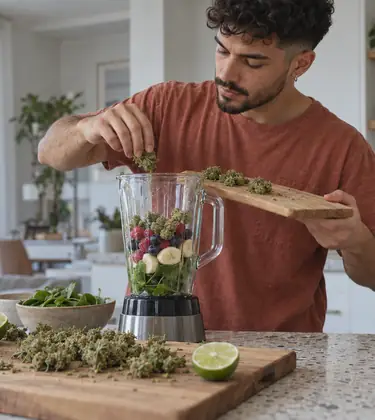
If CBDA is what you want, keep heat away from the flower. Store dried buds cool and dark in a sealed container, and skip the oven, the lighter and the vaporizer, since all three turn CBDA into CBD. Fresh or frozen flower holds the most acid, which is why some people juice or blend raw buds and leaves, as our guide to eating a raw cannabis bud describes. Fresh, raw flower will not get you high, because THCA also needs heat to become THC.
CBDA vs. CBD, point by point
On the CBDA vs. CBD question, the differences come down to five things:
- Form. CBDA is what the plant makes, and CBD appears after heat or long storage.
- Stability. CBDA breaks down with heat and time, while CBD is stable enough to sell as a prescription drug, Epidiolex.
- Potency. In rats, CBDA eased nausea and pain at doses too low for CBD to help.
- Absorption. CBDA reached higher blood levels than CBD in dogs and people.
- Human evidence. CBD has large clinical trials behind it, and CBDA mostly has absorption studies.
Because CBDA falls apart so easily, Israeli researchers built a synthetic version that holds together, CBDA methyl ester, also called EPM301. In a 2022 mouse study it reduced weight and overeating in models of genetic obesity, and in July 2024 it was designated an orphan medicine in the European Union for Prader-Willi syndrome, a rare genetic disorder marked by constant hunger.
The hype has run ahead of the science. In January 2022, an Oregon State University study in the Journal of Natural Products found that CBDA and CBGA kept the COVID virus out of human cells in lab tests, and the headlines spread fast. Nobody has shown the same thing in people. A January 2026 review in the Journal of Cannabis Research names three problems for acid cannabinoids as medicines: they break down easily, too little of a dose reaches the blood, and controlled human trials are rare. In the authors' words, chemical instability, low bioavailability, and a dearth of controlled human trials impede clinical translation despite their potential.
Raw, promising and still unproven
CBDA is the form CBD takes in the living plant, and heat or time turns it into CBD, which is why lab reports use the 0.877 factor. In rats and shrews it has outperformed CBD against nausea, vomiting and pain, and it reaches higher blood levels than CBD in dogs and people. A stable synthetic version has an EU orphan designation, while controlled human trials of CBDA itself remain rare. Until they arrive, treat CBDA benefits as promising animal data, and keep raw flower cool and dark if CBDA is what you want.
Keep the oven off when the acid is the point. Barney's Farm has been developing premium cannabis genetics since the 1980s, with over 40 Cannabis Cup wins. Explore our full seed catalog and find strains bred for every climate and skill level.