Geraniol: The Rose-Scented Terpene Explained
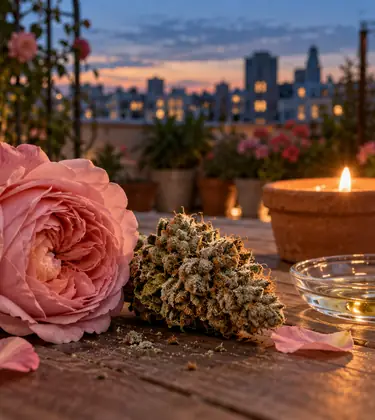
Rose petals, citronella candles and beehives share one molecule. Geraniol gives roses part of their perfume, keeps mosquitoes away and helps honeybees find their way home.
It also turns up in some cannabis, though one large study could not find it in any of 460 samples. The rose note is worth looking for. The health claims need more care, since most of the research on what geraniol does in the body comes from cells and mice.
Roses, citronella and a grass called geranium
Geraniol is a terpene alcohol, a colorless oil found in the essential oils of many fruits, flowers and herbs. The geraniol aroma is easy to recognize once you know it. Wikipedia's entry describes the aroma as sweet, floral, fruity, rose, waxy, citrus, and citronella, and the compound is commonly used in perfumes and in fruit scents such as peach, raspberry and lemon. It boils at about 230 °C (446 °F).
The name is slightly misleading. German chemist Oscar Jacobsen first isolated pure geraniol in 1871 from an essential oil made in India from so-called geranium grass, a cheaper stand-in for real geranium oil, and the compound took its name from that oil. You will find geraniol in:
- Rose oil, where it is one of the main components
- Palmarosa oil, distilled from a fragrant grass
- Citronella oil, where it is the main component
- Geranium and lemon oils, in small amounts
- Honeybee scent glands, which bees use to mark flowers with nectar and to locate the hive entrance
Geraniol also has close relatives. Nerol has the same atoms as geraniol with a different shape around one double bond, and it smells like a fresher rose. Oxygen turns geraniol into geranial and neral, the two forms of citral, the lemon-scented compound that makes up most of lemongrass oil.
Its parent molecule matters to cannabis growers too. Geranyl pyrophosphate, the compound plants turn into geraniol, myrcene and ocimene, is also what cannabis joins to olivetolic acid to build CBGA, the starting point for THCA and CBDA.
Hard to pin down in cannabis
How much geraniol in cannabis there is depends on who measured it. Plant scientists at the University of British Columbia, writing about the hemp variety Finola in 2017, described monoterpene alcohols such as linalool and geraniol as common in some cannabis strains. A year earlier, a study of 460 cannabis samples from the Netherlands, from hemp to drug types, could not detect geraniol in any of them, despite earlier reports of its presence. Both can be true, since terpene profiles vary widely between strains, harvests and labs.
Our strain pages do not list geraniol, and we would not claim it without a lab test. A rose note is easier to find. Jelly Cake, a Biscotti and Sunset Sherbet cross at 27% THC, opens with creamy vanilla, kiwi and sweet berry aromas, and as the fragrance develops, delicate floral rose notes come through alongside citrus. Its listed terpenes are limonene, myrcene and caryophyllene, and it flowers in 56 to 63 days.
Interest in the geraniol terpene also comes from how it behaves next to cannabinoids. In 2021, pharmacologists at the University of Arizona found that α-humulene, geraniol, linalool and β-pinene produced cannabinoid tetrad behaviors in mice. The tetrad is the set of four signs researchers use to spot a cannabinoid: pain relief, lower body temperature, reduced movement and a frozen posture called catalepsy. In cells, every terpene tested switched on CB1, the main cannabinoid receptor. In mice, some of their effects added to those of a synthetic cannabinoid. The mice got the terpenes by injection, at 50 to 200 milligrams per kilogram of body weight, so the study shows what geraniol can do in a lab, not what a joint delivers.
A 2024 follow-up from the same group, in the journal Pain, injected terpenes including geraniol, at 200 milligrams per kilogram, into mice with nerve pain caused by chemotherapy. The terpenes relieved pain roughly as well as a 10-milligram-per-kilogram dose of morphine, and none of them showed the reward effect that makes drugs habit-forming. In the nerve pain model, the researchers traced the pain relief to adenosine A2A receptors.
Effects in cells, mice and one gut trial
Most research on geraniol effects comes from lab dishes and animals. A 2020 review in Molecules notes that geraniol has a number of biological activities, such as antioxidant and anti-inflammatory properties. The same review reports that cell and animal studies have shown activity against prostate, bowel, liver, kidney and skin cancer, and antibacterial activity against respiratory, skin and food-borne bacteria. A 2023 review in the same journal adds that none of the cancer findings has been tested in clinical studies.
Human evidence is thin and comes from the gut. In a 2022 double-blind trial, 56 people with irritable bowel syndrome took a placebo or a low-absorbable geraniol food supplement (LAGS) once daily for four weeks. The supplement was palmarosa oil rich in geraniol, absorbed onto powdered ginger root so that most of it would reach the colon. In the geraniol group, 52% counted as responders, meaning their symptom score fell by at least 50 points, against 16.7% on placebo.
The product was built to stay in the gut and act on gut bacteria, so the trial says nothing about smoking or vaping geraniol. We found no study that measured geraniol's effects at the dose a joint or a vape delivers.
Feeling lost on how to start? Try taking our quiz!
Start a QuizRepellent, flavoring and skin allergen
Geraniol beat citronella, the classic candle scent, in a head-to-head mosquito test. In a 2009 study in the Journal of Vector Ecology, diffusers of pure geraniol repelled 97% of mosquitoes indoors, against 68% for citronella diffusers, and geraniol candles repelled 50%, against 14% for citronella candles. Outdoors, diffusers set 6 meters (about 20 feet) from mosquito traps repelled 75% of female mosquitoes with geraniol, 58% with linalool and 22% with citronella.
It is a food ingredient too. Federal rules list geraniol among synthetic flavoring substances and adjuvants that are generally recognized as safe for their intended use, alongside linalool and limonene.
On skin, the problem is air. Geraniol oxidizes on contact with it, forming geranial, neral and other skin sensitizers, compounds that can trigger an allergy. Geraniol is already part of fragrance mix I, a standard mixture dermatologists use to test for perfume allergy. In a 2018 Swedish study of 1,476 patients referred for patch testing, pure geraniol gave positive reactions in 1%, while oxidized geraniol gave 3% at the same strength and 8% at a higher one, and most patients who reacted did so only to the oxidized form.
The unexamined day is a wasted opportunity. Reflect on what you did, what you learned, and how you can improve.
John Dewey
Growing and keeping a floral nose
Terpenes are made in the same resin glands as cannabinoids, and they are easier to lose. Geraniol has a higher boiling point than lighter terpenes such as myrcene and limonene, so it should evaporate more slowly during drying, but oxygen still breaks it down. In our experience, a floral strain keeps its scent with a few habits:
- Dry slowly. Hang branches in a dark room at around 60 °F (16 °C) and 60% relative humidity for 10 to 14 days.
- Cure sealed. Store buds in airtight glass filled close to the top, and open the container briefly.
- Keep it cool and dark. Heat and light speed up oxidation, so skip the windowsill and the warm cupboard.
- Grind just before use. Ground flower exposes far more surface to air.
For a floral note you can grow yourself, Blue Dream, a Blueberry and Super Silver Haze cross at 28% THC, pairs a sweet berry scent with hints of pine and earth, finished with what its page calls a delicate floral undertone. It flowers in 65 to 70 days, and its reported effects run creative, uplifting and sociable.
Before you buy flower for its floral nose, check the lab report. A lab can only report the terpenes on its test panel, so a missing geraniol line can mean it was never tested. Our guide to reading a cannabis lab report explains the terpene section. To train your nose, smell a fresh rose, then a stalk of lemongrass, then the bud. The rose points toward geraniol and nerol, the lemongrass toward citral.
Sweet smell, thin evidence
Geraniol is the rose-scented terpene alcohol behind rose, palmarosa and citronella oils, and honeybees use it to mark flowers. In cannabis it shows up in some strains and not at all in others, and in lab tests it switched on the same receptor THC uses. Its effects in people rest on one gut trial, while it has outperformed citronella against mosquitoes and its oxidized form is a known skin allergen. If you grow for a floral nose, protect the flower from air, heat and light.
Let your nose and the lab report decide together. Barney's Farm has been developing premium cannabis genetics since the 1980s, with over 40 Cannabis Cup wins. Explore our full seed catalog and find strains bred for every climate and skill level.