
 Autoflower Seeds
 Feminized Seeds
 New Releases
 USA Cannabis Seeds
 High THC Strains
 High Yield Cannabis Strains
 Precision F1 Hybrids
 Washing Strains
 Cup Winning Cannabis Seeds
 Chill Out Cannabis Strains
 Amsterdam Cannabis Seeds Classics
 Best Taste & Aroma Cannabis Seeds
 Regular Seeds
 Merchandise
 Merchandise
 Blog
Blog Contact Us
 Wholesale Login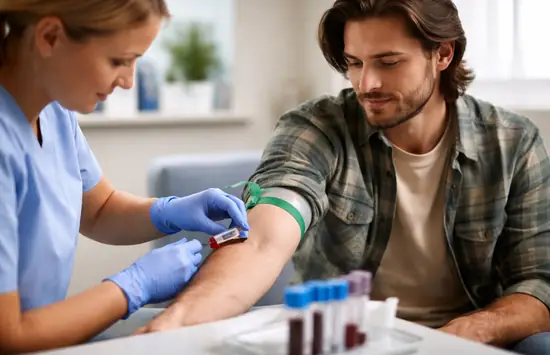
Will Cannabis Show Up in a Blood Test?
You smoked last night. Now there's a blood draw on the calendar. The question hits different when it's your actual arm and an actual needle: will cannabis show up in a blood test? The short answer is: it depends entirely on what kind of blood test you're taking. A standard panel at your doctor's office? You're fine. A targeted drug screening for work, probation, or a post-accident investigation? That's a different conversation.
Let's break it all down. What blood tests actually look for, how long THC stays detectable, how blood compares to other test types, and what science is doing to fix a system that still can't reliably tell the difference between 'high right now' and 'got high last Tuesday.'
Does Weed Show Up in Routine Blood Work?
No. Standard blood panels do not screen for THC. When a doctor orders routine blood work, they're checking things like cholesterol, blood sugar, kidney function, liver enzymes, or thyroid levels. None of these tests are designed to pick up cannabinoids, and your physician isn't going to stumble across evidence of last weekend's session while checking your iron count.
THC will only appear if someone specifically orders a drug panel. That typically happens in a few scenarios: pre-employment screening, court-ordered testing, post-accident toxicology, or monitoring in certain treatment settings. If nobody asks for it, nobody finds it.
Here's where it gets real for working people, though. According to an analysis of nearly 10 million workforce drug tests conducted in 2023, marijuana positivity in the general U.S. workforce climbed to 4.5%, the highest rate ever recorded. So yes, people are getting tested, and more people than ever are testing positive.
How Long Does THC Stay in Blood?
THC blood test detection time is short compared to other methods. When you smoke, THC floods your bloodstream within minutes, peaks fast, then drops sharply. For a casual or one-time user, THC concentrations in blood typically fall below detectable levels within 3 to 4 hours after use. For most occasional users, the window closes within 12 to 24 hours.
Regular smokers face a longer timeline. Because THC is fat-soluble, it accumulates in your body's fatty tissues and slowly releases back into the bloodstream over days or weeks. A controlled clinical study on chronic daily cannabis smokers found that some participants still had detectable blood THC levels after 30 days of monitored abstinence. Out of 30 chronic daily smokers, 27 tested THC-positive on admission, and two still tested positive at the 30-day mark.
So the answer to how long marijuana is detectable in blood depends heavily on frequency. A once-a-month smoker and a daily smoker are living in completely different detection windows.
What Does a Cannabis Blood Test Actually Detect?
Blood tests measure active THC and its metabolites. When your body processes THC, the liver converts it into several metabolites. The two that matter most are 11-hydroxy-THC (11-OH-THC), which is psychoactive, and THC-COOH, which is inactive. Blood tests can pick up both the parent compound and these breakdown products.
This matters because blood tests measure active, recently consumed THC. That's what separates them from urine tests, which primarily detect THC-COOH, an inactive metabolite that lingers in your system long after you've come down. Cannabis is detectable in blood for roughly 12 to 24 hours in most users, while urine can flag THC-COOH for days or weeks depending on consumption patterns.
For anyone who knows their strains, this is worth paying attention to. Different cultivars produce different cannabinoid ratios. A high-THC strain is going to put more delta-9 into your blood than a CBD-dominant variety. At Barney's Farm, every strain in our catalog comes with detailed cannabinoid profiles so you always know exactly what you're working with. Whether you're reaching for a heavy hitter like LSD or something lighter and more functional, understanding the THC content of what you consume gives you a better sense of how your body will process it.
Blood Test vs Urine Test for Weed: Which One Should You Worry About?
Different tests serve different purposes, and they detect different things. Urine testing is by far the most common method for workplace drug screening because it's cheap, non-invasive, and has a long detection window. But here's the trade-off: urine tests tell you nothing about whether someone is currently impaired. They detect an inactive metabolite that can stick around for 30 days or longer in heavy users.
Blood tests offer a narrower, more accurate snapshot of recent use. That's why they tend to show up in legal and medical contexts like DUI investigations, post-accident inquiries, or emergency room toxicology. They're more invasive and more expensive, but they're better at answering the question law enforcement actually cares about: did this person consume cannabis recently?
Saliva tests sit in between. They detect parent THC (not metabolites) for roughly 24 to 72 hours and are increasingly popular for roadside screening. Hair tests play the long game, potentially flagging cannabis use up to 90 days back, but they're unreliable for detecting light or occasional consumption.
The bottom line on cannabis drug test types is that each one answers a slightly different question. Blood tells you about the last day or two. Urine tells you about the last few weeks. Hair looks at the last three months. None of them can definitively tell you whether someone is actually impaired at the moment of testing.
What Affects Your Cannabis Detection Window?
Several factors determine how long THC hangs around in your system, regardless of test type:
Frequency and dose. This is the biggest variable. A single session from a casual user clears out fast. Daily use at high doses saturates your fat cells, creating a slow-release reservoir of THC that feeds back into your blood over weeks.
Body composition. THC is lipophilic. It parks itself in fat tissue. Higher body fat percentage generally means a longer detection window because there's more storage space for THC to hide in. Metabolism speed plays a role too. Faster metabolizers break down and excrete cannabinoids more efficiently.
Consumption method. Smoking and vaping deliver THC to the blood rapidly, and it clears relatively quickly. Edibles take longer to kick in because THC has to pass through the liver first, and that slower absorption can extend detection times. The liver converts orally ingested THC into 11-hydroxy-THC at higher rates, which also stays in circulation longer.
This is one of those areas where knowing your product actually helps. Barney's Farm has spent over 30 years breeding strains with precise cannabinoid and terpene profiles. That kind of consistency means you can build a personal understanding of how specific strains interact with your body over time. Growers and consumers who pay attention to genetics tend to have a better handle on their own tolerance, dosing, and recovery curve.
Can Science Actually Tell If You're High Right Now?
Not reliably. And that's the core problem with cannabis drug testing. Unlike alcohol, where a breathalyzer reading correlates directly with impairment level, no current test can look at a THC number in your blood and accurately say whether you're impaired at that moment.
Researchers at the University of Colorado are working on it. A federally funded study found that using a molar metabolite ratio of THC to THC-COOH achieved 96% accuracy in identifying recent cannabis use, compared to only 80% accuracy when measuring THC alone. The method compares active versus inactive metabolites to build a more accurate picture of timing.
Meanwhile, NIST researchers are testing a dual-breath-test approach for roadside cannabis detection. The idea is that two breath tests spaced apart could track declining THC levels, which would indicate recent use rather than residual presence from days earlier. But even the researchers behind it acknowledge we're years away from a reliable, standardized tool.
The current system punishes the daily medical user and the weekend smoker equally, which is exactly the kind of blunt (pun intended) approach that frustrates the cannabis community. Testing technology hasn't caught up with legalization, and until it does, a positive result doesn't mean what most people assume it means.
Drug Screening for Marijuana: Know Your Rights
Legalization does not automatically protect you from workplace drug testing. Even in states where recreational cannabis is fully legal, employers can still test for it and take action on positive results. Federal employees, DOT-regulated workers, and anyone in a 'safety-sensitive' position are subject to mandatory testing regardless of state law.
That said, the landscape is shifting. States like California, New York, and Washington have passed laws restricting pre-employment cannabis testing or prohibiting discrimination based on off-duty use. The specifics vary wildly from state to state, so knowing your local protections matters.
If you're a cannabis consumer navigating workplace testing, a few things are worth keeping in mind. Understand what type of test your employer uses. Know the detection windows for each method. And if you're a medical patient, document your status and understand what protections your state offers. Knowledge is your best defense in a system that still treats a plant differently than a six-pack of beer.
The Takeaway
Will cannabis show up in a blood test? Only if someone is specifically looking for it. Routine checkups won't flag your THC levels. Targeted drug screens will, and blood tests can detect recent use for anywhere from a few hours to a few weeks depending on how often you consume.
The testing landscape is messy, inconsistent, and still catching up to reality. But as a consumer, you have options. You can understand the science, know the timelines, choose your products wisely, and stay informed about your rights.
Barney's Farm has been developing premium cannabis genetics since the 1980s, with over 40 Cannabis Cup wins. Explore our full seed catalog and find strains bred for every climate and skill level.