Wild Cannabis vs. What You Buy: Why Ditch Weed and Dispensary Flower Are Worlds Apart
Cannabis grows on every continent except Antarctica. That sounds like a flex until you realize most of it is stuff you would never, ever want to smoke. Wild marijuana blankets highway ditches across the Midwest, creeps along mountain trails in the Himalayas, and sprouts from cracks in Siberian sidewalks. And yet none of it comes close to the flower sitting on a dispensary shelf. The gap between feral cannabis and cultivated bud is massive, and understanding it tells you a lot about why genetics, breeding, and careful growing actually matter.
What Is Ditch Weed, and Where Does It Come From?
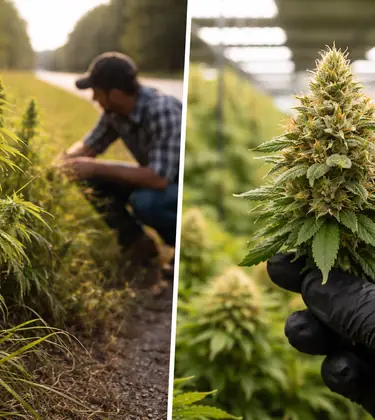
Ditch weed is exactly what it sounds like: cannabis growing wild in ditches, along roadsides, near railroad tracks, and in abandoned fields. The DEA officially defines it as wild, scattered marijuana plants with no evidence of planting, fertilizing, or tending. Most of the ditch weed growing across the U.S. today is descended from industrial hemp that was cultivated in the Midwest during the mid-20th century, particularly to support the war effort during World War II. After the war, hemp farming dried up, but the plants didn’t get the memo. They reseeded naturally and have been thriving ever since in states like Indiana, Missouri, Nebraska, Iowa, and Minnesota.
The stuff is practically unkillable. Feral cannabis seeds can lie dormant in soil for seven to ten years before sprouting again. In Indiana, where the largest concentrations of ditch weed exist nationally, law enforcement eventually gave up trying to eradicate it. One police spokesman famously compared the effort to trying to wipe out dandelions. Minnesota even classifies wild hemp among its 11 officially listed noxious prohibited weeds because it jams up farming equipment.
Where Does Cannabis Grow Wild Around the World?
The question of where cannabis grows wild depends on whether you mean truly native populations or feral escapees. A landmark 2021 genomic study published in Science Advances analyzed 110 whole cannabis genomes and found that Cannabis sativa was first domesticated in East Asia during the early Neolithic period, roughly 12,000 years ago. The researchers determined that modern Chinese landraces and feral plants represent the closest living descendants of the ancestral cannabis gene pool. The pure wild ancestors of the species have likely gone extinct.
Today, wild cannabis still thrives across a wide geographic spread. The Hindu Kush mountain range spanning Afghanistan and Pakistan remains a stronghold for hardy indica varieties that evolved to handle high altitudes and cold temperatures. The Himalayas, stretching across Nepal, India, and Bhutan, are home to some of the most photographed wild cannabis on earth. In parts of Himachal Pradesh and Uttarakhand in Northern India, cannabis grows alongside other native flora as naturally as grass. Central and Eastern Europe, particularly Russia, Ukraine, and the Baltic states, harbor large populations of Cannabis ruderalis. And across Africa, from Morocco’s Rif Mountains to South Africa’s Eastern Cape, locally adapted wild strains have been intertwined with regional culture for centuries.
What Is Cannabis Ruderalis?
If you’ve ever grown an autoflowering strain, you’ve got Cannabis ruderalis to thank. First formally classified in 1924 by Russian botanist D.E. Janischewsky while studying wild cannabis along the Volga River, ruderalis is a hardy subspecies native to Central and Eastern Europe and Russia that rarely grows taller than two feet. The name comes from the Latin word "ruderal," meaning a plant that grows on waste ground or among rubble. Fitting.
What makes ruderalis unique is its flowering behavior. Unlike sativa and indica varieties, which need specific light cycle changes to trigger flowering, ruderalis flowers based on age alone. It starts blooming roughly three to four weeks after germination regardless of how many hours of sunlight it gets. This autoflowering trait evolved as a survival mechanism in northern climates where summers are brutally short. The plant had to complete its entire life cycle fast or die trying.
On its own, ruderalis produces very little THC and won’t get you high in any meaningful way. But its genetics are gold for breeders. By crossing ruderalis with high-THC indica and sativa strains, cultivators have created autoflowering hybrids that combine the convenience of age-based flowering with the potency and flavor profiles consumers actually want. At Barney’s Farm, this is territory we know well. Decades of selective breeding have allowed us to harness ruderalis genetics in our autoflowering lineup without sacrificing the resin production, terpene complexity, or cannabinoid strength that define a top-shelf experience. Strains like Gorilla Zkittlez Auto demonstrate what’s possible when ruderalis’s autoflowering trait meets elite genetics: fast turnaround, serious potency, and a flavor profile that wild cannabis could never produce on its own.
Feeling lost on how to start? Try taking our quiz!
Start a QuizWhy Ditch Weed Will Never Get You High
Here’s the reality check for anyone who’s ever spotted a tall, pungent cannabis plant by the highway and wondered if they just hit the jackpot: you didn’t. Feral cannabis in the U.S. is overwhelmingly descended from industrial hemp strains grown for fiber, not cannabinoid content. The THC levels are negligible. You’d get a headache before you got a buzz.
The scale of this problem is almost comical. Research into wild cannabis populations has consistently shown that feral plants lack the cannabinoid profiles that make cultivated flower valuable. Without human selection for THC production over generations, wild cannabis simply reverts to producing minimal psychoactive compounds. The trichome coverage is thin, the resin content is low, and the terpene profiles are nowhere near what modern breeding can achieve.
Beyond potency, there’s a safety issue. Cannabis is a bioaccumulator, meaning it absorbs and stores whatever is in the soil and groundwater around it. Ditch weed growing on a roadside or near agricultural runoff can accumulate heavy metals, pesticides, and other contaminants that make it genuinely unsafe to consume. Nobody is testing it. Nobody is monitoring it. It grew up wild, and that wildness carries real risk.
The unexamined day is a wasted opportunity. Reflect on what you did, what you learned, and how you can improve.
John Dewey
What Makes Dispensary Flower a Completely Different Product?
The flower on a dispensary shelf is the result of thousands of years of selective breeding compressed into overdrive by modern genetics. Every aspect of the plant has been shaped by intentional choices: cannabinoid ratios, terpene profiles, growth structure, flowering time, resin production, pest resistance, yield. Cultivated cannabis is engineered to deliver a specific experience. Wild marijuana is whatever nature decided to spit out.
Modern cultivators control every environmental variable. Light spectrum and duration, temperature, humidity, nutrient feeding schedules, CO2 levels, irrigation timing. The result is dense, trichome-coated flower with cannabinoid percentages that would have been unthinkable a few decades ago. Top-shelf strains routinely test above 25% THC, with some pushing into the low 30s. Meanwhile, ditch weed might struggle to hit 0.5%.
At Barney’s Farm, the difference between wild and cultivated cannabis sits at the core of everything we do. With over 30 years of breeding history and more than 40 Cannabis Cup wins, our approach has always been rooted in working with the genetics of the plant, not against them. Landrace strains from the Hindu Kush, the tropical belts of Southeast Asia, and the highlands of Africa all inform our breeding library. A strain like Critical Kush traces its lineage directly back to those Hindu Kush mountain genetics, but refined through years of stabilization into something consistent, resinous, and powerful. The wild origins of cannabis are literally in our seeds’ DNA. But what separates a Barney’s Farm strain from a roadside weed plant is generation after generation of deliberate selection, stabilization, and refinement. That work is what turns raw genetic potential into a reliable, flavorful, potent product that performs the same way every time you grow it.
Can Wild Cannabis Genetics Still Teach Us Something?
Absolutely. Wild cannabis populations are living genetic archives. Researchers studying feral plants have discovered traits related to pest resistance, drought tolerance, and unique cannabinoid expressions that don’t show up in heavily commercialized strains. The 2021 genomic study from Science Advances identified an entire basal lineage of cannabis in East Asia that is more closely related to the plant’s wild ancestors than anything grown commercially today. That discovery opened up new possibilities for breeders looking for untapped genetic diversity.
But here’s the tension: wild cannabis populations are shrinking. Habitat destruction, climate change, and eradication programs all threaten these feral gene pools. Once a landrace population disappears from a remote valley in Afghanistan or a mountainside in Nepal, those specific genetic expressions are gone for good. The cannabis industry has a real interest in preservation, not just for conservation’s sake, but because those wild genetics could hold the key to breeding breakthroughs we haven’t even imagined yet.
The Bottom Line: Wild Weed and Your Weed Are Not the Same Thing
Feral cannabis is a survivor. It has outlasted eradication campaigns, ice ages, and human neglect. It grows where nothing else wants to grow and it keeps coming back year after year. That kind of resilience deserves respect. But respect and smokability are two very different things.
The flower you pick up from a dispensary or grow from quality genetics has been shaped by centuries of human knowledge, refined through modern science, and tested for safety and potency. It exists because breeders took the raw material that nature provided and asked: what if we made this better? Ditch weed is the answer to a different question entirely: what happens when cannabis is left completely alone? Both have their place in the story. Only one belongs in your grinder.
Barney's Farm has been developing premium cannabis genetics since the 1980s, with over 40 Cannabis Cup wins. Explore our full seed catalog and find strains bred for every climate and skill level.